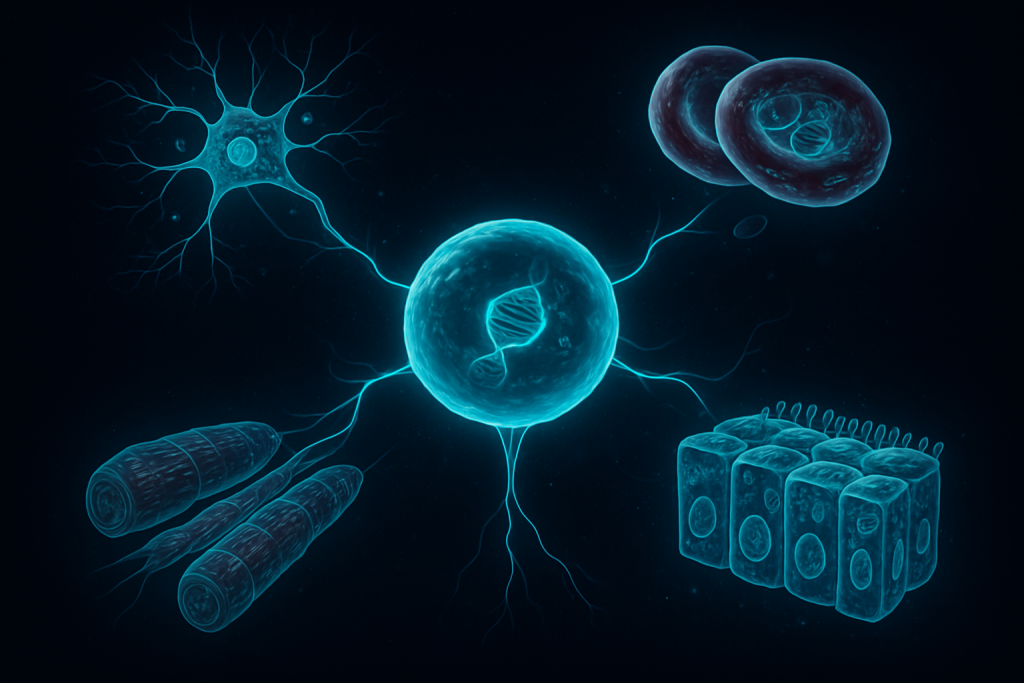
Image generated by AI
Every cell in your body shares the same DNA, yet a neuron in your brain operates entirely differently from a pancreatic cell producing insulin, which functions nothing like a muscle cell contracting in your heart. How can identical genetic instructions produce such radically different cell types? The answer lies in a fundamental biological process called cell differentiation, a molecular symphony that transforms generic embryonic cells into the estimated 200 specialized cell types that compose the human body. This transformation represents one of biology’s most elegant puzzles—and solving it could revolutionize medicine.
Understanding cell identity and differentiation has moved from academic curiosity to urgent practical necessity. Scientists are now harnessing this knowledge to develop regenerative therapies, reprogram adult cells into replacement tissues, and understand why cells sometimes lose their identity, leading to cancer or degenerative disease. The stakes are enormous: if we can fully decode how cells “decide” what to become, we could potentially cure conditions ranging from diabetes to Parkinson’s disease by simply coaxing the right cells to differentiate into whatever tissue needs repair.
What Is Cell Identity and Differentiation?
Cell identity refers to the specific characteristics and functions that define what a cell is—a liver cell, a neuron, a blood cell—determined by which genes are actively expressed and which are silenced. Differentiation is the process by which undifferentiated cells (primarily stem cells or progenitor cells) progressively acquire this specialized identity, becoming increasingly committed to a particular cell type as development proceeds. This process involves complex cascades of molecular signals that selectively activate and deactivate genes, gradually restricting a cell’s developmental potential until it becomes highly specialized. Once differentiated, most cells maintain their identity through epigenetic mechanisms—chemical modifications that sit atop DNA like bookmarks, instructing the cell which genes to read and which to ignore. Remarkably, these changes are often reversible under the right conditions, a discovery that has opened entirely new therapeutic possibilities.
The systematic study of cell differentiation began in earnest during the late 19th and early 20th centuries, when embryologists using microscopes observed that early embryos containing apparently identical cells gradually developed distinct tissue types. However, the molecular mechanisms remained obscure until the late 1980s, when John Gurdon’s experiments demonstrated that differentiated cells could be reprogrammed back to a pluripotent state—capable of becoming any cell type. This work, which earned him a Nobel Prize in 2012, fundamentally challenged the assumption that differentiation was irreversible. Later, Shinya Yamanaka’s 2006 discovery that just four genes could reprogram adult cells into induced pluripotent stem cells (iPSCs) proved Gurdon’s principle worked in mammals, transforming regenerative medicine from speculation into experimental reality.
How It Works in Nature
Cell differentiation begins with an undifferentiated cell encountering chemical signals—called growth factors, cytokines, and morphogens—that flow through the developing organism like invisible currents. These signals bind to receptors on the cell’s surface, triggering cascades of internal molecular events that alter which genes are transcribed into proteins. Master regulatory genes, sometimes called transcription factors, act like molecular conductors, turning on clusters of genes specific to a particular cell type while simultaneously silencing genes appropriate for other fates. As differentiation progresses, cells undergo epigenetic modifications: DNA methylation, histone acetylation, and chromatin remodeling physically alter how tightly DNA is packaged, making certain genes more or less accessible to the transcription machinery. This multi-layered regulation ensures that once a cell commits to a particular identity, it remains stable even when external signals change, creating cellular identity that persists through the cell’s lifetime.
Think of a developing embryo as a musical score where each region contains different instructions. Initially, all cells read from the same basic sheet—they possess the complete genetic score. But as development unfolds, position-dependent signals tell cells which sections to emphasize and which to ignore. A cell in the neural region of an early embryo receives signals that activate the genes for neurons while silencing those for muscle or liver. This isn’t destruction of genetic material; it’s selective reading. If you could travel backward through time within that cell’s nucleus and rewind the epigenetic changes, you could theoretically restore the cell’s ability to become something entirely different. This potential reversibility proves that differentiation isn’t a one-way gate but rather a reversible shift in which genes a cell “listens to” and “expresses.”
Medical and Scientific Relevance
The practical implications of understanding cell differentiation have become strikingly clear in modern medicine. Regenerative medicine aims to use this knowledge to repair or replace damaged tissues—growing new neurons for spinal cord injuries, creating functional beta cells for diabetics, or engineering replacement organs. Cancer research has revealed that cancer cells often lose proper identity control, with differentiated cells reverting to stem-like states and proliferating uncontrollably. Understanding how differentiation normally works provides crucial insights into how it goes wrong, potentially enabling new cancer prevention and treatment strategies. Furthermore, studying how cells maintain their identity helps us understand aging and age-related diseases: as we grow older, cells progressively lose their identity fidelity, contributing to tissue degeneration and loss of function.
Currently, regenerative medicine is employing differentiation knowledge in several concrete ways. Researchers are programming iPSCs into specific cell types—cardiomyocytes for heart disease, dopaminergic neurons for Parkinson’s disease, retinal cells for blindness—and testing these in preclinical trials. Organoid technology, which grows miniature organ-like structures from stem cells, relies entirely on directing differentiation through carefully controlled chemical signals. Companies are developing small-molecule drugs that can nudge cells toward specific fates, potentially allowing in-situ tissue regeneration without requiring cell transplantation. Additionally, understanding lineage commitment is revolutionizing approaches to blood disorders and leukemia, where manipulating differentiation pathways in bone marrow cells offers new therapeutic avenues.
Recent Breakthroughs in Cell Identity and Differentiation
The past few years have witnessed remarkable advances in our ability to precisely manipulate cell identity. Researchers have developed increasingly sophisticated methods to directly convert one differentiated cell type into another without passing through a pluripotent intermediate state—a process called transdifferentiation that bypasses the lengthy reprogramming phase. Advanced single-cell RNA sequencing technology now allows scientists to map the precise molecular states of individual cells as they differentiate, revealing previously unknown intermediate cell states and identifying new master regulators of cell identity. In 2022 and 2023, multiple laboratories discovered that certain combinations of transcription factors could reprogram cells with remarkable efficiency and speed, opening doors to faster therapeutic cell production. Additionally, computational approaches using machine learning are increasingly predicting which genetic modifications could drive specific differentiation outcomes, accelerating the pace of discovery.
Scientists are currently grappling with several fundamental questions that remain only partially answered. How do cells “remember” their identity through repeated cell divisions, and what molecular mechanisms ensure this memory is stable yet reversible? Can we identify universal principles of differentiation that would allow us to reprogram any cell type into any other type reliably and efficiently? How do epigenetic modifications accumulate and change throughout an organism’s lifetime, and can we therapeutically reverse aging-associated epigenetic drift? These open questions drive intense research, with laboratories worldwide racing to develop better tools, establish clearer molecular maps of differentiation pathways, and translate laboratory discoveries into clinical therapies.
Why Cell Identity and Differentiation Matters for the Future
As biotechnology advances, the ability to control cell identity will become increasingly central to medicine and agriculture. Personalized medicine may soon involve taking a patient’s own cells, reprogramming them into whatever cell type is needed for repair, and reintroducing them—avoiding immune rejection and ethical complications associated with donor tissues. In agriculture, controlling plant cell differentiation could enable cultivation of specific tissues like muscle without raising entire animals, potentially transforming food production. Climate-related resilience research may eventually use understanding of differentiation to engineer cells capable of adapting to environmental stresses. The convergence of cell biology with artificial intelligence promises to accelerate these developments, enabling computational prediction of differentiation pathways that would take years to discover experimentally.
However, significant obstacles remain before these possibilities become routine medical practice. Generating pure populations of differentiated cells from stem cells remains technically challenging and expensive, limiting clinical scalability. Off-target effects plague direct reprogramming approaches—cells intended to become one type sometimes acquire characteristics of multiple types or remain partially reprogrammed. Ethical frameworks around cell-based therapies and human experimentation continue to evolve, and regulatory pathways for such treatments remain complex. Additionally, the sheer complexity of the human body means that successfully regrowing functional tissues requires not only producing correctly differentiated cells but also arranging them in proper three-dimensional architecture with appropriate vascular and neural connections—a challenge requiring advances beyond our current capabilities.
Key Takeaways
- Cell identity and differentiation describe how genetically identical cells become specialized into distinct types through selective gene expression and epigenetic modifications, creating the 200+ cell types that compose the human body.
- The mechanism relies on transcription factors and signaling molecules that activate and silence specific genes while altering chromatin structure through epigenetic mechanisms, progressively restricting cellular potential.
- Regenerative medicine represents the most promising real-world application, enabling production of replacement tissues for diseases ranging from diabetes to neurodegeneration through directed differentiation of stem cells.
- Current research has achieved unprecedented precision in reprogramming cells and mapping differentiation pathways at single-cell resolution, though translating these discoveries into scalable clinical therapies remains an active challenge.
- Mastering cell differentiation could enable personalized regenerative medicine, transform food production through cultured tissues, and provide fundamental insights into aging, cancer, and how to maintain cellular health throughout human life.
Explore TED Talks on Cell Identity and Differentiation:
TED content is used under CC BY-NC-ND 4.0. © TED Conferences, LLC.
Frequently Asked Questions
If all cells in the human body contain identical DNA, what determines whether a cell becomes a neuron or a pancreatic cell?
Cell differentiation is controlled by selective gene expression, where different sets of genes are activated or silenced in different cells through epigenetic mechanisms like DNA methylation and histone modification. These molecular switches determine which genes are "read" by each cell type, causing identical genetic instructions to produce specialized cell functions.
How many distinct cell types does the human body actually contain, and how are they created from a single embryonic cell?
The human body contains approximately 200 specialized cell types, all derived from a single embryonic stem cell through successive rounds of differentiation. During development, cells receive signals from their environment that progressively restrict their potential, causing them to specialize into increasingly specific cell types.
Can scientists reverse cell differentiation to convert an adult cell back into a different cell type for medical treatment?
Yes, scientists can reprogram adult cells into different cell types or pluripotent stem cells through techniques like induced pluripotent stem cell (iPSC) technology, which reactivates genes normally silenced during differentiation. This capability enables the potential creation of replacement tissues and organs for regenerative medicine applications.
What is the relationship between loss of cell identity and cancer development?
Cancer occurs when cells lose their normal identity and differentiation controls, causing them to divide uncontrollably and abandon their specialized functions. This loss of identity involves mutations that disrupt the epigenetic and genetic mechanisms that normally maintain cell-type-specific gene expression patterns.