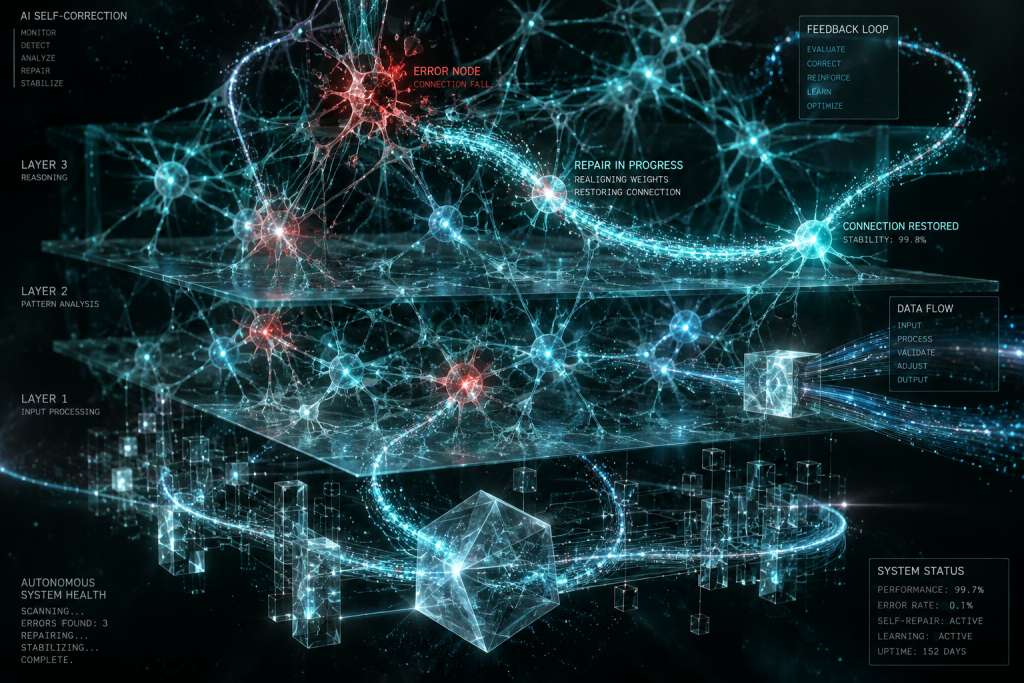
Image generated by AI
Imagine a doctor consulting an AI system to diagnose a patient, only to have the algorithm second-guess itself mid-analysis and correct its own reasoning. Or consider a self-driving car that detects an anomaly in its sensor data and recalibrates before proceeding. These scenarios may sound like science fiction, but they represent one of the most pressing challenges in artificial intelligence: creating systems that can recognize when they’re making mistakes and fix them without human intervention. The stakes couldn’t be higher—as AI systems increasingly influence critical decisions in medicine, law, transportation, and finance, the ability to catch and correct errors has become essential to their reliability and trustworthiness.
Error detection and self-correction in AI is no longer a theoretical curiosity confined to research laboratories. Tech companies, government agencies, and academic institutions are racing to build AI systems that don’t just perform tasks accurately, but actively monitor their own performance and intervene when things go wrong. This capability could represent the difference between AI that is merely impressive and AI that is genuinely safe and beneficial. Understanding how these systems work—and where they still fall short—is crucial for anyone seeking to comprehend the trajectory of artificial intelligence in the coming decades.
What Is Error Detection and Self-Correction in AI Systems?
Error detection and self-correction in AI systems refers to the ability of artificial intelligence models to identify mistakes in their own predictions, reasoning, or outputs, and then modify their behavior or conclusions to improve accuracy. Unlike traditional software, which typically executes instructions exactly as programmed, modern AI systems operate as probabilistic engines that generate predictions with varying degrees of confidence. Error detection mechanisms allow these systems to recognize when their confidence is misplaced or when their outputs violate logical constraints. Self-correction goes further: it enables the system to not only flag potential errors but also generate corrected versions, much like how a human might catch themselves mid-sentence and rephrase for clarity.
The concept emerged gradually from several research threads in computer science and mathematics. In the 1940s and 1950s, Claude Shannon and others laid theoretical groundwork for error-correcting codes in information theory—mathematical schemes that allow data to survive corruption during transmission. By the 1960s and 1970s, researchers began applying these ideas to expert systems and logic-based AI. However, the modern era of error detection in machine learning truly began in the 2010s, as deep neural networks became increasingly powerful and their “black box” nature made it harder to understand why they made mistakes. Researchers like Stuart Russell and others began exploring how to build verification and correction mechanisms directly into AI architectures.
The Basics
To understand how error detection and self-correction work, it helps to think about how AI systems make decisions. Most modern AI systems, particularly deep learning models, operate by processing input data through multiple layers of mathematical transformations and producing a numerical output—a prediction, classification, or ranking. The system doesn’t “know” if this output is correct; it merely outputs a probability or confidence score. Error detection mechanisms work by adding additional checks and validation steps to this process. These might include comparing the output against known constraints, checking for logical inconsistencies, cross-referencing with alternative reasoning paths, or querying external knowledge bases to verify claims.
Consider a practical analogy: imagine a travel planning AI that recommends flights for a business trip. A basic system might suggest a red-eye flight departing at 2 AM and arriving at 6 AM—technically feasible, but possibly missing crucial context about whether this makes sense for the specific trip. An error detection layer might identify the problem: the arrival time is before a 9 AM meeting, and overnight travel might not align with the user’s stated preferences. The self-correction mechanism could then regenerate options, ranking them by arrival time relative to the meeting, sleep quality, and cost. The system catches its own mistake through logical analysis before presenting it to the user.
Why It Matters
Error detection and self-correction capabilities are becoming essential as AI systems move into high-stakes domains where mistakes carry real consequences. In medical diagnostics, an AI system that can recognize when it’s uncertain about a diagnosis—and can either request additional imaging or flag the case for human review—could significantly improve patient outcomes. In legal applications, an AI system that detects when it’s applying an outdated legal precedent or when facts are ambiguous can prevent grave injustices. Beyond safety, these capabilities also improve user trust and system reliability. When users see that an AI system catches its own errors, they’re more likely to trust it in situations where human oversight isn’t available. From a practical standpoint, self-correcting AI systems can reduce the burden on human supervisors, who would otherwise need to manually verify every output.
Current applications span multiple industries. Healthcare organizations are implementing AI diagnostic systems with built-in verification loops that flag uncertain cases before they reach patients. Autonomous vehicle companies use cascading error detection—multiple sensors verify conclusions before the car takes action. Large language models like GPT-4 employ various self-correction strategies, including generating multiple candidate responses and selecting the best one, or explicitly reasoning through problems before answering. Financial institutions use AI systems with embedded checks that catch suspicious transactions, unusual trading patterns, or violations of regulatory constraints. Manufacturing companies deploy computer vision systems that not only detect defects but also verify their own conclusions by rotating perspectives or increasing magnification.
Recent Breakthroughs in Error Detection and Self-Correction in AI Systems
The past few years have witnessed remarkable progress in this field, driven largely by advances in large language models and multimodal AI. Researchers have discovered that simply prompting AI systems to “think step-by-step” or to “check their work” can dramatically improve accuracy—a phenomenon known as chain-of-thought reasoning. More sophisticated approaches involve training AI systems to generate multiple candidate answers, evaluate them against criteria, and select the best one. In 2023 and 2024, major breakthroughs emerged in what researchers call “constitutional AI,” where systems are trained not just to generate correct answers but to explicitly reason about their reasoning and identify potential flaws. Some models can now engage in genuine self-debate, generating opposing viewpoints and synthesizing them into improved conclusions.
Current research frontiers include developing more efficient verification mechanisms that don’t require running the model multiple times, creating systems that can verify their own outputs without external validation, and building AI that can not only detect errors but understand and explain why errors occurred. Researchers are also exploring how to combine multiple specialized AI systems—some for generation, some for verification, some for correction—into integrated pipelines. Open questions remain about whether self-correction capabilities will scale to more complex domains, how to ensure that correction mechanisms don’t introduce new biases, and whether there are fundamental limits to how reliable self-correcting systems can be without human oversight.
Why Error Detection and Self-Correction in AI Systems Matters for the Future
The ability to build self-correcting AI systems represents a potential inflection point in the relationship between humans and machines. If AI systems can reliably detect and correct their own errors, the scope of tasks we can safely delegate to them expands dramatically. This has profound implications for society: it could accelerate scientific discovery by enabling AI systems to explore hypotheses autonomously and validate their own findings; it could improve access to expertise in developing nations by deploying AI systems that can verify their own medical or legal advice; it could make autonomous systems safer by reducing their dependence on external oversight. On a deeper level, self-correcting AI systems might help us understand intelligence itself—the process of recognizing mistakes is fundamental to how humans learn and adapt.
However, significant challenges remain unresolved. One persistent problem is that AI systems can be confidently wrong—they might fail to detect errors that human reviewers would immediately spot. Another challenge is that error detection mechanisms themselves can fail or be fooled by adversarial inputs specifically designed to exploit verification weaknesses. There’s also a philosophical question: if an AI system cannot verify claims beyond its training data, how can it recognize errors in novel situations? Building systems robust enough for critical applications may require combining AI self-correction with human oversight, creating hybrid decision-making systems where AI handles routine error detection but humans intervene in uncertain cases.
Key Takeaways
- Error detection and self-correction in AI systems refers to mechanisms that allow artificial intelligence to identify and fix its own mistakes, moving beyond passive prediction toward active verification and improvement.
- These systems work by adding validation layers that check outputs against logical constraints, cross-reference alternative reasoning paths, and compare conclusions against known information before presenting results.
- Medical diagnosis, autonomous vehicles, large language models, and financial services are among the most promising domains for deployment, where the costs of errors are highest and the benefits of self-correction most valuable.
- Recent breakthroughs include chain-of-thought reasoning, constitutional AI, and multi-model verification systems, though challenges around confidence calibration and adversarial robustness remain significant.
- As AI systems assume greater responsibility in critical domains, self-correction capabilities will likely become as essential as accuracy itself, potentially enabling a new era of trustworthy autonomous systems that can operate with minimal human supervision.
Explore TED Talks on Error Detection and Self-Correction in AI Systems:
TED content is used under CC BY-NC-ND 4.0. © TED Conferences, LLC.
Frequently Asked Questions
How do AI systems technically detect errors in their own outputs without human feedback?
AI systems use internal validation mechanisms such as consistency checks, confidence scoring, and anomaly detection algorithms that compare outputs against expected patterns or cross-validate predictions using multiple pathways. These mechanisms flag discrepancies between predicted and observed data, allowing the system to identify potential errors in real time.
What is the difference between error detection and self-correction in AI systems?
Error detection is the process of identifying when an AI system has made a mistake through monitoring and validation techniques, while self-correction is the subsequent mechanism that automatically adjusts the system's reasoning or recalibrates parameters to fix the identified error. Detection answers 'what went wrong,' while correction answers 'how do we fix it.'
Why is self-correction capability particularly critical for AI systems used in medical diagnosis and autonomous vehicles?
These high-stakes applications involve direct consequences for human safety and health, where a single uncorrected error could result in misdiagnosis, injury, or death. Self-correction enables these systems to catch and remediate errors before they propagate into consequential decisions, reducing risk and improving overall system reliability.
Can current AI systems reliably correct all types of errors they detect?
Current AI systems can effectively self-correct certain systematic errors such as sensor calibration issues or mathematical inconsistencies, but they struggle with fundamental reasoning errors, hallucinations, or errors rooted in biased training data. This limitation means human oversight remains necessary for high-stakes applications despite advanced self-correction capabilities.