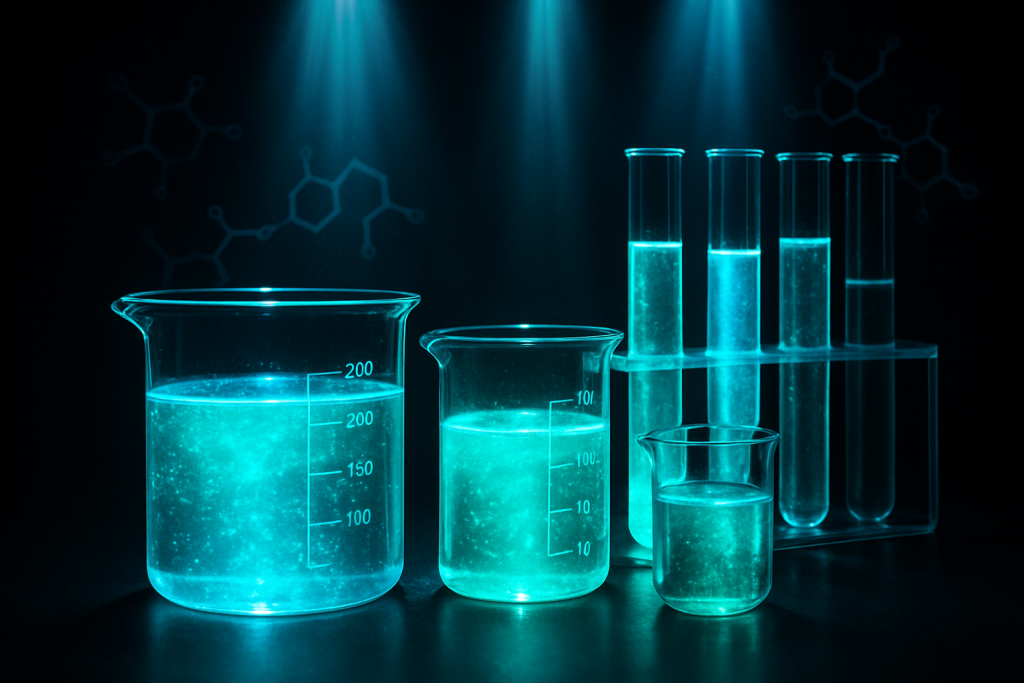
Image generated by AI
When a forensic investigator sprays an invisible substance onto a crime scene, biological evidence suddenly glows under ultraviolet light, revealing the presence of bodily fluids invisible to the naked eye. This moment of revelation—where darkness transforms into illuminating truth—represents one of chemistry’s most elegant tricks: the conversion of invisible molecular signals into visible light. Fluorescence and luminescence have quietly revolutionized how we detect everything from disease markers in blood samples to counterfeit drugs in supply chains, yet most people never learn how this scientific magic actually works.
In our increasingly complex world, the ability to detect and identify trace chemicals has become essential—not just for law enforcement, but for medicine, environmental monitoring, and food safety. As diseases become harder to diagnose early and contaminants more difficult to track, chemists are turning to fluorescence and luminescence as powerful tools that can identify specific molecules in milliseconds. These techniques have become so integral to modern science that researchers estimate they’re used in billions of diagnostic tests annually, making them among the most practical applications of quantum physics in everyday life.
What Is Fluorescence and Luminescence in Chemical Detection?
Fluorescence and luminescence are closely related phenomena involving the emission of light from matter, but they differ in their underlying mechanisms and energy sources. Fluorescence occurs when a molecule absorbs photons of light energy, becomes excited to a higher energy state, and then rapidly releases that energy by emitting photons of visible light—typically within nanoseconds. Luminescence is a broader category that includes fluorescence but also encompasses other light-emission processes like chemiluminescence (light from chemical reactions) and phosphorescence (light emission that persists after the energy source is removed). In chemical detection, these properties allow scientists to identify and measure specific substances by the characteristic light they emit when excited, turning invisible molecules into detectable signals.
The story of fluorescence in science begins in the 17th century when an Italian physicist named Vincenzo Casciorolo discovered that a mineral called barite stone glowed mysteriously after being heated and then left in darkness—though he didn’t understand why. The term “fluorescence” itself wasn’t coined until 1852 by Irish scientist George Gabriel Stokes, who discovered that the mineral fluorspar emitted blue light when exposed to ultraviolet radiation. Stokes’s experiments laid the foundation for understanding fluorescence as a distinct physical phenomenon. Throughout the 20th century, scientists harnessed this knowledge to develop fluorescent dyes and probes that could attach to biological molecules, revolutionizing microscopy, diagnostics, and analytical chemistry.
The Chemistry Behind It
To understand fluorescence, imagine an electron as a ball sitting on a staircase. When a photon (a particle of light) strikes a fluorescent molecule, it imparts energy to an electron, causing it to jump up several steps to a higher energy level—a state physicists call an “excited state.” The electron cannot remain in this high-energy state for long because it’s inherently unstable. Within picoseconds, the electron loses some energy through vibrations and collisions with surrounding molecules, a process called “non-radiative relaxation.” When the electron finally settles back down to its original energy level, it releases the remaining energy as a photon of light—this is the fluorescent emission we observe. The color of the emitted light depends on the energy difference between the electron’s excited and ground states, which is unique to each molecule, making fluorescence an excellent fingerprint for chemical identification.
Consider a common fluorescent dye like fluorescein, widely used in medical diagnostics. When fluorescein absorbs a photon of blue or ultraviolet light, electrons in its molecular structure jump to excited states. The molecule rapidly sheds excess energy through molecular vibrations—a process that generates heat. Then, in a quantum jump lasting billionths of a second, the electron returns to its ground state, releasing a photon of green light that we can see with the naked eye or detect with sensitive instruments. This conversion is remarkably efficient; fluorescein can repeat this absorption-emission cycle thousands of times per second, making it bright enough to be detected in extremely dilute solutions. This brightness, combined with the specificity of the emission wavelength, is why fluorescein appears in everything from highlighter markers to emergency water markers and medical imaging agents.
Where It Is Used Today
Fluorescence and luminescence have become indispensable tools across medicine, research, and industry. In clinical diagnostics, fluorescent markers attached to antibodies can identify disease-specific proteins in patient blood samples within minutes, enabling rapid diagnosis of infections, cancers, and autoimmune conditions. Environmental scientists use luminescent sensors to detect pollutants in water with extraordinary sensitivity, sometimes identifying contaminants at concentrations as low as parts per trillion. Security agencies rely on fluorescent reagents to detect explosives and narcotics at borders and airports. Meanwhile, in pharmaceutical research, fluorescently-labeled compounds help scientists understand how drugs move through the body and interact with target tissues, accelerating the drug development process by years.
The pharmaceutical industry depends heavily on luminescence-based techniques for quality control and drug discovery. Companies use fluorescence spectroscopy to verify the purity of manufactured compounds and detect contaminants that could render a batch unsafe. In hospitals, flow cytometry—a technique that sorts and counts cells using fluorescent labels—has become the gold standard for diagnosing leukemias and lymphomas, measuring immune function in HIV patients, and monitoring transplant rejection. Crime laboratories worldwide use alternate light sources combined with fluorescent reagents to visualize biological evidence at crime scenes. Meanwhile, the cosmetics industry uses fluorescent brightening agents in detergents and fabric care products to make whites appear brighter and more vibrant under both natural and artificial light.
Recent Breakthroughs in Fluorescence and Luminescence in Chemical Detection
In the past few years, researchers have made remarkable strides in developing new fluorescent molecules and detection strategies that push the boundaries of sensitivity and specificity. Scientists have created “smart” fluorescent probes that only emit light when they encounter their target molecules, reducing background noise and improving signal clarity. A 2023 study published in Nature Chemistry described a new class of biocompatible fluorescent nanoparticles that can penetrate deep into living tissues while maintaining exceptional brightness, opening possibilities for real-time imaging of disease progression inside the body. Researchers have also developed multiplexed detection systems that can simultaneously identify dozens of different molecules using different fluorescent dyes, each emitting at distinct wavelengths. These advances have been driven partly by improvements in quantum chemistry simulations, which allow researchers to computationally design molecules with precisely tuned optical properties before synthesizing them.
The field is currently focused on several ambitious challenges. Chemists are working to develop fluorescent probes that work in the near-infrared region of the spectrum, where tissue penetration is superior and biological autofluorescence is minimal—a capability that could revolutionize surgical imaging and cancer detection. Others are exploring luminescent systems that don’t require external light sources at all, relying instead on chemiluminescence from enzymatic reactions or electrochemiluminescence from electrochemical processes. A particularly promising area involves using machine learning to analyze complex fluorescence signatures, allowing researchers to detect multiple analytes simultaneously even when their emission spectra overlap. These approaches suggest that the next generation of fluorescence-based detection will be faster, more specific, and more integrated with digital technology than current systems.
Why Fluorescence and Luminescence in Chemical Detection Matters for the Future
As we face escalating challenges in healthcare, environmental monitoring, and biosecurity, fluorescence and luminescence technologies are becoming increasingly critical. The COVID-19 pandemic demonstrated how essential rapid, accurate chemical detection is for public health—many of the fastest diagnostic tests developed relied on fluorescent antibodies or chemiluminescent enzymes. Looking ahead, these techniques will be essential for detecting emerging pathogens, monitoring climate change impacts through environmental sensing, and enabling personalized medicine by allowing doctors to identify disease markers specific to individual patients in real time. The development of portable, inexpensive fluorescence-based sensors could bring diagnostic capabilities to remote regions and low-resource settings where laboratory infrastructure is limited, potentially saving millions of lives by democratizing access to early disease detection.
Despite their power, fluorescence and luminescence-based detection still faces significant limitations. Many biological tissues are opaque, limiting the depth to which fluorescent signals can be detected in living organisms. Photobleaching—the gradual loss of fluorescence as dye molecules are chemically degraded by repeated light absorption—remains a challenge for extended monitoring applications. The development of truly multiplexed systems that can track dozens of different molecules simultaneously without cross-interference remains technically demanding. Additionally, concerns about the toxicity of some fluorescent dyes and nanoparticles continue to limit their use in clinical applications, particularly for long-term implantable devices. Overcoming these obstacles will require continued innovation in organic chemistry, materials science, and biomedical engineering.
Key Takeaways
- Fluorescence is a quantum mechanical process where molecules absorb light energy, become excited, and rapidly emit visible light as they return to their ground state—a process that occurs within nanoseconds and is unique to each molecule type.
- The mechanism works because electrons can only occupy discrete energy levels in atoms and molecules; when an electron absorbs a photon and jumps to a higher level, it must eventually fall back down, releasing energy as a new photon with properties determined by the energy gap.
- The most promising applications lie in medical diagnostics for rapid disease detection, environmental monitoring for pollutant identification, and personalized medicine through molecular profiling of individual patient tissues.
- Recent research has focused on developing “smart” probes that only fluoresce when encountering target molecules, near-infrared fluorophores for deeper tissue penetration, and artificial intelligence systems for analyzing complex spectral data.
- Fluorescence and luminescence will be essential for addressing future challenges in healthcare, biosecurity, and environmental science, particularly in bringing diagnostic capabilities to underserved populations and enabling real-time monitoring of disease and environmental change.
Explore TED Talks on Fluorescence and Luminescence in Chemical Detection:
TED content is used under CC BY-NC-ND 4.0. © TED Conferences, LLC.
Frequently Asked Questions
How does fluorescence allow invisible molecules to become visible under ultraviolet light?
When UV light excites electrons in fluorescent molecules to a higher energy state, they rapidly release this excess energy as visible light when returning to their ground state, making previously invisible chemical compounds detectable to the human eye. This process of light absorption and re-emission is specific to certain molecular structures, allowing chemists to identify particular compounds based on their characteristic fluorescence.
What is the key difference between fluorescence and luminescence in chemical detection?
Fluorescence requires external light (typically UV) to excite molecules and produce visible light, while luminescence is a broader category that includes any light emission from chemical reactions or processes without requiring external excitation. In chemical detection applications, luminescence encompasses fluorescence as well as chemiluminescence, where light is generated directly from a chemical reaction.
Why are fluorescence and luminescence particularly useful for detecting trace chemicals compared to other analytical methods?
These techniques can identify specific molecules in milliseconds with extremely high sensitivity because they rely on quantum-level energy transitions that are unique to each chemical structure, allowing rapid detection even at very low concentrations. Their selectivity and speed make them ideal for applications requiring real-time analysis, such as forensic investigation and clinical diagnostics.
Can fluorescence and luminescence detect any type of chemical compound, or are there limitations?
Only molecules with appropriate chemical structures—those capable of absorbing specific wavelengths of light and undergoing electronic transitions—can naturally fluoresce or luminesce. However, chemists can overcome this limitation by using fluorescent labels or tags attached to target molecules, expanding detection capabilities to virtually any compound of interest.