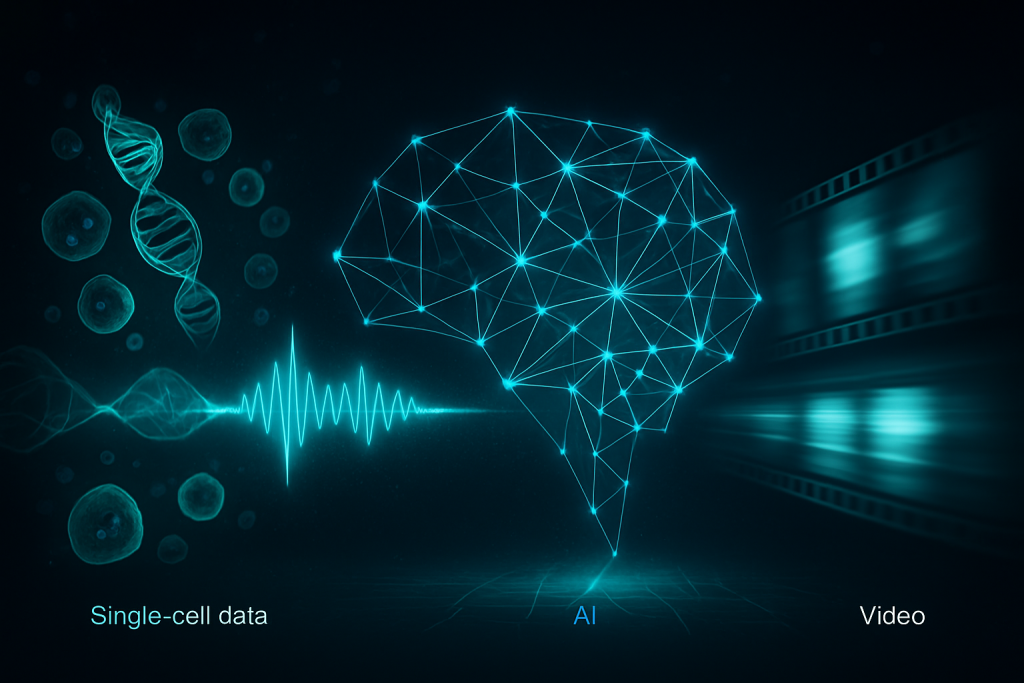
Image generated by AI
Imagine if a computer could watch a video of cells dividing, listen to the patterns in biological recordings, and then generate entirely new, realistic versions of those phenomena that have never existed before. This is not science fiction—it is happening right now in laboratories around the world, powered by a class of artificial intelligence systems called generative models. These tools are transforming how scientists understand everything from the inner workings of individual cells to the complex dynamics of biological tissues, representing a fundamental shift in how we extract meaning from the torrents of data that modern science produces.
The stakes could not be higher. Every day, scientists collect vast quantities of biological data—single-cell transcriptomes, high-resolution microscopy videos, audio recordings of animal vocalizations—yet much of it remains underutilized, locked in the dimensionality and complexity that makes it difficult to interpret. Generative models for scientific data offer a new approach: rather than simply analyzing what we have, they learn the underlying patterns and rules, then generate synthetic data that can validate hypotheses, fill in gaps, and accelerate discovery. This represents one of the most promising frontiers in computational biology and biomedical research.
What Is Generative Models for Scientific Data (Single-Cell, Audio, Video)?
Generative models for scientific data are artificial intelligence systems trained to understand and reproduce the statistical patterns present in complex biological datasets. Unlike traditional machine learning approaches that simply classify or predict outcomes, generative models learn the fundamental structure of the data itself—the ways that cells express genes, how neurons fire in sequence, or how proteins fold under different conditions—and can then create new, synthetic examples that follow the same underlying rules. These models work across multiple data modalities: single-cell transcriptomics (measuring gene expression in individual cells), time-series data like audio recordings, and visual sequences like microscopy videos. The key insight is that by learning to generate new data, the models develop a deeper understanding of the scientific phenomena they represent.
The modern era of generative models for scientific data began roughly in the mid-2010s, though the foundational ideas stretch back further. Variational autoencoders (VAEs) and generative adversarial networks (GANs) emerged in 2013-2014, initially developed for images by researchers like Yoshua Bengio and Ian Goodfellow. But the real revolution came when these techniques were adapted for scientific data. Around 2018-2020, researchers began applying these methods to single-cell biology, with notable contributions from computational biologists like Fabian Theis at the Helmholtz Center Munich and others working on tools like scVI and other single-cell generative models. The field has since exploded, with diffusion models—a newer class of generative models that has proven remarkably powerful—joining the toolkit in recent years.
The Basics
At their core, generative models work through a process of learning compression and reconstruction. When trained on a dataset of, say, single-cell gene expression profiles, the model learns to represent each cell as a point in a lower-dimensional “latent space”—think of it as a kind of conceptual map where similar cells cluster together, and different cell types occupy distinct regions. The model then learns the reverse process: starting from a point in this compressed space, it can reconstruct a realistic gene expression profile that matches the statistical properties of real cells. This bidirectional learning—compression and decompression—is what allows the model to both understand the data and generate new instances of it. The mathematics is complex, involving neural networks with millions of parameters, but the intuition is straightforward: the model asks “what are the essential features that make this data recognizable as real?”
Consider an analogy from art: if you studied thousands of paintings and learned the essential patterns—how light interacts with color, how proportions relate to perspective, how brushstrokes create texture—you could eventually paint new, original works that feel authentic even though they depict scenes that never existed. Generative models do something similar with scientific data. They absorb the “grammar” of biological systems and can speak fluently in that grammar, generating new sentences (new datasets) that sound natural but represent novel possibilities. The difference is that instead of paintings, we’re talking about gene expression patterns where every gene’s activity is statistically consistent with the biological knowledge embedded in the training data.
Why It Matters
The practical importance of generative models for scientific data extends across multiple dimensions of modern research. First, they address a fundamental problem in data science: most scientific datasets are smaller than those used in, say, internet-scale machine learning, yet far more complex and expensive to collect. By learning to generate synthetic data that maintains the statistical properties of real data, researchers can effectively amplify their datasets for machine learning pipelines, testing new hypotheses without requiring additional experiments. Second, generative models can impute missing values—a pervasive problem in biology where some cells die during processing, some genes fail to be measured, or some time points are skipped in recordings. Third, and perhaps most importantly, they enable a form of scientific discovery: by exploring the latent space of possibilities, researchers can identify new cell states, novel phenotypes, or unexpected relationships that might suggest new experiments to perform.
The applications are already concrete and widespread. In drug discovery, pharmaceutical companies use generative models trained on single-cell data to predict how cancer cells will respond to different treatments, potentially identifying new therapeutic targets. In neuroscience, researchers use generative models of neural recording data to understand population-level dynamics and predict how neural circuits might behave under novel conditions. In developmental biology, scientists apply these models to time-lapse microscopy videos to generate hypothetical developmental trajectories, exploring the space of “what could happen” in embryonic development. Clinical applications are emerging as well, with hospitals beginning to use generative models to understand patient-specific cell populations and tailor treatments accordingly.
Recent Breakthroughs in Generative Models for Scientific Data (Single-Cell, Audio, Video)
The past two to three years have witnessed remarkable acceleration in this field. The emergence of diffusion models—a class of generative models that work by gradually adding noise to data and then learning to reverse the process—has proven transformative. Unlike earlier approaches, diffusion models have shown superior performance across modalities: they generate higher-quality single-cell transcriptomes, more coherent video sequences, and more natural audio reconstructions. Research from groups at MIT, Stanford, and the Broad Institute has demonstrated that diffusion models can generate single-cell data with near-perfect fidelity to real distributions while maintaining biological validity. Simultaneously, researchers have developed novel architectures that combine generative modeling with other AI techniques—reinforcement learning for optimizing protein sequences, attention mechanisms for understanding which genes interact, and graph neural networks for modeling cell-cell interactions. In video synthesis for scientific data, generative models now enable the creation of realistic microscopy videos showing cellular processes that would take weeks to observe in real time.
Current research frontiers include several critical questions that will shape the field’s evolution. How can we ensure that generative models don’t amplify biases present in training data, particularly problematic when training on human genetic or medical data? How do we build generative models that can handle multiple data modalities simultaneously—combining gene expression, protein abundance, spatial location, and time—to generate truly comprehensive synthetic cells? And how do we interpret what generative models have learned, ensuring that the synthetic data they create is not just statistically realistic but also biologically meaningful? Researchers are also pushing into multimodal synthesis, where a single model can generate correlated data across multiple measurement types, and into conditional generation, where models can be prompted to generate data matching specific criteria—for example, “generate a cancer cell population with high expression of this marker gene and resistance to this drug.”
Why Generative Models for Scientific Data (Single-Cell, Audio, Video) Matters for the Future
The implications of this technology extend far beyond current applications. As generative models mature, they promise to democratize access to computational biology—researchers without massive sequencing budgets could use synthetically generated data to validate preliminary hypotheses before committing resources to expensive experiments. They could accelerate personalized medicine, allowing doctors to generate and test patient-specific cell populations in silico before deciding on treatments. More speculatively, generative models might eventually enable us to reverse-engineer biological complexity, to understand not just what cells do but why they do it, by exploring the full space of possible cellular states and behaviors. In fundamental science, they could help us understand which features of biological systems are essential and which are incidental, by seeing what happens when we perturb different aspects of the generative model.
But significant challenges remain. Generative models require enormous computational resources, raising questions about accessibility and environmental impact. There are profound questions about biological validity: just because a generative model produces statistically realistic data does not automatically mean that data represents biologically possible states. Regulatory and ethical concerns loom, particularly around generating synthetic human genetic or medical data—who owns that data, how should it be used, and how do we prevent misuse? The field also faces a reproducibility challenge: generative models often involve complex hyperparameter choices and random initialization, making results difficult to replicate. Despite these hurdles, the trajectory is clear—generative models are becoming indispensable tools for modern biology, and their development will likely accelerate as more researchers enter the field.
Key Takeaways
- Generative models for scientific data are AI systems that learn the underlying statistical patterns in complex biological datasets and can create new, synthetic data that maintains those patterns—enabling data amplification, missing value imputation, and novel discovery.
- These models work by learning a compressed representation of data (a latent space) and then reconstructing realistic examples, using techniques like variational autoencoders, generative adversarial networks, and increasingly, diffusion models.
- The most promising near-term applications include drug discovery and personalized medicine, where generative models trained on single-cell data can predict cellular responses and enable hypothesis testing without extensive experimental work.
- Recent breakthroughs in diffusion models and multimodal approaches have dramatically improved the quality and applicability of synthetic scientific data, with active research ongoing into biological validity, interpretability, and ethical governance.
- These models represent a fundamental shift in how science works—moving from passive observation of complex phenomena toward active exploration of biological possibility spaces, with profound implications for medicine, drug development, and our understanding of life itself.
Explore TED Talks on Generative Models for Scientific Data (Single-Cell, Audio, Video):
TED content is used under CC BY-NC-ND 4.0. © TED Conferences, LLC.
Frequently Asked Questions
How do generative models learn to create realistic synthetic single-cell data?
Generative models learn the underlying statistical distributions and patterns from real single-cell transcriptomes by analyzing thousands of actual cells, then use this learned knowledge to generate new synthetic cell profiles that preserve biological validity. These models capture the key relationships between genes and cellular states without simply copying existing data.
Why is generating synthetic biological data valuable for validating scientific hypotheses?
Synthetic data generated from learned patterns allows researchers to test hypotheses in silico and validate predictions before conducting costly or time-consuming experiments on real biological samples. This approach reduces experimental waste and helps researchers prioritize which biological mechanisms to investigate empirically.
Can generative models for video data reveal mechanisms of cellular processes that are difficult to observe directly?
Yes—by learning spatiotemporal patterns from time-lapse microscopy videos of cells dividing or interacting, generative models can interpolate or extrapolate missing frames and generate new plausible dynamics that reveal underlying biological rules. This enables researchers to understand cellular processes at temporal and spatial resolutions beyond what direct observation alone provides.
What scientific advantage does generating synthetic audio recordings of animal vocalizations provide for bioacoustics research?
Generative models can create diverse, realistic synthetic vocalizations that expand training datasets for studying animal communication patterns, species identification, and behavioral analysis without requiring extensive new field recordings. This addresses data scarcity and allows researchers to explore the acoustic parameter space more thoroughly than naturally occurring recordings alone permit.