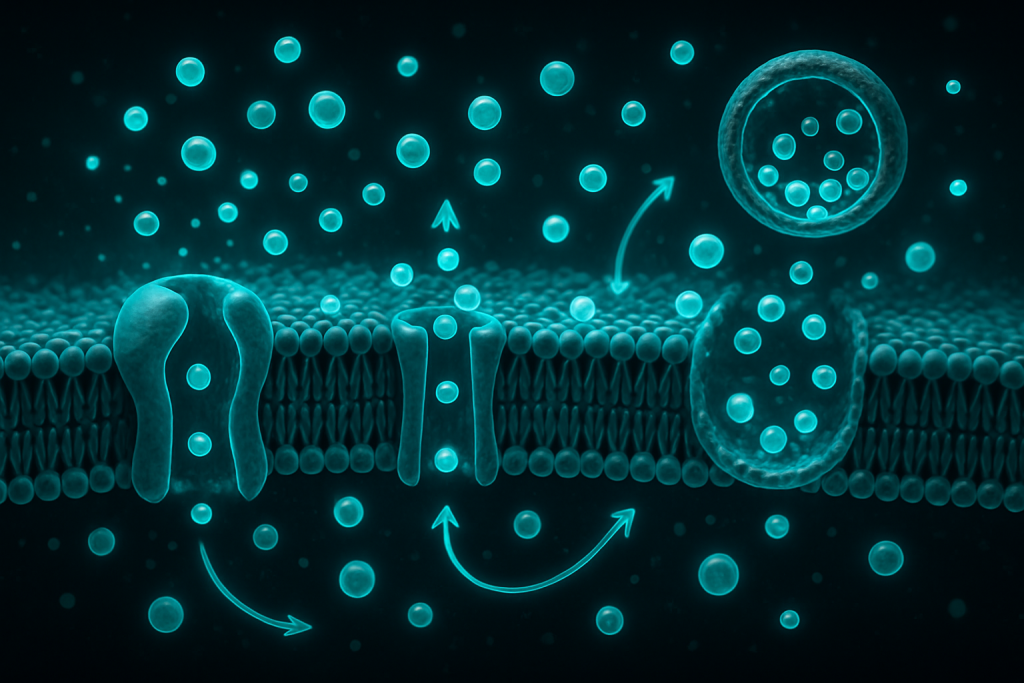
Image generated by AI
Every second of every day, trillions of molecules are moving across the membranes that surround your cells—yet most of us never give this invisible choreography a moment’s thought. These molecular journeys are not random; they are governed by an elegant system of biological gatekeepers that decide what enters a cell, what leaves it, and when. This process, known as membrane transport and cellular uptake, is so fundamental to life that without it, no organism could survive for more than a few minutes. It is the difference between a cell that thrives and one that withers, between health and disease, between life and death.
Today, understanding membrane transport has become urgently relevant. From developing new drugs that can penetrate cancer cells to engineering plants that resist drought and designing synthetic cells from scratch, scientists across disciplines are realizing that controlling what crosses a cell membrane is the key to solving some of the world’s most pressing problems. As biotechnology accelerates and personalized medicine becomes reality, membrane transport is no longer a curiosity for cell biologists alone—it has become central to breakthroughs in medicine, agriculture, and synthetic biology.
What Is Membrane Transport and Cellular Uptake?
Membrane transport is the process by which molecules and ions move across the phospholipid bilayer that forms the boundary of every living cell. This barrier is not a passive wall but an active, highly selective interface that controls traffic with remarkable precision. Cellular uptake, a specific form of membrane transport, refers to the movement of substances from outside the cell to the inside—essentially, the way cells consume nutrients, absorb signals, and take in material they need to survive. Think of the cell membrane as a fortress wall with sophisticated checkpoints: some molecules are welcomed guests that pass through with ease, while others are turned away entirely, and still others require special security clearance and escort through the gates.
The concept of membrane transport began to crystallize in the 19th and early 20th centuries, when scientists noticed that cells seemed to accumulate certain substances against concentration gradients—meaning molecules moved toward regions where they were already more concentrated, apparently defying the laws of thermodynamics. In 1949, a researcher named Ernest Overton proposed that the cell membrane was composed of lipids, and that this lipid barrier explained why some molecules could pass through while others could not. The revolutionary fluid mosaic model, proposed by Singers and Nicolson in 1972, finally revealed that the membrane was not a static sheet but a dynamic structure studded with proteins that actively moved substances across the barrier. This insight transformed our understanding of how cells maintain the internal chemical balance necessary for life.
How It Works in Nature
Nature employs two fundamentally different strategies for moving substances across cell membranes, each suited to different circumstances and different types of cargo. Passive transport requires no energy expenditure from the cell; molecules simply diffuse across the membrane, following the natural gradient from areas of high concentration to areas of low concentration. Imagine a room full of perfume molecules gradually spreading throughout a house—no one is pushing them along, they simply move until evenly distributed. However, cells frequently need to move molecules against this gradient, accumulating nutrients or ions in higher concentrations inside the cell than outside, which requires active transport. This process burns cellular fuel, primarily in the form of ATP (adenosine triphosphate), the cell’s energy currency, to power specialized protein pumps that drag molecules against the concentration gradient, essentially pushing water uphill.
To understand these mechanisms in a tangible way, consider how cells take up glucose, a critical fuel molecule. Glucose cannot simply drift through the lipid membrane on its own—it is too polar, too “water-loving” to navigate the hydrophobic interior of the membrane. Instead, cells deploy specialized transport proteins called glucose transporters that form channels and carriers. Some work passively, allowing glucose to flow through when external concentrations are high, while others work actively, using energy to pull glucose in even when external concentrations are low. A neuron in your brain, which consumes enormous amounts of glucose to power electrical signaling, uses active transport to maintain a glucose concentration inside the cell that is roughly 20 times higher than in the blood—a remarkable feat of molecular engineering that requires constant energy expenditure and exquisite regulation.
Medical and Scientific Relevance
Understanding membrane transport has proven essential for modern medicine. A vast proportion of pharmaceuticals work by targeting specific transporters or blocking them entirely; roughly 10-15 percent of all FDA-approved drugs exert their effects by modulating membrane transport in some way. If a drug cannot cross the cell membrane to reach its target, it is worthless, which is why pharmaceutical companies invest enormous effort in understanding the membrane transport properties of potential medicines. Cancer cells, which divide rapidly and require constant fuel, often upregulate certain transporters to gorge themselves on nutrients; this creates a vulnerability that researchers are learning to exploit with drugs that hijack cancer cell transporters or starve tumors by blocking nutrient uptake. Additionally, many genetic diseases result from mutations in transport proteins, causing accumulation of toxic substances or depletion of essential molecules, and understanding how these proteins work has enabled researchers to develop therapies targeting the underlying molecular defect.
In clinical practice, membrane transport principles inform everything from dialysis treatment for kidney failure—which exploits concentration gradients and diffusion across a semi-permeable membrane—to antibiotic design. Antibiotics like aminoglycosides penetrate bacterial cells more efficiently than human cells, partly because they exploit bacterial-specific transport mechanisms, which is why they can kill infections without severely harming the patient. In agriculture, scientists are engineering crop plants with enhanced nutrient transporters to improve yield and drought resistance, allowing plants to extract more water and minerals from soil even under stress. Gene therapy relies on delivering genetic material into cells, and researchers are increasingly using knowledge of natural transport mechanisms to design vehicles that can carry genes across cellular membranes, including the notoriously difficult-to-cross blood-brain barrier.
Recent Breakthroughs in Membrane Transport and Cellular Uptake
The past few years have witnessed extraordinary advances in visualizing and manipulating membrane transport at the molecular level. In 2021 and 2022, researchers using cryo-electron microscopy—a technique that can freeze proteins in their native state and image them at near-atomic resolution—revealed the three-dimensional structures of several major transport proteins in unprecedented detail, showing exactly how they change shape to move molecules across the membrane. These structures have already begun yielding insights into how mutations cause disease and how drugs can be designed to modulate transport. Simultaneously, synthetic biologists have begun constructing artificial transport systems, demonstrating that they can insert genes for nutrient transporters into simple cells to reprogram their feeding behavior, a capability that hints at the possibility of engineered organisms with entirely novel metabolic capabilities.
Researchers are also investigating endocytosis and exocytosis—processes where cells engulf or expel material in bubble-like vesicles, allowing transport of cargo too large to fit through regular channels. Recent work has illuminated how cells use elaborate machinery to control these processes with precision, opening new possibilities for drug delivery systems that can deposit cargo directly into specific cellular compartments. Additionally, scientists are exploring how viruses hijack cellular transport mechanisms to invade cells, knowledge that could lead to both antiviral therapies and new strategies for using modified viruses as delivery vehicles for therapeutic genes. The emerging field of cell engineering is beginning to use membrane transport principles to reprogram cell behavior and create living technologies that can sense and respond to their environment.
Why Membrane Transport and Cellular Uptake Matters for the Future
As cells become the factories and materials of the future—whether as biofuels producers, pharmaceutical makers, or tissue replacements—controlling membrane transport will become increasingly critical. The biotechnology industry is racing toward “programmable cells” that can manufacture medicines, sense disease biomarkers, or generate sustainable materials, and all of these applications depend fundamentally on precisely controlling what gets in and out of the cell. Climate change has made understanding plant nutrient and water transport urgent; breeding or engineering crops with superior membrane transport capabilities could significantly boost food security in an increasingly unpredictable environment. In medicine, the ability to target specific transporters offers opportunities to develop personalized therapies tailored to the unique transport protein signatures of individual tumors, moving us closer to the dream of truly precision medicine.
Yet challenges remain formidable. The mammalian cell membrane contains hundreds of different transport proteins, many still poorly characterized, and the interplay between them is bewilderingly complex. Cells regulate membrane transport through networks of signaling pathways that respond to internal and external cues, and we are only beginning to understand this regulatory landscape. Furthermore, many transport proteins are inherently difficult to work with experimentally—they are unstable outside the cell membrane and prone to aggregating when isolated. There is also the fundamental challenge that transport is context-dependent; the same protein can behave differently in different tissues, at different times, and under different physiological conditions. Solving these puzzles will require continued innovation in experimental techniques, computational modeling, and a willingness to bring together insights from molecular biology, biophysics, engineering, and medicine.
Key Takeaways
- Membrane transport and cellular uptake are the fundamental processes that allow cells to control what enters and exits, maintaining the chemical environment necessary for life.
- Cells use two primary mechanisms: passive transport, which requires no energy and relies on concentration gradients, and active transport, which consumes ATP energy to move molecules against gradients.
- The most promising near-term application is in targeted drug delivery and cancer therapy, where understanding how to exploit cancer cell transporters could revolutionize treatment.
- Recent breakthroughs in cryo-electron microscopy have revealed the atomic-scale structures of transport proteins, enabling rational drug design and synthetic biology applications that were previously impossible.
- As biotechnology advances and climate pressures intensify, the ability to engineer and manipulate membrane transport could become as transformative in the 21st century as the germ theory of disease was in the 19th.
Explore TED Talks on Membrane Transport and Cellular Uptake:
TED content is used under CC BY-NC-ND 4.0. © TED Conferences, LLC.
Frequently Asked Questions
What is the phospholipid bilayer and why does it require specialized transport mechanisms?
The phospholipid bilayer is the hydrophobic (water-repelling) structural foundation of cell membranes, composed of lipid molecules arranged with their fatty tails facing inward. Because this barrier repels water-soluble molecules, cells require specific protein channels and active transport systems to move ions, nutrients, and other polar substances across it.
How do cells distinguish between molecules that should enter and those that should be kept out?
Cells use selective transport proteins—such as channel proteins and carrier proteins—that recognize specific molecular shapes, sizes, and chemical properties, allowing only compatible molecules to pass through. This selectivity is determined by the three-dimensional structure of the transport proteins and receptor sites that only match certain molecules, functioning like biological locks and keys.
Why is membrane transport critical for human health and disease treatment?
Membrane transport controls the delivery of oxygen, glucose, and medications into cells while removing metabolic wastes; disruptions in this process cause diseases like cystic fibrosis and diabetes. Understanding transport mechanisms allows scientists to design drugs that can penetrate diseased cells (like cancer cells) and develop therapies that restore normal cellular uptake in patients with transport defects.
Can scientists artificially engineer or control membrane transport for biotechnology applications?
Yes, scientists can engineer synthetic cells and design drug delivery systems by manipulating or inserting specific transport proteins into membranes to control what substances enter cells. This ability enables applications like creating plants with enhanced water uptake for drought resistance and developing targeted therapies that deliver medications precisely where they are needed.