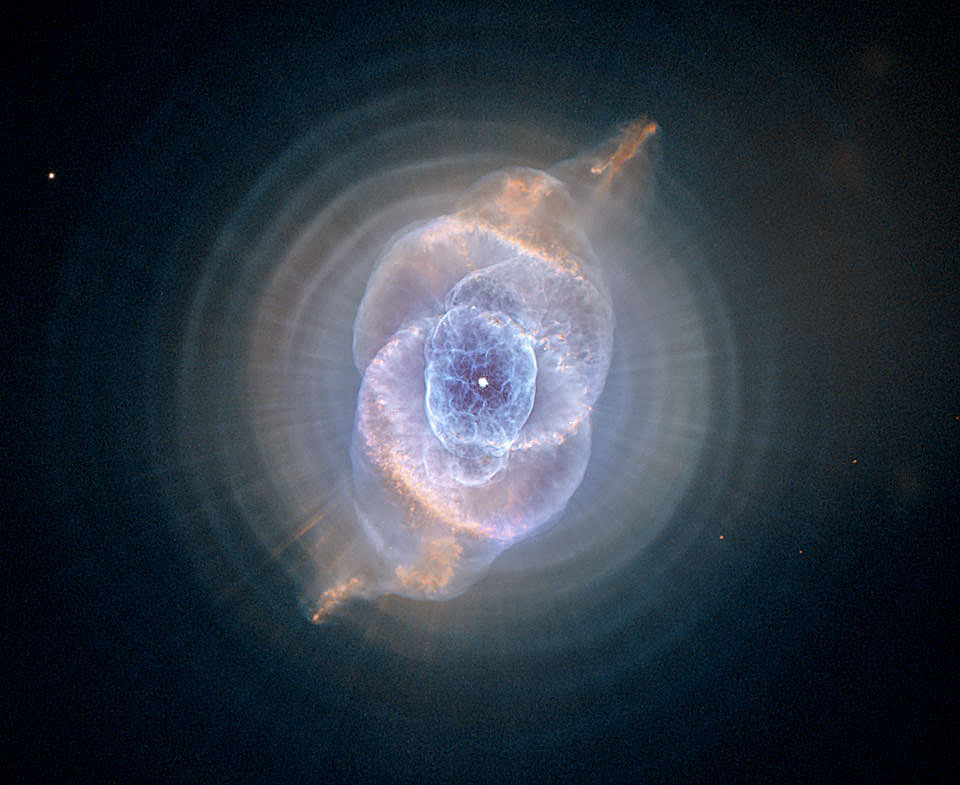
Image: NASA
AI Insight
Neutron stars are extremely dense stellar remnants formed when massive stars collapse, compressing matter to extraordinary densities where a teaspoon would weigh a billion tons. On August 17, 2017, scientists detected gravitational waves from two colliding neutron stars 130 million light-years away, marking the first time such an event was observed through both gravitational waves and electromagnetic radiation across the spectrum. This collision, designated GW170817, released more energy than the sun will emit in its entire lifetime and provided direct evidence for how heavy elements in the universe are created.
Why it matters
This discovery confirms Einstein's gravitational wave predictions and reveals how the heaviest elements in nature are formed through neutron star collisions. The multi-messenger observation combining gravitational waves with traditional telescope data opens a new era of astronomy for understanding extreme physics and the chemical evolution of the universe.
Understand the Science
On August 17, 2017, detectors on Earth picked up a gravitational wave signal lasting just 100 seconds—a tremor in spacetime itself caused by two city-sized objects colliding at nearly the speed of light, 130 million light-years away. In that catastrophic embrace, the collision released more energy than our sun will emit in its entire 10-billion-year lifetime. For the first time, scientists witnessed not only gravitational waves from such a collision but also caught the resulting explosion across the electromagnetic spectrum, from radio waves to gamma rays. This event, later named GW170817, fundamentally changed how we understand the universe’s most extreme physics and provided direct evidence for the origin of some of the heaviest elements in existence.
The study of neutron star collisions has become central to modern astrophysics, reshaping our understanding of gravity, matter, and cosmic evolution. Every neutron star collision that occurs somewhere in the universe tells us something profound about the nature of reality itself—about how matter behaves at densities that dwarf anything we can create in laboratories, and about the violent processes that forge the elements in our bodies. With gravitational wave observatories now operating worldwide and new technologies emerging, we’re entering an era where cosmic collisions aren’t merely theoretical curiosities but observable events that illuminate the deepest laws of physics. This matters not just for scientists seeking fundamental truths, but for understanding the chemical composition of our universe and the mechanisms that might one day enable human civilization to tap into the most concentrated energy sources in existence.
What Is Neutron Stars and Collisions?
Neutron stars represent the extreme aftermath of stellar death. When massive stars—those at least 20 times heavier than our sun—reach the end of their lives, they collapse in a supernova explosion so violent that it compresses all the remaining material into a sphere roughly the size of a city, typically 20 kilometers across. The matter becomes so densely packed that electrons and protons merge into neutrons, creating a substance so compact that a teaspoon would weigh as much as a billion tons on Earth’s surface. These neutron stars spin rapidly, often hundreds of times per second, and many emit beams of radiation that sweep across space like cosmic lighthouses—these are called pulsars. When two neutron stars orbit each other in a binary system, they gradually lose energy through gravitational radiation and eventually spiral inward, colliding in one of the universe’s most catastrophic events.
The phenomenon of neutron star collisions was theoretically predicted long before it was ever observed. In the 1970s, physicists recognized that Einstein’s theory of general relativity predicted the existence of gravitational waves—ripples in spacetime itself. Scientists hypothesized that catastrophic events like neutron star mergers would produce these waves, but detecting them seemed impossible given their infinitesimal magnitude. The 1993 Nobel Prize in Physics was awarded to Russell Hulse and Joseph Taylor for their observations of a binary neutron star system whose orbital decay matched Einstein’s predictions perfectly, providing indirect evidence that gravitational waves existed and that neutron star collisions would eventually occur. Their discovery set the stage for the direct detection that would finally arrive in 2015, when advanced laser interferometers called LIGO detected the first gravitational wave signal from merging black holes, followed by neutron star collisions two years later.
What We Know So Far
The mechanics of neutron star collisions represent one of physics’s most intricate puzzles, involving the interplay of gravity, nuclear physics, and electromagnetic phenomena all happening simultaneously. As two neutron stars orbit each other in their death spiral, they deform from the immense gravitational tidal forces, their surfaces bulging and stretching. The collision itself lasts only milliseconds, but during this brief window, the two objects merge into either a hypermassive neutron star—a temporary configuration that exists for seconds or minutes—or directly into a black hole, depending on the total mass involved. Throughout this violent process, the collision’s gravitational waves carry away enormous amounts of energy and angular momentum, allowing the material to settle into its final state. Simultaneously, nuclear reactions occur at unprecedented density, creating the conditions necessary for the rapid neutron capture process that synthesizes heavy elements like gold, platinum, and uranium—elements that are fundamentally impossible to create in normal stellar processes.
To grasp the scale of these events, consider that a neutron star’s density is comparable to crushing the entire Earth to the size of a marble, then compressing that marble down further by another factor of billions. When two such objects collide, the energy released equals that of a gamma-ray burst, the universe’s most energetic electromagnetic explosions. The resulting shockwaves and nuclear reactions are so violent that they create an expanding fireball of exotic matter and radiation. Scientists have discovered that these collisions produce “kilonovae”—explosions that shine with the light of a thousand ordinary novae and fade over weeks, leaving behind a signature visible across Earth-based and space telescopes. The collision ejects material moving at speeds up to 30 percent the speed of light, spreading these freshly synthesized heavy elements across space where they eventually become part of new stars and planets. Every gold ring on Earth, every uranium nucleus, traces its origin back to similar collisions that occurred billions of years ago, seeding the cosmos with the atomic building blocks of complex chemistry.
The Future of Exploration
The practical applications of neutron star collision research extend far beyond satisfying theoretical curiosity. Gravitational wave astronomy, made possible by the study of such collisions, has become a revolutionary tool for mapping the universe and testing the limits of Einstein’s theory in extreme environments. The construction of next-generation detectors—including the Einstein Telescope in Europe and the Cosmic Explorer in the United States—will improve sensitivity by orders of magnitude, allowing astronomers to detect merger events throughout the observable universe and to study the properties of nuclear matter under conditions no laboratory can replicate. Additionally, detailed observations of neutron star collisions provide constraints on the equation of state of neutron star matter, information that directly informs our understanding of particle physics, dark matter candidates, and the fundamental forces that govern reality. These observations have already challenged some theoretical predictions and refined our models of how matter behaves at nuclear densities.
Current research initiatives worldwide focus on coordinated multi-messenger astronomy—observing neutron star collisions simultaneously through gravitational waves, electromagnetic radiation, and potentially neutrino detection. The Laser Interferometer Gravitational-Wave Observatory (LIGO) in the United States, the Virgo detector in Italy, and the KAGRA detector in Japan now operate as an international network, triangulating the locations of cosmic events with increasing precision. Major telescope facilities, including the Very Large Telescope, Gemini Observatory, and Swift satellite, stand ready to observe the electromagnetic aftermath of detected mergers within seconds of gravitational wave alerts. Universities and research institutions from Tokyo to Cambridge compete to develop better computational models that simulate these collisions, solving the equations of general relativity and nuclear physics simultaneously to predict observable signatures. This coordinated global effort represents science at its most collaborative, with researchers sharing data openly to accelerate discoveries.
Recent Breakthroughs in Neutron Stars and Collisions
The past three years have witnessed remarkable advances in understanding neutron star collisions, driven by accumulated observations and improved computational models. In 2023, researchers analyzing data from previous merger events discovered unexpected signatures suggesting that some neutron star collisions may produce short-lived but extremely massive neutron stars before collapsing into black holes—objects that exist in a previously unexplored regime of density and temperature. Advanced simulations published by teams at institutions including UC Berkeley and the Max Planck Institute now reproduce the observable features of kilonovae with unprecedented detail, revealing how shock waves propagate through the collision and trigger the nuclear reactions that synthesize heavy elements. The identification of specific electromagnetic signatures associated with different collision scenarios has improved astronomers’ ability to extract detailed information about what happened during the first milliseconds after merger, when direct observation is impossible. Additionally, careful statistical analysis of multiple gravitational wave events has begun to constrain the equation of state of neutron star matter more precisely than ever before, ruling out some theoretical proposals and supporting others.
Scientists currently debate several open questions that promise to reshape our understanding of neutron star physics in coming years. What happens to the magnetic fields during collision, and how do they contribute to the explosive energy release observed in kilonovae? Does every neutron star merger produce detectable amounts of gravitational waves, or are there stealth mergers we’re missing? How much of each heavy element is actually synthesized in neutron star collisions versus other cosmic processes, and what does this tell us about the chemical history of galaxies? New observations from the James Webb Space Telescope, with its unprecedented infrared sensitivity, are detecting the thermal radiation from kilonovae days and weeks after merger, providing data points that challenge existing models and suggest additional physics may be occurring in the post-merger environment. These questions drive research agendas across multiple subfields of astrophysics and nuclear physics, ensuring that neutron star collisions will remain at the frontier of astronomical investigation for decades to come.
Why Neutron Stars and Collisions Matter for the Future
Neutron star collisions occupy a unique place in fundamental physics because they represent the only naturally occurring laboratory where we can study matter at nuclear densities and test the most extreme predictions of Einstein’s general relativity. The existence of gravitational waves, predicted a century ago but only directly observed thanks to neutron star research, has opened entirely new sensory organs for astronomy—we can now “hear” the universe’s violent events, not just see them. This capability will transform how we map the universe, discover previously unknown populations of objects like primordial black holes, and test whether space and time are truly continuous or possess some deeper granular structure. Furthermore, neutron star collisions serve as our primary cosmic source for heavy elements, meaning that understanding these events is essential to understanding the chemical composition of galaxies, planets, and life itself. In an era when humanity increasingly appreciates its connection to cosmic processes, recognizing that the gold in our technology and jewelry originated in neutron star collisions billions of years ago creates a profound link between the most violent events in the universe and our everyday existence.
Despite recent progress, significant challenges remain in fully understanding neutron star collisions and extracting maximum information from observed events. The extreme physics occurring during the collision—involving simultaneously strong gravity, relativistic speeds, and nuclear reactions—requires solving coupled equations that currently push supercomputers to their limits, and approximate solutions may still miss crucial physical processes. The electromagnetic signals from kilonovae are faint and fade rapidly, making detailed observations difficult for distant events, and the gravitational wave signal itself becomes too distorted near merger to provide clear information about what happens at the highest densities. We also lack direct constraints on whether black holes form immediately upon merger or whether an intermediate neutron star stage occurs, a distinction with profound implications for nuclear physics. Future progress will require not only more sensitive detectors and faster telescopes, but also breakthroughs in computational methods that allow us to simulate the complete collision process more accurately and connect theoretical predictions to observable signatures with greater precision.
Key Takeaways
- Neutron star collisions are among the universe’s most violent events, releasing as much energy in milliseconds as our sun will produce in its entire lifetime, and they represent the primary cosmic source of heavy elements like gold and platinum.
- When two neutron stars spiral inward and merge, they create gravitational waves—ripples in spacetime that can be detected from billions of light-years away—alongside spectacular electromagnetic explosions called kilonovae that shine with the light of thousands of ordinary stellar explosions.
- The most promising application of neutron star collision research is gravitational wave astronomy, which opens an entirely new way to observe the universe and test the fundamental laws of physics in extreme environments that cannot be replicated in any laboratory.
- Current research efforts focus on multi-messenger astronomy and improved computational modeling to understand the millisecond-long collision process and extract information about the equation of state of matter at nuclear densities, with major breakthroughs occurring as recently as 2023.
- Neutron star collisions matter fundamentally for the future of physics and cosmology because they represent the only naturally occurring way to study matter under the most extreme conditions imaginable, test Einstein’s relativity at its limits, and forge the elements that compose stars, planets, and life itself.
Explore TED Talks on Neutron Stars and Collisions:
TED content is used under CC BY-NC-ND 4.0. © TED Conferences, LLC.
Frequently Asked Questions
What creates the gravitational waves detected during neutron star collisions?
Gravitational waves are generated by the acceleration of massive objects—in this case, two neutron stars spiraling toward each other and merging, which causes ripples in spacetime itself. The rapid orbital motion and final violent collision release enormous amounts of energy in the form of these spacetime distortions, which propagate outward at the speed of light.
Why do neutron star collisions produce heavy elements like gold and platinum?
During the extreme temperatures and pressures of a collision, rapid neutron capture (r-process nucleosynthesis) occurs, allowing neutrons to fuse onto atomic nuclei faster than radioactive decay can occur, creating elements heavier than iron. The event GW170817 produced an estimated 10 Earth-masses of gold and similar quantities of other precious metals, confirming neutron star mergers as a primary source of these heavy elements in the universe.
How do scientists detect electromagnetic radiation from neutron star collisions across the entire spectrum?
The collision's enormous energy output triggers emission across all wavelengths—from gamma rays produced by radioactive decay of freshly-created heavy elements, to X-rays, visible light, and radio waves from the expanding debris cloud. Multiple specialized observatories (gamma-ray satellites, X-ray telescopes, optical surveys, and radio arrays) work together to observe the same event across these different wavelengths simultaneously.
What does the density of matter inside a neutron star tell us about physics at extreme conditions?
Neutron stars compress an entire sun's mass into a city-sized object, creating densities so extreme that electrons are forced into protons to form neutrons, a state unachievable in Earth laboratories. Studying collisions reveals how nuclear matter behaves when packed beyond normal atomic limits, testing fundamental physics theories and revealing the strength and limits of the strong nuclear force.