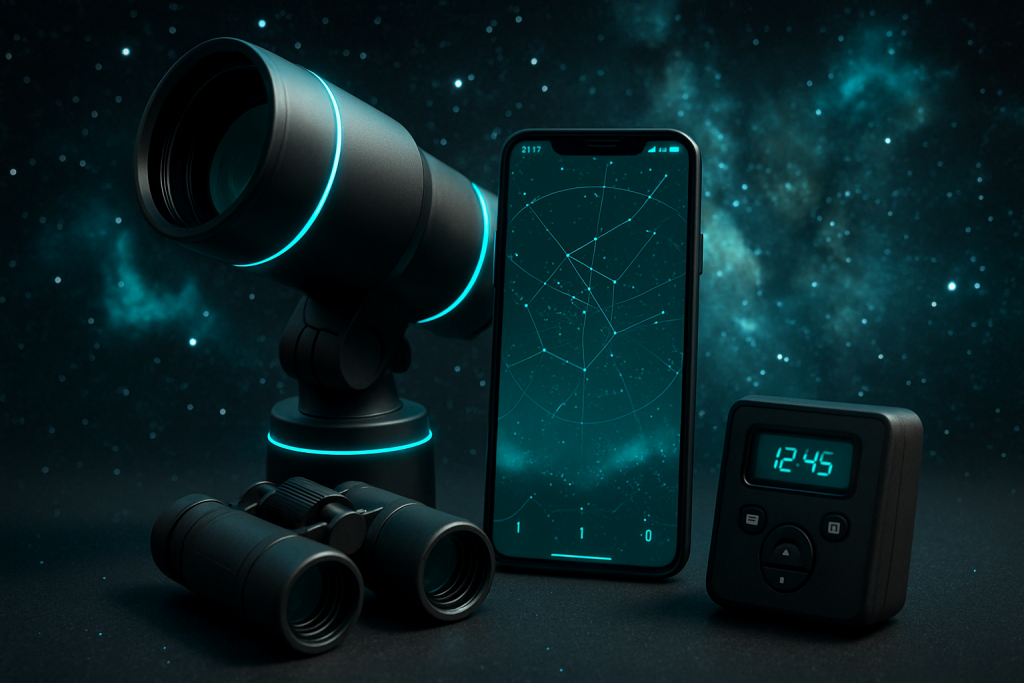
Image generated by AI
A decade ago, observing Saturn’s rings required a visit to a planetarium or a serious investment in equipment. Today, you can peer at Jupiter’s Great Red Spot through a smartphone-connected telescope smaller than a water bottle, or track the International Space Station with an app that vibrates when it passes overhead. The explosion of portable and consumer astronomy technology has democratized the cosmos, placing the instruments of discovery in billions of pockets worldwide. This revolution isn’t merely about convenience—it’s fundamentally reshaping who gets to explore the universe and how.
The implications ripple far beyond backyard stargazing. As more people engage with the night sky through accessible technology, citizen scientists contribute to genuine astronomical discoveries, funding for space education increases, and the next generation of astronomers finds their inspiration not in textbooks but in real-time observations of the heavens. We stand at a remarkable inflection point where the gap between professional and amateur astronomy has narrowed to the width of a smartphone screen, yet many people remain unaware of the tools available to them or the exciting discoveries they can make. Understanding this technology landscape matters because it touches on questions of scientific literacy, democratic access to knowledge, and how humanity will continue to explore space in an increasingly digital age.
What Is Portable and Consumer Astronomy Technology?
Portable and consumer astronomy technology encompasses the instruments, software, and systems designed to make astronomical observation accessible to the general public without requiring professional training, massive budgets, or permanent installations. These tools range from simple binoculars and refractor telescopes to sophisticated computerized mounts, smartphone apps with augmented reality capabilities, and networked cameras that automatically track celestial objects. The defining characteristic isn’t sophistication—it’s accessibility. A consumer astronomy device prioritizes ease of use, portability, affordability, and integration with technologies people already own. Unlike professional instruments housed in observatories, consumer astronomy technology is built for people to carry outside on a clear night and immediately begin making observations.
The origins of this field trace back to the early 2000s, when advances in miniaturization and digital technology began converging with growing public interest in space exploration. The launch of the Hubble Space Telescope in 1990 and subsequent spectacular images ignited widespread fascination with astronomy. By the early 2010s, smartphone technology had reached a tipping point—processors became powerful enough to run sophisticated planetarium software, cameras gained sensitivity to faint light, and internet connectivity became ubiquitous. Companies like Celestron, Meade, and later startups like Vaonis recognized an enormous untapped market. They began designing equipment specifically for people who wanted to explore the night sky without years of specialized training or thousands of dollars in equipment. This democratization accelerated through the 2010s and 2020s, creating an ecosystem where amateur astronomy became accessible to virtually anyone with curiosity and a modest budget.
What We Know So Far
The fundamental mechanics of consumer astronomy technology rest on optical and digital principles refined over centuries but repurposed for modern use. When light from distant stars and planets travels through space and reaches Earth, it’s often just a handful of photons—barely enough for human eyes to detect. Consumer telescopes work by gathering this diffuse light through objective lenses or mirrors, concentrating it to make dim objects appear brighter and larger. Digital cameras paired with these telescopes further amplify this light through electronic sensors sensitive enough to detect individual photons, then integrate thousands of these detections over seconds or minutes to create images impossible to see with the human eye alone. Computer processors then enhance these images, identifying astronomical objects and aligning the telescope to keep them centered as Earth rotates. Modern smartphones amplify this capability by serving as both computational powerhouses and sensors themselves, running algorithms that can identify constellations, track satellites, and guide users to specific celestial targets.
Consider a practical example: imagine you’re observing the Moon with a basic consumer telescope. The telescope’s lens gathers light reflecting from the lunar surface and focuses it through an eyepiece into your eye, magnifying the image perhaps 50 to 100 times. Now attach a smartphone with a specialized app, and the processor identifies which lunar features you’re viewing using image recognition algorithms, overlaying crater names and geological information in real-time. Add a motorized mount with computerized tracking, and the telescope automatically follows the Moon as it appears to move across the sky due to Earth’s rotation. If you replace the eyepiece with a digital camera, you can take long exposures revealing features invisible through the eyepiece alone—the same principle that allows professional astronomers to detect distant galaxies. Each layer of technology builds on fundamental optics principles, but the combination creates capabilities that bring professional-grade observations within reach of the average person.
The Future of Exploration
Consumer astronomy technology is catalyzing a shift in how scientific research happens in the 21st century. Professional astronomers increasingly recognize that citizen scientists with access to portable equipment can contribute meaningful data to legitimate research projects. Organizations like the American Association of Variable Star Observers have documented exoplanet transits and stellar variations with help from amateur astronomers using consumer-grade equipment. The expansion of automated plate-solving software—algorithms that can identify which patch of sky a telescope is viewing and guide it to specific objects with precision—has lowered the skill barrier significantly. Networked telescopes that can be controlled remotely from a computer or smartphone have opened possibilities for collaborative observing and continuous monitoring that would be economically impossible with traditional observatory models. Meanwhile, lighter, cheaper, more rugged equipment design means that astronomy is no longer limited to developed nations; educators and students in emerging economies can now access tools once available only to privileged institutions.
Real-world applications demonstrate the tangible impact of this accessibility. Citizen science projects like Galaxy Zoo have engaged millions of people in classifying galaxies, contributing to peer-reviewed publications. Satellite tracking apps that run on smartphones help people observe the International Space Station and other orbital objects, generating valuable data about atmospheric drag and orbital decay. In education, portable planetariums and telescope kits have transformed STEM teaching in rural schools with limited budgets. The surge in interest has also spawned a thriving commercial ecosystem: companies developing smartphone adapters for telescopes, manufacturers creating smaller and more affordable computerized mounts, and software developers building increasingly intuitive observing guides. This commercial activity creates economic incentives for continued innovation while maintaining products at price points accessible to middle-class consumers globally.
Recent Breakthroughs in Portable and Consumer Astronomy Technology
The past three years have witnessed remarkable acceleration in several domains. Artificial intelligence and machine learning have revolutionized automated object recognition; modern apps can now identify not just constellations but specific deep-sky objects like nebulae and galaxies by analyzing smartphone photos of the night sky. Manufacturers have achieved dramatic improvements in optical quality while reducing size and weight—compact Dobsonian telescopes with 8-inch apertures that fit in a car trunk now rival mid-sized professional telescopes from two decades ago in light-gathering ability. The integration of augmented reality has transformed observing; users point their smartphones skyward and see overlaid information about what’s above them, constellation patterns, satellite tracking, and even real-time alerts about meteor showers or ISS passes. Perhaps most significantly, the emergence of affordable computerized mounts with GoTo capabilities—systems that automatically locate and track celestial objects—has eliminated the steep learning curve that once kept casual observers from venturing beyond the Moon and bright planets.
Current research directions reveal where the field is heading. Engineers are developing ultra-compact optics using metamaterials—engineered materials with optical properties not found in nature—to create telescopes that challenge conventional size and weight limitations. Scientists are exploring quantum sensors that could detect photons with previously impossible efficiency, potentially enabling detection of fainter objects with smaller instruments. Software developers are racing to implement real-time processing pipelines that can search telescope imagery for transient phenomena—sudden flashes or changes in brightness—potentially allowing amateur astronomers to discover supernovae or other dramatic cosmic events. One particularly exciting frontier involves remote telescope networks: arrays of modest consumer-grade telescopes distributed across multiple locations and coordinated through cloud computing, potentially achieving the imaging power of much larger instruments through clever combination of data. Open questions remain about how best to train the next generation to use these tools scientifically, how to ensure data quality from diverse observers, and how to continue lowering cost barriers for global access.
Why Portable and Consumer Astronomy Technology Matters for the Future
The democratization of astronomy carries profound implications for how humanity understands itself and its place in the cosmos. When millions of people have direct, personal access to observational astronomy, the abstract becomes concrete. Someone who has actually seen Jupiter’s moons through a telescope understands celestial mechanics differently than someone who has only read about it. This experiential learning translates into greater scientific literacy, more informed public discourse about space policy, and stronger support for funding basic research. Moreover, accessible astronomy technology creates a vast talent pool for professional astronomy and related fields; many of today’s professional astronomers report that childhood experiences with consumer telescopes sparked their career choices. At a societal level, shared wonder at the night sky provides a rare common experience that transcends national boundaries and cultural differences—an antidote to the fragmenting effects of modern media ecosystems.
Yet significant challenges persist in realizing this technology’s full potential. Light pollution continues to worsen in urban areas where most people live, limiting what consumer instruments can observe regardless of their quality. Economic disparities remain pronounced; while a basic telescope costs $100-200, serious equipment still runs into thousands of dollars, creating barriers for economically disadvantaged communities. Digital divides also matter—accessing smartphone apps and online resources requires internet connectivity that remains inconsistent in rural and developing regions. Perhaps most concerning, some worry that the abundance of data from citizen scientists could overwhelm professional astronomers’ ability to validate and integrate findings into the scientific literature. Additionally, questions about intellectual property rights, proper attribution, and equitable benefit-sharing when citizen science contributes to discoveries remain incompletely resolved. Addressing these challenges will require continued innovation in both technology and social structures.
Key Takeaways
- Portable and consumer astronomy technology has democratized celestial observation, making professional-grade observations possible for millions of people through affordable, accessible equipment and software.
- These tools work by gathering and concentrating faint starlight through optical systems, then using digital sensors and algorithms to enhance what human eyes alone cannot see, often integrated seamlessly with smartphones.
- Citizen science projects powered by consumer astronomy equipment now contribute meaningfully to professional astronomical research and discovery, from exoplanet detection to supernova identification.
- Recent breakthroughs in artificial intelligence, compact optics, and computerized tracking systems have accelerated adoption and capability improvements, making sophisticated observing accessible to complete beginners.
- This technological revolution matters profoundly for scientific literacy, STEM education, professional talent development, and humanity’s collective engagement with the cosmos, though challenges around light pollution, equity, and data validation remain to be addressed.
Explore TED Talks on Portable and Consumer Astronomy Technology:
TED content is used under CC BY-NC-ND 4.0. © TED Conferences, LLC.
Frequently Asked Questions
How do smartphone-connected telescopes achieve magnification in such a compact size?
Portable telescopes use high-quality optical elements and shorter focal lengths than traditional models, combined with digital magnification through the smartphone camera sensor to achieve viewing power. The smartphone's processing capabilities allow real-time image enhancement and stabilization that compensates for the instrument's small physical size.
What scientific data can citizen scientists actually contribute to astronomy using consumer technology?
Amateur astronomers with consumer tools can monitor variable stars, track asteroids, observe exoplanet transits, detect sunspots, and record occultations—data that professional networks aggregate for legitimate astronomical analysis. These observations fill gaps in long-term monitoring that would be impossible for professional observatories to maintain continuously.
Why is real-time observation through portable technology scientifically valuable compared to pre-recorded planetarium shows?
Live observation allows detection of transient astronomical events like meteor showers, supernovae, and satellite passes that cannot be predicted in advance, plus it engages the observer's own pattern recognition and critical thinking skills. This hands-on methodology reinforces scientific method understanding in ways passive viewing cannot achieve.
Can smartphone apps accurately track objects like the International Space Station using consumer-grade equipment?
Apps calculate the ISS's orbital position using publicly available Two-Line Element data from NORAD and use the smartphone's GPS and compass to guide users to the correct point in the sky with high precision. The vibration alert functions when the satellite's predicted trajectory passes through the user's location, which is accurate to within a few kilometers on Earth's surface.