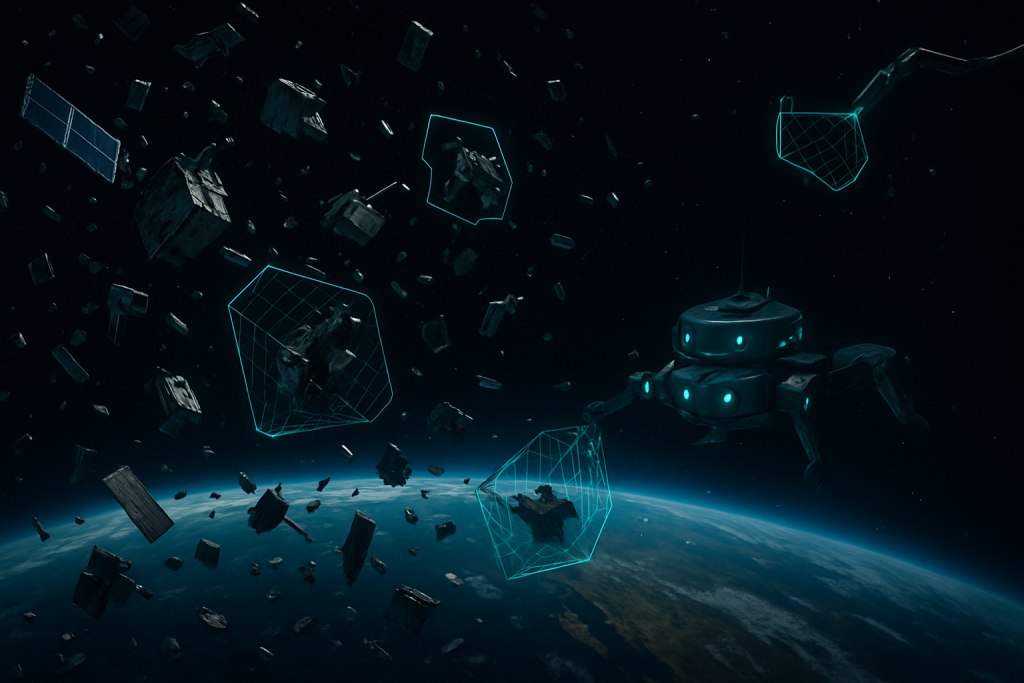
Image generated by AI
Imagine standing in a crowded room where thousands of invisible objects are hurtling past you at 17,500 miles per hour, each one capable of obliterating whatever it strikes. This isn’t science fiction—it’s the reality of low Earth orbit today. Space debris, the accumulating refuse of six decades of spaceflight, now poses one of the most serious threats to humanity’s future in space, yet it remains largely invisible to the general public. A single collision between a defunct satellite and an active spacecraft could trigger a catastrophic chain reaction, creating thousands of new fragments and rendering entire orbital zones unusable.
As commercial spaceflight explodes and countries worldwide launch mega-constellations of thousands of satellites to beam internet across the globe, the debris problem has shifted from a distant concern to an urgent crisis. Today, space agencies and private companies are racing to develop technologies that can capture, deorbit, and remove the very junk that threatens their own operations. This collision of necessity and innovation is reshaping how we think about orbital real estate, establishing the first environmental management systems for the cosmos itself.
What Is Space Debris and Removal Technologies?
Space debris refers to all non-functional objects in orbit around Earth, including defunct satellites, spent rocket stages, fragments from collisions and explosions, and even lost astronaut tools. These objects range from massive structures weighing tens of thousands of kilograms down to paint flecks and slag particles barely visible under a microscope. The problem isn’t simply clutter; it’s kinetic energy. At orbital velocities, even a gram-sized fragment travels fast enough to puncture a spacecraft hull, and larger pieces can destroy multi-million-dollar satellites outright. The European Space Agency estimates that there are approximately 36,500 pieces of debris larger than 10 centimeters in low Earth orbit, with millions of smaller fragments too small to track but large enough to cause damage.
Space debris removal technologies encompass an emerging field of engineering solutions designed to mitigate this threat through active removal, passive deorbiting, and prevention strategies. These technologies include robotic arms that can grapple defunct satellites, nets that ensnare targets, harpoons that impale drifting objects, and ion beams that nudge debris into decaying orbits. Some systems rely on tractor beams of light or electromagnetic forces, while others employ conventional methods like hooks and clamps. The field is genuinely novel—the first operational active debris removal mission didn’t launch until 2021—making this one of spaceflight’s youngest and most urgent engineering frontiers.
The history of space debris awareness begins not with a dramatic collision but with a mathematical insight. In 1978, NASA scientist Donald Kessler published a seminal paper warning that once orbital debris reaches a critical density, collisions would generate new debris faster than objects naturally deorbit, creating a runaway cascade. This phenomenon became known as “Kessler Syndrome,” and it fundamentally changed how engineers and policy makers think about the long-term sustainability of space. For decades, Kessler’s warning remained largely theoretical, but as the number of satellites multiplied and space missions accumulated, his predictions began looking uncomfortably prescient.
What We Know So Far
Space debris accumulates through several interconnected mechanisms. Satellites and rocket stages reach end-of-life but remain in orbit, their aluminum bodies and electronic components persisting for decades or centuries before natural drag from Earth’s thin upper atmosphere gradually lowers their orbits. More dramatically, collisions between objects create fragmentation events that instantly generate thousands of new pieces. The 2009 collision between the Iridium 33 communications satellite and the defunct Russian Cosmos 2251 military satellite produced an estimated 2,300 trackable fragments and tens of thousands of smaller pieces. Explosions of fuel tanks and batteries on aging spacecraft add to the problem, as do micrometeorite impacts that chip away material. Some debris comes from intentional anti-satellite weapons tests—India, China, and Russia have all destroyed satellites in orbit, generating massive debris clouds. Each launch also contributes, with rocket stages and payload fairings regularly becoming orbital flotsam.
Consider the debris environment as a cosmic shooting gallery where the bullets regenerate themselves. A piece of orbital debris traveling at 10 kilometers per second carries the kinetic energy of a small explosion. When it strikes another object, it doesn’t just damage the target—it creates new projectiles from the collision fragments. These secondary fragments then threaten other satellites, potentially creating more debris. This cascading effect is what keeps space agencies awake at night. The International Space Station regularly performs debris-avoidance maneuvers, sometimes several times per year, expending fuel and disrupting operations to dodge objects predicted to pass within danger zones. Astronauts have evacuated to Soyuz spacecraft during particularly close approaches.
The Future of Exploration
Active debris removal technologies are transitioning from laboratory concepts to operational systems, driven by both government space agencies and private companies seeking to protect their investments. The European Space Agency’s ClearSpace-1 mission, scheduled for 2026, will attempt to rendezvous with and capture a piece of debris—specifically, a Vega rocket upper stage from 2013—using a spacecraft equipped with four robotic arms resembling an octopus. Japan’s Space Agency successfully deployed a tractor beam technology in 2021 using an ion beam to slightly push a piece of debris, demonstrating that contactless removal is feasible. Meanwhile, companies like Axiom Space and startups specializing in debris removal are developing commercial services that could eventually establish orbital maintenance and cleanup as standard industry practices.
The applications extend beyond simply removing existing debris. Satellite operators are designing spacecraft with mission-end procedures that ensure reliable deorbiting at end-of-life, incorporating fuel reserves and deployment mechanisms that reliably separate stages and fairings. Standards organizations are developing guidelines for “design for demise,” engineering satellites to burn up completely during atmospheric reentry rather than leaving persistent debris. Active removal focuses on the most dangerous legacy objects—large, massive pieces in heavily trafficked orbits that pose the greatest collision risk. Some researchers propose using space-based lasers to nudge debris into lower orbits where atmospheric drag hastens their demise, while others advocate for grabbing the largest objects with robotic spacecraft and deorbiting them in controlled reentries.
Recent Breakthroughs in Space Debris and Removal Technologies
The past three years have witnessed unprecedented momentum in debris removal technology development and operational deployment. In 2021, the RemoveDebris mission demonstrated multiple capture techniques in orbit, including a net that successfully captured a target satellite and a harpoon that successfully impaled a foam panel. The mission proved that these methods could function reliably in the actual space environment, not just in ground simulations. In 2023, ESA awarded contracts for ClearSpace missions through the 2030s, committing to removing multiple pieces of debris. China announced plans for an orbital debris cleanup capability, and several private companies completed successful demonstrations of capture mechanisms on CubeSat platforms, proving that debris removal doesn’t require enormous, expensive spacecraft.
Current research focuses on autonomous systems that can identify, track, and capture debris without human intervention, since the hazardous velocities and distances involved make real-time human control impractical. Machine vision systems must reliably identify target objects tumbling unpredictably through space and navigate to within meters of non-cooperative targets. Engineers are developing gripper mechanisms that can secure objects without damaging them unnecessarily, and propulsion systems efficient enough to maneuver a heavily laden debris-removal spacecraft back to a lower orbit for controlled reentry. Simultaneously, researchers continue refining predictive models of debris distribution, working to identify which pieces pose the greatest collision risk and therefore deserve removal priority.
Why Space Debris and Removal Technologies Matter for the Future
The stakes for getting debris management right could hardly be higher. If Kessler Syndrome cascades develop unchecked, entire orbital regions could become inaccessible, effectively closing off access to the most valuable real estate in space. This would devastate the emerging space economy, from GPS and communications to weather monitoring and Earth observation. More immediately, it would force abandonment of the International Space Station, ending decades of continuous human presence in orbit. The climate implications ripple outward as well: satellite-based climate monitoring, sea-level measurements, and atmospheric studies depend on functioning satellites in specific orbits. Beyond Earth observation, the space-based internet services that companies like SpaceX are building to provide global broadband require hundreds or thousands of functioning satellites in low Earth orbit—exactly the region most congested with debris.
Yet significant challenges remain unsolved. Current debris removal technologies work well for large, relatively stationary targets, but many pieces of concern are smaller, less cooperative objects tumbling unpredictably. Each removal mission costs tens to hundreds of millions of dollars, making it economically unfeasible to remove all debris; prioritization decisions carry enormous consequences. International agreement on debris removal liability and responsibility remains incomplete—if a debris-removal spacecraft damages a satellite belonging to another nation, who bears responsibility? Questions of space sovereignty and national security complicate development of international standards. Perhaps most fundamentally, removing debris doesn’t solve the prevention problem; without new spaceflight practices that minimize debris creation, removal efforts will always lag behind new debris generation.
Key Takeaways
- Space debris—defunct satellites, rocket stages, and collision fragments—now numbers over 36,500 trackable pieces larger than 10 centimeters, traveling at 17,500 miles per hour and capable of destroying functioning spacecraft.
- Donald Kessler’s 1978 theoretical warning about cascading debris collisions creating a runaway chain reaction has shaped orbital management policy for decades and now drives urgent engineering solutions.
- Active removal technologies including robotic capture arms, nets, harpoons, and ion beams are transitioning from demonstrations to planned operational missions, with ESA’s ClearSpace-1 launch scheduled for 2026.
- Current research focuses on autonomous systems for identifying and capturing non-cooperative tumbling objects, while policy frameworks struggle to address international responsibility and sustainable long-term orbital management.
- Without aggressive debris removal and prevention strategies, Kessler Syndrome could render critical orbital zones inaccessible, threatening satellite communications, weather monitoring, climate science, and the emerging space economy.
Explore TED Talks on Space Debris and Removal Technologies:
TED content is used under CC BY-NC-ND 4.0. © TED Conferences, LLC.
Frequently Asked Questions
What constitutes space debris and what are its primary sources?
Space debris includes all non-functional objects orbiting Earth, such as defunct satellites, spent rocket stages, and fragments from collisions and explosions. These materials have accumulated over six decades of spaceflight operations and represent the abandoned or broken remnants of space missions.
Why is space debris traveling at such high speeds, and what makes collisions so dangerous?
Objects in low Earth orbit travel at approximately 17,500 miles per hour due to the velocity required to maintain stable orbits around Earth. At these extreme speeds, even small debris fragments can obliterate spacecraft upon impact, and a single collision can trigger a cascade of secondary collisions that creates thousands of new fragments.
How can a single debris collision create a chain reaction that threatens entire orbital zones?
When two orbiting objects collide at high velocity, the impact produces numerous new fragments that remain in orbit and can strike other satellites, creating additional fragments in a self-perpetuating cycle known as Kessler syndrome. This cascading effect can render vast regions of orbital space unusable for future missions.
What removal technologies are being developed to address the space debris problem?
Space agencies and private companies are developing capture and deorbiting technologies designed to physically remove defunct satellites and debris from orbit. These technologies aim to either safely guide objects out of orbit to burn up in Earth's atmosphere or capture them for controlled disposal.