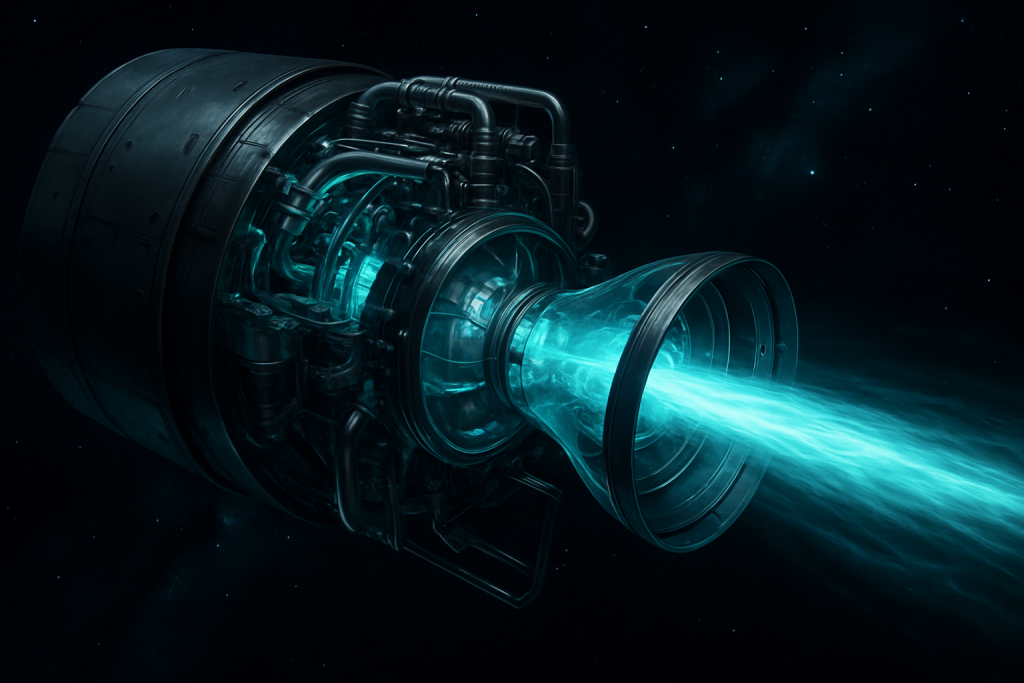
Image generated by AI
Imagine accelerating a metal cylinder weighing as much as a building from zero to 17,500 miles per hour in under nine minutes. This is not science fiction—it happens every time a rocket launches, and it represents one of humanity’s most audacious feats of engineering. Spacecraft propulsion systems are the carefully orchestrated dance of physics, chemistry, and mathematics that allows us to escape Earth’s gravity and venture into the cosmos. Without understanding the principles that govern how rockets work, we cannot fully appreciate how humans landed on the moon, how rovers explore Mars, or how telescopes like James Webb peer billions of years into space.
Today, spacecraft propulsion systems stand at a critical juncture. Traditional chemical rockets—the workhorses that have carried humans and robots to the stars for over six decades—are being supplemented and potentially replaced by revolutionary technologies like ion drives, nuclear propulsion, and reusable rocket systems that land themselves. These innovations are not merely academic curiosities; they directly determine how quickly we can reach distant planets, how much cargo we can deliver to orbit, and ultimately whether humanity can become a truly spacefaring civilization. For scientists, engineers, and space enthusiasts alike, understanding rocket engineering has never been more relevant.
What Is Spacecraft Propulsion Systems and Rocket Engineering?
Spacecraft propulsion systems are the mechanisms that generate thrust—the force needed to accelerate a vehicle through the vacuum of space. At their core, all rocket engines operate on Newton’s third law of motion: for every action, there is an equal and opposite reaction. A rocket engine expels material at high velocity in one direction, and this creates a reaction force pushing the spacecraft in the opposite direction. Unlike airplanes, which push against air to generate lift and thrust, rockets carry their own reaction mass and can operate in the complete vacuum of space. The fundamental challenge of rocket engineering is maximizing the efficiency of this thrust while managing extreme temperatures, pressures, and structural forces.
Modern rocket engineering emerged from the dreams and calculations of pioneers like Konstantin Tsiolkovsky in Russia, Hermann Oberth in Germany, and Robert Goddard in America during the early twentieth century. Tsiolkovsky, a schoolteacher and visionary, derived the fundamental rocket equation in 1903, showing mathematically how to calculate the velocity a rocket could achieve based on its exhaust velocity and the ratio of its initial mass to its final mass—what engineers call the mass ratio. The practical demonstration came later: in 1926, Goddard launched the first liquid-fueled rocket in his aunt’s cabbage patch in Massachusetts, traveling only 41 feet in 2.5 seconds, yet proving the concept worked. These early theorists transformed rocketry from fireworks into science, laying the groundwork for the space age that would follow.
What We Know So Far
Chemical rockets remain the most common propulsion systems today, and their operation is elegantly straightforward in principle though extraordinarily complex in practice. A chemical rocket mixes fuel and oxidizer in a combustion chamber, where they react violently, producing hot, high-pressure gases. These gases expand and escape through a specially shaped nozzle called a de Laval nozzle, which accelerates the exhaust to supersonic speeds—typically between 7,000 and 14,000 feet per second for most chemical rockets. The momentum of these expelled gases creates thrust that propels the rocket forward. The efficiency of this process is measured by “specific impulse,” abbreviated as Isp, which indicates how much thrust you get per pound of propellant burned per second. Higher specific impulse means you can achieve greater velocity with less fuel, a critical consideration when every kilogram of material you launch into space must first be lifted against Earth’s gravity.
Think of a chemical rocket like a person standing on ice wearing roller skates, throwing heavy objects backward as hard as possible. The faster and heavier the objects they throw, the faster they move forward. A rocket works the same way, except instead of objects, it’s superheated gas, and the “ice” is the frictionless vacuum of space. The Tsiolkovsky rocket equation, the mathematical foundation underlying all rocket design, reveals a profound truth: achieving higher velocities requires either higher exhaust velocity or a much larger mass ratio. This is why multi-stage rockets exist—as lower stages burn out and fall away, they shed dead weight, allowing the upper stages to accelerate more efficiently with the remaining fuel. A three-stage rocket to low Earth orbit might weigh 100 tons on the launch pad but only needs 5 tons or so in its final stage to reach orbital velocity.
The Future of Exploration
The future of spacecraft propulsion extends far beyond traditional chemical rockets. Ion drives, also called ion thrusters, represent a fundamentally different approach that has already proven its worth in deep space. These engines ionize propellant atoms and accelerate them using electric fields, achieving exhaust velocities of 20,000 to 200,000 feet per second—dramatically higher than chemical rockets. Although ion drives produce less total thrust (making them impractical for launches from Earth’s surface), they excel in the vacuum of space where continuous, low-thrust acceleration over weeks or months can achieve extraordinary velocities. The Dawn spacecraft used ion propulsion to visit asteroids Vesta and Ceres, becoming humanity’s most fuel-efficient interplanetary explorer. Similarly, NASA’s DART mission used ion thrusters to reach the asteroid Dimorphos, where it intentionally crashed to test our ability to alter asteroid trajectories—a technology essential for planetary defense.
Beyond ion drives, engineers are developing nuclear thermal rockets, which could double the specific impulse of chemical engines by using a reactor to heat propellant to extreme temperatures before expelling it through a nozzle. NASA and the Department of Energy are actively developing such systems for crewed missions to Mars, where the reduced transit time could significantly lower radiation exposure to astronauts. Private companies like SpaceX are simultaneously revolutionizing chemical rocket technology through reusability—the Falcon 9’s first stage routinely lands itself and flies again, dramatically reducing launch costs from tens of thousands to just a few thousand dollars per kilogram to orbit. Meanwhile, researchers explore even more exotic concepts like solar sails, which use the momentum of photons from sunlight to accelerate without any propellant, and plasma thrusters, which manipulate ionized gas using magnetic fields to achieve high specific impulse with sustained thrust.
Recent Breakthroughs in Spacecraft Propulsion Systems and Rocket Engineering
The past three years have witnessed remarkable progress across multiple propulsion technologies. SpaceX’s Starship, the largest and most powerful rocket ever built, completed its first integrated flight test in April 2023, demonstrating progress toward a fully reusable super-heavy-lift launch system capable of carrying 100 tons to low Earth orbit and potentially enabling lunar bases and Mars missions. Meanwhile, NASA awarded contracts for lunar lander development, spurring innovations in spacecraft guidance, control, and descent engines optimized for the Moon’s thin atmosphere. The European Space Agency tested the Prometheus engine, a 3D-printed rocket engine designed for high performance and reduced manufacturing complexity, signaling a shift toward additive manufacturing in rocket production. Additionally, private companies like Relativity Space are advancing entirely 3D-printed rockets, potentially reducing supply chain complexity and enabling faster iteration and testing cycles.
On the ion propulsion front, researchers continue pushing the boundaries of electric propulsion. Hall effect thrusters and gridded ion engines are achieving higher power levels and longer operational lifespans, enabling increasingly ambitious deep space missions. NASA’s upcoming Artemis II mission will use Service Module engines descended from decades of in-space propulsion development, while plans for the Lunar Gateway station and future Mars missions drive demand for high-efficiency propulsion systems. Open questions remain about the scalability of nuclear thermal propulsion, the viability of advanced concepts like fusion rockets or antimatter propulsion, and how to minimize the environmental impact of large-scale rocket launches on Earth’s atmosphere. The fundamental challenge remains unchanged: how to maximize the kinetic energy delivered to a payload while minimizing cost and environmental impact.
Why Spacecraft Propulsion Systems and Rocket Engineering Matters for the Future
Spacecraft propulsion systems are not merely technical achievements—they are the enabling technology for humanity’s future in space. As climate change accelerates, satellite technology dependent on reliable launch systems becomes increasingly vital for Earth monitoring, weather prediction, and climate science. The ability to establish sustainable human presence on the Moon and Mars depends entirely on developing more efficient, reliable, and cost-effective propulsion systems. Furthermore, as Earth’s orbit becomes increasingly congested with active satellites, defunct rockets, and debris, the need for advanced maneuvering and propulsion capabilities becomes critical for collision avoidance and orbital traffic management. The companies and nations that master next-generation propulsion technologies will shape the geopolitical landscape of the coming decades, much as nuclear weapons and ballistic missiles defined the late twentieth century.
However, significant challenges remain. The cost of reaching space has dropped dramatically due to reusable rockets, yet a substantial gap persists between chemical propulsion’s capability and the efficiency needed for truly ambitious deep space exploration. Environmental concerns about rocket launches—particularly the impact of exhaust on the ozone layer and upper atmosphere—demand cleaner propulsion methods. Technical hurdles persist in scaling up technologies like nuclear thermal propulsion and in developing in-situ resource utilization, where spacecraft could manufacture propellant from materials found on the Moon or Mars rather than launching everything from Earth. Additionally, the field faces talent and resource constraints, with competition for aerospace engineers intensifying as both government agencies and private companies expand their ambitions. Solving these challenges will require sustained investment, international cooperation, and a commitment to fundamental research in physics and materials science.
Key Takeaways
- Spacecraft propulsion systems work by expelling high-velocity material to generate thrust via Newton’s third law, enabling vehicles to accelerate in the vacuum of space where no atmosphere exists for traditional engines to push against.
- Chemical rockets remain the primary launch technology because they deliver high thrust needed to escape Earth’s gravity, while ion drives excel in deep space with much higher specific impulse but lower total thrust.
- Reusable rocket systems like SpaceX’s Falcon 9 are revolutionizing access to space by reducing launch costs dramatically and enabling the next generation of space exploration including lunar bases and Mars missions.
- Current research focuses on nuclear thermal propulsion for crewed Mars missions, additive manufacturing for rocket engines, advanced ion and plasma thrusters for deep space, and sustainable propulsion technologies that minimize environmental impact.
- Mastering spacecraft propulsion determines humanity’s capability to address climate change through satellite monitoring, establish sustainable presence beyond Earth, manage orbital debris, and shape the future of spacefaring civilization.
Explore TED Talks on Spacecraft Propulsion Systems and Rocket Engineering:
TED content is used under CC BY-NC-ND 4.0. © TED Conferences, LLC.
Frequently Asked Questions
How do chemical rockets achieve the acceleration described in the article, reaching 17,500 miles per hour in under nine minutes?
Chemical rockets generate thrust by rapidly expelling hot, high-pressure gases produced from burning fuel and oxidizer in a combustion chamber, with the expelled mass creating an equal and opposite reaction force according to Newton's third law. The enormous mass of propellant burned in the first stage, combined with the rocket's tapered design and staging system, enables this extreme acceleration despite the spacecraft's massive weight.
What is the fundamental physical difference between how chemical rockets and ion drives generate propulsion?
Chemical rockets produce thrust through rapid, high-temperature combustion that expels large volumes of gas at moderate velocities, while ion drives use electrical fields to ionize and accelerate individual charged particles to extremely high velocities—creating lower thrust but far greater fuel efficiency over long durations. Ion drives exemplify the trade-off between high acceleration (chemical) and high specific impulse (electrical propulsion).
Why are reusable rocket systems that land themselves scientifically and economically significant for spacecraft propulsion?
Reusable rockets dramatically reduce the cost per kilogram of payload delivered to orbit by eliminating the need to manufacture entirely new first stages for each launch, allowing more frequent missions and greater access to space. This enables larger payloads and more ambitious deep-space missions that traditional expendable rockets cannot economically support.
How does the staging system in rocket engineering allow spacecraft to overcome Earth's gravitational pull and reach orbital velocity?
Multi-stage rockets jettison empty fuel tanks and engines after their propellant is exhausted, allowing subsequent stages to accelerate with less mass to propel, enabling continuous acceleration until orbital velocity is achieved without carrying the dead weight of spent stages. Each stage operates at higher efficiency because it only needs to accelerate the remaining rocket mass rather than the entire initial structure.