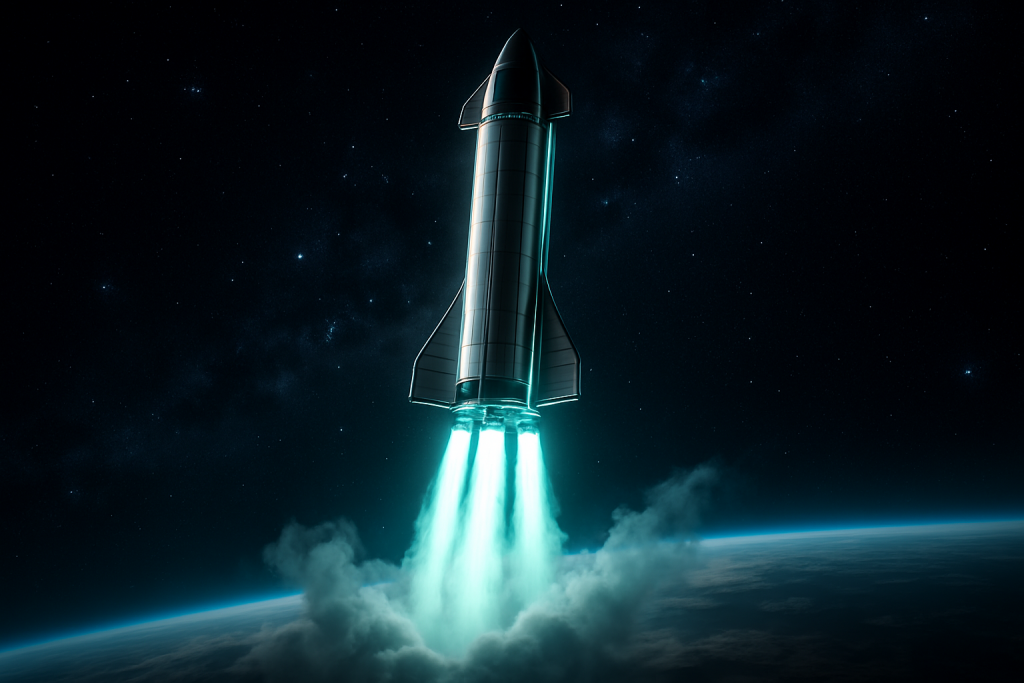
Image generated by AI
In April 2023, a 400-foot-tall steel tower lifted off from the Texas coast in a thunderous roar of flame and exhaust, carrying humanity’s most ambitious spacecraft into the sky—and then, spectacularly, into the Gulf of Mexico. This wasn’t a failure in the traditional sense. For SpaceX, the Starship’s first integrated flight test was exactly what the company needed: data, lessons, and proof of concept for a fully reusable super-heavy-lift launch vehicle that could fundamentally reshape space exploration. What made this moment remarkable wasn’t just the sheer scale of the rocket, but the audacity of the engineering philosophy behind it: build it big, test it fast, and learn from every explosion.
The SpaceX Starship represents far more than a single aerospace project. It embodies a philosophical shift in how humanity approaches spaceflight—from cautious, incremental advancement to rapid iteration and acceptable failure. In an era when nations compete for lunar and Martian dominance, when space-based industries promise to reshape Earth’s economy, and when the dream of becoming a multiplanetary species no longer sounds like science fiction, understanding Starship matters. This vehicle could determine whether we establish sustainable human presence beyond Earth, enable affordable space tourism, support orbital manufacturing, and make Mars colonization economically feasible for the first time in history.
What Is SpaceX Starship Launches?
SpaceX Starship is a next-generation, fully reusable super-heavy-lift launch vehicle designed to carry unprecedented payloads into orbit and beyond. Unlike previous rockets that fall into the ocean as expensive debris, Starship is engineered to land itself vertically on Earth and be immediately refueled for the next mission, much like an airplane. The complete Starship system consists of two primary components: the Super Heavy booster—the powerful first stage that accelerates the vehicle through the densest part of Earth’s atmosphere—and the Starship spacecraft itself, which carries crew or cargo to orbit and beyond. Together, they form the most powerful rocket ever built, capable of lifting 250 metric tons to low Earth orbit, nearly double the capacity of NASA’s Space Launch System.
The origins of Starship trace back to 2016 when SpaceX founder Elon Musk unveiled the Interplanetary Transport System concept. This vision evolved through several iterations, including the BFR (Big Falcon Rocket) phase, before crystallizing into the current Starship design around 2019. The vehicle represents the culmination of SpaceX’s previous accomplishments: the reusable Falcon 9 rocket (first successfully landed in 2015) and the Falcon Heavy, which proved that massive payloads could reach orbit economically. Starship takes these principles to their ultimate expression—not merely landing a single booster, but recovering the entire launch system for rapid reuse.
What We Know So Far
Starship operates on principles that seem almost counterintuitive compared to traditional rockets. The vehicle uses methane and liquid oxygen as propellant—a combination chosen for several critical reasons. Methane can be synthesized from carbon dioxide and water using renewable energy, which becomes essential if SpaceX hopes to produce fuel on Mars from the planet’s thin atmosphere. Liquid oxygen is efficient and clean-burning. The 33 Raptor engines in the Super Heavy booster work in concert, a technological feat requiring extraordinary precision in throttling, sequencing, and thrust management. If a single engine fails, the remaining engines can theoretically compensate, providing redundancy that earlier rocket designs lacked.
Consider how a conventional rocket resembles a single-use pencil: you sharpen it, write until the lead breaks, and discard it. Starship, by contrast, aims to function like a mechanical pencil—refill the lead (fuel), write again, repeat indefinitely. This seemingly simple conceptual difference demands revolutionary changes in engineering. Starship’s steel construction helps achieve this reusability by reducing weight compared to aluminum while maintaining adequate strength. The vehicle is designed to survive repeated heating cycles during atmospheric reentry, using a novel “transpiration cooling” system where excess propellant is pumped through the exterior tiles to dissipate heat—turning waste into thermal management.
The Future of Exploration
The practical applications of Starship extend across domains that will reshape human civilization. First and most obviously, lunar exploration becomes economically viable at scales previously impossible. NASA’s Artemis program relies on Starship for delivering cargo and eventually crew to the lunar surface; a single Starship can transport more mass to the Moon in one launch than dozens of previous missions combined. For Mars exploration, Starship promises to reduce the cost per kilogram of reaching the Red Planet by orders of magnitude—transforming Mars colonization from a distant dream requiring government programs with budgets measured in hundreds of billions into a potentially self-sustaining venture. SpaceX has explicitly stated that establishing a self-sufficient city on Mars depends on achieving Starship’s technical and economic targets.
Beyond deep space, Starship enables novel Earth-based applications. Space-based solar power—collecting energy from the sun in space and beaming it to Earth—has always been dismissed as impractical due to launch costs; Starship could change that calculus. On-orbit manufacturing and space tourism represent growing industries that demand reliable, affordable access to orbit. Point-to-point suborbital flights using Starship could eventually transport passengers between any two cities on Earth in under an hour. Military and national security applications also loom large, as the U.S. military explores rapid global logistics capabilities and space-based defense systems that only vehicles like Starship make feasible.
Recent Breakthroughs in SpaceX Starship Launches
The first integrated flight test in April 2023 represented a watershed moment despite the dramatic destruction. Both the Super Heavy booster and Starship spacecraft achieved booster separation—a critical milestone that had never been attempted before with such magnitude. The booster executed several engines shutdown sequences correctly, and Starship itself coasted to near-space, reaching an apogee of approximately 39 kilometers and demonstrating controlled flight. Though explosive disassembly occurred during reentry and the booster never completed its landing sequence, SpaceX gathered terabytes of telemetry data that engineers analyzed obsessively. By the second integrated flight test in November 2023, SpaceX had incorporated hundreds of modifications, achieving even more ambitious objectives including successful booster engine cutoff, controlled booster descent, and Starship’s first spaceward flip maneuver.
By 2024, the third integrated flight test achieved booster catch by the launch tower’s mechanical arms—a previously untested system that worked flawlessly. Starship demonstrated improved structural integrity, completing its full ascent phase and achieving controlled reentry. Researchers continue investigating thermal protection systems, propellant slosh dynamics, grid fin effectiveness, and the complex physics of methane-oxygen combustion at extreme scales. Open questions remain about the vehicle’s ultimate payload capacity under various mission profiles, the practical turnaround time between launches, and whether the transpiration cooling system can provide sufficient thermal protection for hundreds of reuse cycles.
Why SpaceX Starship Launches Matter for the Future
Starship represents a fundamental inflection point in space exploration—the moment when reaching orbit transitions from an expensive, nation-state-exclusive activity to something approaching commodity access. This mirrors historical transitions like aviation, where flying was once impossible, then rare and extraordinary, then progressively ordinary until millions of people fly daily. When launch costs drop sufficiently through Starship’s reusability, entirely new industries and scientific endeavors become possible. Climate scientists could deploy networks of space-based sensors with unprecedented density. Astronomers could construct ever-larger space telescopes. Humanity could begin harvesting resources from asteroids and the Moon. The economic implications ripple across energy, manufacturing, communications, and resource sectors.
Yet formidable challenges remain before this utopian vision materializes. The transpiration cooling system must prove itself across hundreds of reuse cycles, not just demonstrations. Turnaround time between launches must improve from current estimates of weeks to days or hours. The full catch system requires perfecting autonomous precision engineering that must work hundreds of times without failures. Regulatory frameworks for rapid reusability and point-to-point suborbital transport don’t yet exist. Environmental concerns about frequent heavy lift launches require serious investigation and mitigation. Most fundamentally, Starship must achieve high operational flight rates while maintaining safety standards—a combination that demands excellence in engineering, operations, and organizational culture.
Key Takeaways
- SpaceX Starship is a fully reusable super-heavy-lift launch vehicle capable of carrying 250 metric tons to low Earth orbit, designed to revolutionize space access through rapid iteration and recovery of both booster and spacecraft.
- The vehicle employs methane-oxygen propulsion with 33 raptor engines in the booster, using transpiration cooling and steel construction to achieve rapid reusability never before attempted at this scale.
- Most promising application: enabling economically feasible Mars colonization and sustainable lunar exploration by reducing launch costs by orders of magnitude compared to previous systems.
- Current research state: Starship has completed multiple integrated flight tests with increasing success, achieving booster catch by launch tower arms and demonstrating controlled orbital flight, though many reusability challenges remain under investigation.
- Why it matters: Starship’s success will determine whether humanity can transition spaceflight from an exclusive, expensive activity to routine access enabling new industries, scientific discovery, and multiplanetary civilization.
Explore TED Talks on SpaceX Starship launches:
TED content is used under CC BY-NC-ND 4.0. © TED Conferences, LLC.
Frequently Asked Questions
How does the Starship's fully reusable design differ from traditional expendable rockets in terms of physics and engineering?
Traditional expendable rockets discard most stages after use, whereas Starship is engineered to land both its Super Heavy booster and upper stage intact for multiple flights, dramatically reducing the mass that must be launched and the propellant required per mission. This reusability fundamentally changes the energy economics of spaceflight by amortizing the vehicle's construction cost across dozens of launches rather than a single flight.
What is the scientific significance of Starship's rapid iteration testing approach, including controlled explosions?
Rapid iteration with instrumented test flights generates real-world data on structural performance, aerodynamics, engine behavior, and failure modes far faster than ground testing alone can provide. Each controlled test—including those ending in explosions—yields critical engineering data that accelerates learning and de-risks subsequent flight attempts in a way that aligns with modern scientific experimental methodology.
Why would a fully reusable super-heavy-lift vehicle like Starship make Mars colonization economically feasible?
The cost per kilogram to orbit is inversely proportional to launch vehicle reusability and payload capacity; Starship's combination of massive lift capacity and full reusability could reduce launch costs by an order of magnitude. Lower launch costs make it economically viable to transport the large quantities of cargo, fuel, and supplies necessary to establish and sustain a self-sufficient human settlement on Mars.
How does Starship's scale and design enable in-space refueling, and why is this scientifically important?
Starship's large fuel capacity allows it to reach orbit partially filled, then rendezvous with tanker vehicles to refuel on-orbit before continuing to deeper space destinations. This capability breaks the tyranny of the rocket equation for deep-space missions, enabling Starship to achieve Mars transit velocities and lunar missions that would be impossible with a single ground launch.