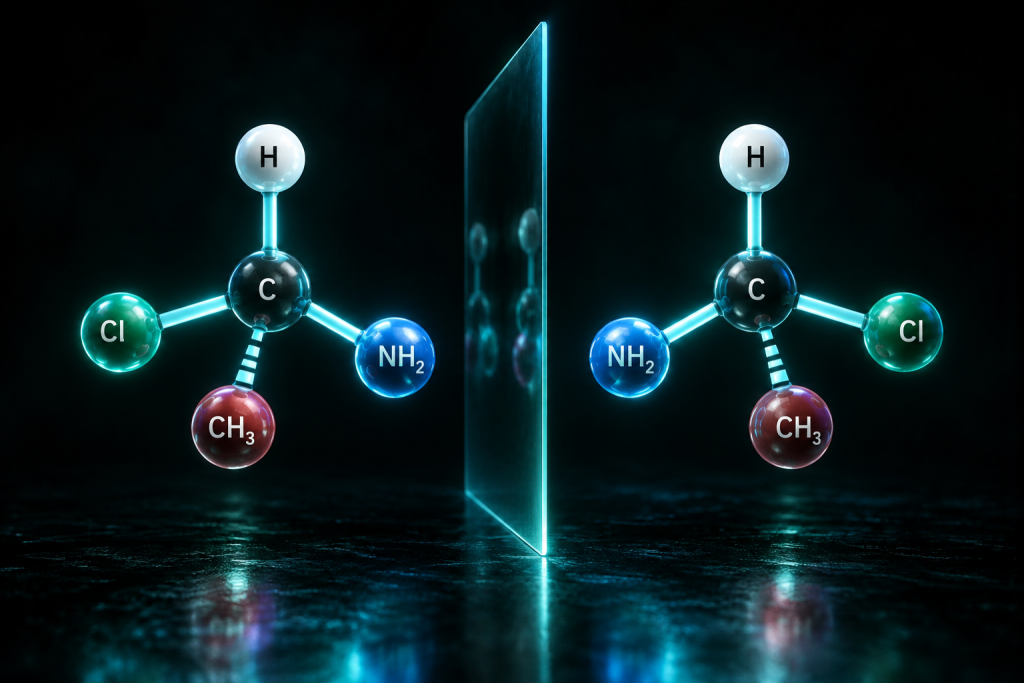
Image generated by AI
Imagine two molecules that contain exactly the same atoms in exactly the same order, yet one cures a migraine while the other causes severe birth defects. This is not science fiction—it is the profound reality of stereochemistry. The molecular geometry of a compound, down to the precise three-dimensional orientation of its atoms in space, can mean the difference between medicine and poison. Understanding why molecules with identical chemical formulas can behave so differently has become one of the most consequential challenges in modern chemistry and drug development.
Today, stereochemistry is no longer confined to academic laboratories or theoretical discussions. It shapes the pharmaceutical industry, guides the design of everything from pesticides to fragrances, and influences how we understand protein folding in disease. As chemists push toward more precise manufacturing and personalized medicine, the ability to control and predict which form of a molecule we create has become not just scientifically fascinating but economically and medically essential. Nearly 56 percent of all FDA-approved drugs are now single-enantiomer compounds—molecules where the stereochemistry has been carefully controlled—a dramatic shift from decades past when mixed forms were common.
What Is Stereochemistry and Asymmetric Molecular Structure?
Stereochemistry is the branch of chemistry that examines how atoms are arranged in three-dimensional space within a molecule and how those spatial arrangements influence chemical behavior. An asymmetric molecular structure occurs when a molecule lacks symmetry—most commonly when it contains a carbon atom bonded to four different groups, creating what chemists call a chiral center. At this point, the molecule can exist in two distinct three-dimensional configurations that are mirror images of each other, like left and right hands that cannot be superimposed no matter how you rotate them. These mirror-image forms are called enantiomers, and despite having identical molecular weights and the same atoms in the same order, they can interact with biological systems in dramatically different ways.
The discovery of stereochemistry emerged in the 19th century when chemists noticed puzzling inconsistencies in how certain compounds behaved. In 1874, Dutch chemist Jacobus van ‘t Hoff and French chemist Joseph-Achille Le Bel independently proposed that carbon atoms exist in three dimensions, not flat on a page as chemists had drawn them. This revolutionary insight explained why some compounds rotated polarized light while chemically identical compounds rotated it in the opposite direction—they were different spatial arrangements of the same atoms. The subsequent development of stereochemical theory transformed chemistry from a largely two-dimensional descriptive science into one grounded in molecular geometry and spatial relationships.
The Chemistry Behind It
The mechanism underlying stereochemistry stems from how atoms bond together in space. When a carbon atom forms four single bonds with four different atoms or groups, those bonds arrange themselves in three dimensions to minimize electron repulsion—adopting a tetrahedral geometry where the four bonds point toward the corners of an imaginary tetrahedron. This three-dimensional arrangement means the molecule cannot be rotated or flipped to look identical to its mirror image. The two possible arrangements at a chiral center create two distinct molecules that differ only in their three-dimensional orientation, not in their atomic composition. This spatial difference, seemingly minor on paper, becomes profound when these molecules encounter the equally three-dimensional environment of a living cell.
Consider your hands: they contain the same bones, muscles, and tissues in the same order, yet a left hand cannot fit into a right glove. Similarly, biological molecules like proteins and enzymes have evolved to recognize and interact with one specific enantiomer. An enzyme shaped to accommodate one form of a drug molecule may completely reject its mirror-image counterpart. The drug thalidomide illustrates this principle tragically: one enantiomer acts as an effective sedative, while the other causes severe birth defects. Even though the body can convert one form to the other, this difference in initial effect revealed how exquisitely sensitive biochemistry is to molecular architecture.
Where It Is Used Today
Stereochemistry has become indispensable across multiple industries, but nowhere more critically than in pharmaceuticals. The global market for single-enantiomer drugs exceeds $200 billion annually, reflecting the pharmaceutical industry’s commitment to producing pure stereoisomers rather than racemic mixtures—equal blends of both mirror-image forms. Drug development now routinely involves asymmetric synthesis, the process of deliberately creating one enantiomer preferentially, ensuring patients receive the therapeutically active form while minimizing unwanted side effects from its inactive mirror image. Companies like Novartis, Merck, and Roche have invested billions in developing asymmetric catalysts and synthetic strategies that produce desired enantiomers with high selectivity and efficiency.
The applications extend far beyond medicine. Agricultural companies use stereochemistry to design more effective pesticides and herbicides that target specific insect or plant enzymes. The fragrance industry employs stereochemical knowledge to synthesize compounds where one enantiomer smells like orange blossom while its mirror image smells like musty cellar—critical when formulating perfumes worth thousands of dollars per bottle. Materials scientists use stereochemistry to design polymers with specific properties, while food manufacturers employ it to understand why the L-form of tartaric acid tastes different from the D-form. Even in brewing and winemaking, stereochemistry influences fermentation pathways and the final flavor profile of the product.
Recent Breakthroughs in Stereochemistry and Asymmetric Molecular Structure
The past three years have witnessed remarkable advances in our ability to control stereochemistry. In 2022, the Nobel Prize in Chemistry was awarded to Benjamin List, David MacMillan, and Karl Barry Sharpless for their development of asymmetric catalysis—methods to synthesize complex molecules with exquisite control over stereochemistry. More recently, researchers have developed artificial intelligence systems trained to predict and optimize asymmetric reactions, dramatically accelerating drug discovery. Machine learning models can now analyze millions of possible reaction pathways and identify which catalysts and conditions will produce the desired enantiomer with the highest yield and purity. Companies like DeepMind have begun applying such approaches to molecular design, suggesting that artificial intelligence will play an increasingly central role in stereochemical optimization.
Flow chemistry has emerged as a transformative technology enabling asymmetric synthesis at unprecedented scales. By performing reactions in small-diameter tubes where reactants, catalysts, and solvents mix with exquisite precision, chemists can achieve selectivities and yields that conventional batch synthesis cannot match. Pharmaceutical manufacturers are now building continuous-flow plants that produce single-enantiomer drugs more efficiently and sustainably than traditional methods. Meanwhile, researchers are exploring enzymatic asymmetric synthesis, harnessing evolved enzymes to perform reactions with stereochemical control that synthetic chemists struggle to achieve, a biological blueprint that promises cleaner and more elegant drug manufacturing in the coming decades.
Why Stereochemistry and Asymmetric Molecular Structure Matters for the Future
As medicine becomes increasingly personalized, understanding stereochemistry will become more critical. Different people metabolize drugs differently depending on genetic variations in their enzymes, variations that often depend on how those enzymes interact with stereochemical features of drug molecules. Future pharmacotherapy may involve customizing which enantiomer a patient receives based on their genetic profile, optimizing efficacy while minimizing side effects. Beyond medicine, sustainability concerns drive renewed interest in asymmetric synthesis, since producing pure enantiomers reduces waste compared to synthesizing racemic mixtures and then separating them. Climate change demands that we manufacture chemicals more efficiently, and stereochemically selective synthesis offers a pathway to that goal.
Significant challenges remain. While asymmetric catalysis has advanced remarkably, some transformations still lack efficient stereoselective routes, forcing chemists to rely on expensive starting materials or lengthy synthetic sequences. Scaling asymmetric synthesis to meet global demand for pharmaceuticals and agrochemicals remains economically challenging, and many developing countries lack access to the sophisticated infrastructure required for stereoselective synthesis. Additionally, our understanding of how stereochemistry influences complex biological processes—particularly in protein misfolding diseases like Alzheimer’s—remains incomplete, representing a frontier where stereochemistry research may unlock disease mechanisms currently inaccessible to study.
Key Takeaways
- Stereochemistry examines how atoms are arranged in three-dimensional space within molecules, and asymmetric structures create mirror-image forms called enantiomers that can have profoundly different biological effects.
- Molecules with chiral centers cannot exist in a single flat configuration; instead, they adopt tetrahedral geometry where atoms point toward corners of an imaginary three-dimensional shape, creating two distinguishable mirror-image forms.
- Single-enantiomer pharmaceuticals now dominate the drug market, with over 56 percent of FDA-approved drugs carefully designed to deliver only the therapeutically active stereoisomer while eliminating potentially harmful mirror-image counterparts.
- Recent advances in asymmetric catalysis, artificial intelligence-guided optimization, and continuous-flow chemistry are dramatically improving our ability to synthesize desired enantiomers with high selectivity, efficiency, and scalability.
- Stereochemistry will become increasingly central to personalized medicine, sustainable manufacturing, and understanding disease mechanisms, making it one of the most consequential frontiers in 21st-century chemistry and biochemistry.
Explore TED Talks on Stereochemistry and Asymmetric Molecular Structure:
TED content is used under CC BY-NC-ND 4.0. © TED Conferences, LLC.
Frequently Asked Questions
What is an enantiomer and why do two enantiomers with identical atoms behave differently?
An enantiomer is one of two molecular forms that are mirror images of each other but cannot be superimposed—like left and right hands. They behave differently because biological systems like enzymes and receptors are themselves chiral (asymmetric), so they interact with only one enantiomer the way a left hand fits only a left-handed glove.
How does the three-dimensional orientation of atoms in a molecule affect its biological activity?
The precise 3D spatial arrangement determines how a molecule fits into and interacts with protein binding sites and receptors in the body, which are highly specific for particular stereochemical configurations. Even a single atom positioned differently in space can prevent binding or cause entirely different biological effects, such as one enantiomer curing disease while its mirror image causes harm.
Why has the pharmaceutical industry shifted toward manufacturing single-enantiomer drugs instead of mixtures?
Single-enantiomer drugs reduce unpredictable side effects and improve efficacy because only the biologically active form is present, eliminating interference or toxicity from the inactive or harmful enantiomer. This precision allows for lower doses, better patient outcomes, and more predictable drug behavior in the body.
What is an asymmetric center and how does it create stereoisomers in a molecule?
An asymmetric center is typically a carbon atom bonded to four different groups, which can be arranged in space in two distinct non-superimposable ways. Each different 3D arrangement is a separate stereoisomer with its own chemical and biological properties, even though the molecular formula and atomic connectivity remain identical.