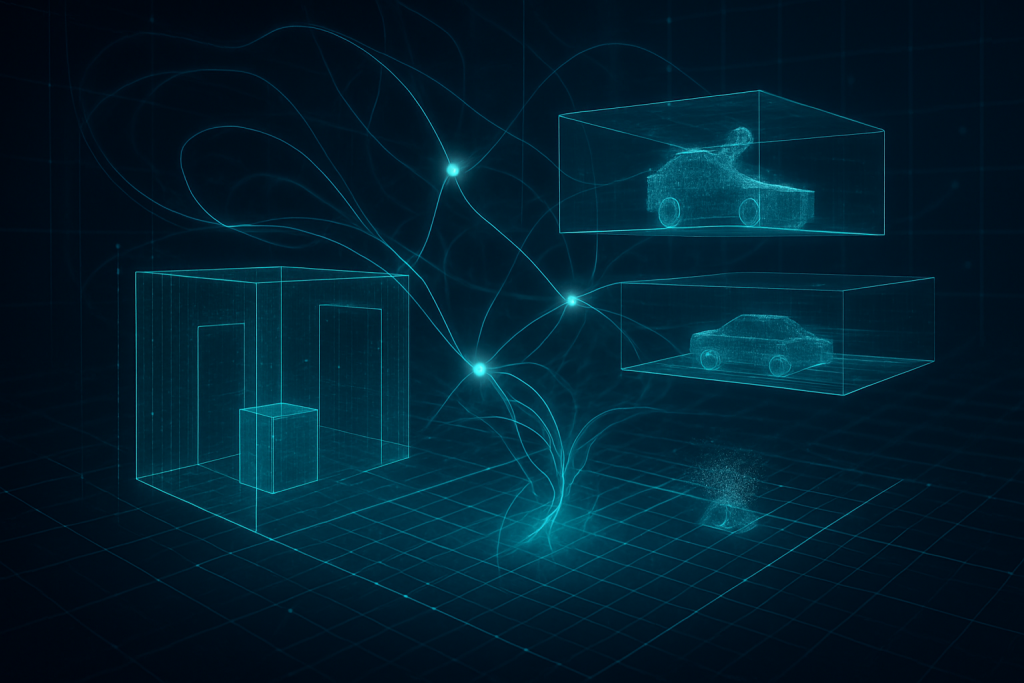
Image generated by AI
Imagine watching a robot navigate a cluttered room it has never seen before, moving fluidly around obstacles and reaching for objects with precision. Or picture an AI system that can predict what will happen next in a video by understanding the three-dimensional relationships between objects, not just recognizing patterns in pixels. These feats are powered by something that remains one of the deepest challenges in artificial intelligence: the ability to build an internal model of space and how the physical world works. This capability, known as world modeling and spatial understanding, represents a fundamental shift in how we teach machines to perceive and reason about reality.
Today, as autonomous systems become more prevalent and AI systems tackle increasingly complex tasks, world models have moved from academic curiosity to practical necessity. Companies building self-driving cars, roboticists designing embodied agents, and researchers training AI systems for scientific discovery all grapple with the same question: how can we enable machines to develop intuitive physical understanding that humans acquire almost effortlessly? The answer lies in a revolution that bridges neuroscience, physics, and deep learning—one that promises to make AI systems far more capable, efficient, and trustworthy.
What Is World Models and Spatial Understanding in AI?
A world model is an internal representation that an AI system builds to understand and predict the behavior of its environment. Rather than simply reacting to immediate sensory inputs, a system with a world model maintains a dynamic understanding of space, objects, forces, and cause-and-effect relationships. This model allows the AI to simulate what will happen if it takes a particular action, to plan ahead, and to generalize its knowledge to new situations it has never encountered. Spatial understanding—the ability to comprehend three-dimensional relationships, distances, orientations, and the physical layout of scenes—is a crucial component of any effective world model.
The concept emerged gradually over the past two decades, with roots stretching back to psychological research on how humans mentally represent their surroundings. In the AI literature, the formalization of world models gained prominence through work in predictive learning and model-based reinforcement learning, where researchers discovered that training systems to predict future video frames could yield representations useful for control and planning. Early pioneering work by researchers including Yann LeCun, Demis Hassabis, and others demonstrated that learning to predict the next frame in a video sequence forced neural networks to develop internal representations that encoded physical understanding—they had to learn that objects persist, that they follow trajectories, and that collisions have consequences.
The Basics
World models work by taking raw sensory data—images, videos, or sensor readings—and progressively abstracting it into a structured representation of space and physics. The system learns to encode the current state of the environment into a latent space, a high-dimensional mathematical representation where similar situations map to nearby points. From this state representation, the model can then make predictions about what comes next. By comparing its predictions with reality and adjusting its internal model accordingly, the system gradually refines its understanding of how the world behaves. Spatial understanding emerges naturally through this process because making accurate predictions requires reasoning about where objects are, how far apart they are, and how they move relative to one another.
Think of it like learning to play a new sport. At first, you process each moment independently—you see the ball, you see the goal, you act. But with practice, you develop an internal model: you learn to predict where the ball will be, to understand how your body moves through space, and to anticipate your opponents’ actions. You can now close your eyes and mentally simulate a play, predicting outcomes before they happen. An AI system with a world model does something analogous: it learns to mentally simulate possible futures and choose actions that lead to desired outcomes. The key difference is that machines must learn this entirely from data, without the embodied experience that humans accumulate unconsciously throughout childhood.
Why It Matters
World models address a fundamental limitation in modern deep learning systems. Current large language models and vision systems are extraordinarily good at pattern matching and interpolation—they excel at tasks similar to their training data. But they often fail at novel reasoning, planning, and understanding cause and effect. A robot trained only to recognize objects and imitate solutions might fail when faced with an unexpected configuration. By contrast, a system with a genuine world model can reason about physics, plan sequences of actions, and adapt to novel situations. This capability is essential for embodied AI—systems that interact with the physical world—and increasingly important for scientific reasoning, where understanding underlying principles matters more than pattern matching.
The applications span nearly every domain where AI meets the physical world. Autonomous vehicles depend on predicting how other cars, pedestrians, and cyclists will move—a task fundamentally about world modeling. Robotics labs use world models to enable robots to grasp novel objects, navigate complex environments, and perform manipulation tasks that require planning. In scientific research, world models help simulate climate systems, molecular dynamics, and astrophysical phenomena. Even in games and simulation, world models enable more efficient learning; an agent that can imagine future states needs fewer actual interactions with the environment to master a task.
Recent Breakthroughs in World Models and Spatial Understanding in AI
The past two to three years have witnessed remarkable advances in scaling world models to handle complex, high-dimensional data. Diffusion models—systems that learn to generate data by gradually removing noise—have proven surprisingly effective as world models, with several teams demonstrating that diffusion-based approaches can predict realistic video sequences and support planning. Simultaneously, researchers have made progress in learning world models from minimal supervision, sometimes requiring only unlabeled video or interaction data. Google DeepMind’s work on action-conditional world models, where the system learns to predict how different actions change the environment, has shown promising results in robotic manipulation and planning tasks.
Beyond raw prediction ability, recent work has focused on learning abstract world models that operate in more compressed representations rather than raw pixels, making them more computationally efficient and generalizable. Researchers are also investigating how to combine world models with language understanding, creating systems that can read descriptions of scenarios and predict their outcomes. Open questions remain about how to learn models that generalize across diverse environments, how to handle long-horizon planning where predictions become increasingly uncertain, and whether current approaches can scale to the complexity of real-world scenarios without prohibitive computational costs.
Why World Models and Spatial Understanding in AI Matters for the Future
As AI systems become more autonomous and capable, world models may become essential for safety and interpretability. A system that can model and predict consequences before acting is inherently more controllable than a black-box system that simply optimizes for immediate rewards. World models provide a natural way to represent constraints and to reason about counterfactuals—asking “what if?” about different actions and their outcomes. This capability will be crucial for developing AI systems that humans can understand, trust, and safely deploy in high-stakes environments like healthcare, transportation, and scientific discovery. Furthermore, world models may be a key ingredient in achieving artificial general intelligence, since any truly intelligent agent must understand the world it inhabits and anticipate the effects of its actions.
However, significant challenges remain. Learning accurate world models for long time horizons is extremely difficult; small errors compound rapidly, leading to wildly inaccurate predictions far into the future. Real-world environments involve complexity that far exceeds current systems’ capabilities—countless interacting factors, rare events, and open-ended physics. Additionally, a major question looms: how much of human spatial understanding is innate versus learned? If much of it is priors built into our neural architecture, copying that inductive bias into artificial systems might require rethinking how we design neural networks themselves. The path forward will likely involve combining learned models with structured priors and possibly neuroevolutionary approaches that discover better architectural biases.
Key Takeaways
- World models are internal representations that enable AI systems to understand and predict the behavior of their environment, making them essential for planning, adaptation, and reasoning about unseen scenarios.
- These systems learn by predicting future observations from current states, gradually developing intuitive physics and spatial understanding through the process of comparing predictions to reality.
- The most promising near-term applications include autonomous vehicles, robotic manipulation, scientific simulation, and planning in complex environments where generalization beyond training data is critical.
- Recent breakthroughs using diffusion models and improved learning algorithms have made world models more practical and scalable, though challenges in long-horizon prediction and real-world complexity remain.
- World models represent a potential path toward more interpretable, controllable, and genuinely intelligent AI systems that understand cause and effect rather than merely pattern-matching within training distributions.
Explore TED Talks on World Models and Spatial Understanding in AI:
TED content is used under CC BY-NC-ND 4.0. © TED Conferences, LLC.
Frequently Asked Questions
What is a world model in AI, and how does it differ from standard pattern recognition?
A world model is an internal representation that captures three-dimensional spatial relationships and physical dynamics, allowing AI systems to understand cause-and-effect in the environment rather than merely recognizing pixel patterns. Unlike traditional pattern recognition, world models enable prediction of future states and reasoning about unseen scenarios by simulating physical laws.
How do AI systems develop spatial understanding to navigate environments they have never encountered before?
AI systems develop spatial understanding through learning representations of 3D geometry, object relationships, and physical interactions from training data, which allows them to generalize to novel environments. This typically involves neural networks that learn to encode spatial information in ways similar to how biological brains process spatial awareness.
Why is spatial understanding considered essential for autonomous systems like self-driving cars?
Spatial understanding is critical because autonomous vehicles must predict the trajectories of other objects, understand occlusion and depth, and reason about complex interactions in dynamic environments—capabilities that raw pattern matching cannot reliably provide. Without accurate world models, these systems cannot safely anticipate future states needed for navigation and collision avoidance.
Can world models help AI systems predict future video frames, and what does this reveal about understanding physics?
Yes, world models can predict future video frames by learning implicit representations of physical laws and object dynamics rather than memorizing visual patterns. The ability to accurately predict future frames demonstrates that the system has internalized causal relationships and physical principles, indicating genuine understanding beyond pattern recognition.