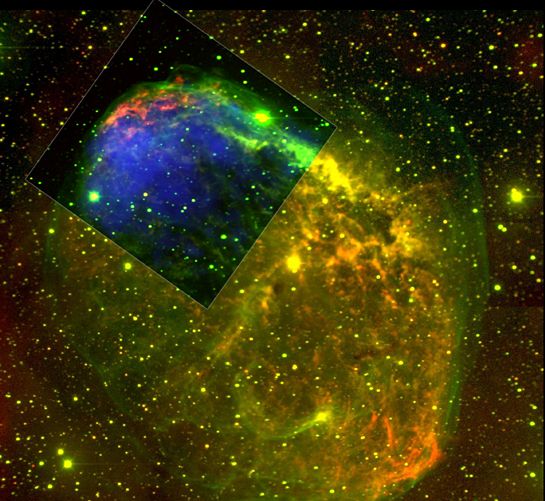
Image: NASA
Imagine light as waves that vibrate in all possible directions, then suddenly, something cosmic constrains them to oscillate in just one plane. This invisible constraint—called polarization—carries secrets about the most violent and exotic objects in the universe, from black holes spinning at near light speed to neutron stars so dense that a teaspoon of their material would weigh as much as Mount Everest. X-ray polarimetry, the technique of measuring the polarization of high-energy light from space, has remained one of astronomy’s most elusive tools for decades, but recent breakthroughs are finally allowing scientists to open this hidden window on the cosmos. The discoveries emerging from this new window are already reshaping our understanding of how the universe’s most extreme objects behave.
For nearly fifty years, X-ray polarimetry was more promise than practice—theoretically powerful but technically impractical. The first dedicated X-ray polarimetry satellite, NASA’s Imaging X-Ray Polarimetry Explorer (IXPE), launched in December 2021, marking a watershed moment in observational astronomy. Today, this powerful new tool is generating the first high-quality measurements of polarized X-rays from cosmic sources, allowing astronomers to test theories about physics under conditions so extreme that they cannot be replicated on Earth. The implications ripple across multiple disciplines: from fundamental physics and the nature of gravity to practical questions about how matter behaves when squeezed beyond ordinary limits.
What Is X-Ray Polarimetry and High-Energy Astrophysics?
X-ray polarimetry is the measurement of the polarization state of electromagnetic radiation at X-ray wavelengths—light so energetic that it lies between visible light and gamma rays on the electromagnetic spectrum. Unlike visible light, which astronomers have been measuring polarization in for centuries, X-rays from space are absorbed by Earth’s atmosphere, requiring specialized satellites to detect them. More importantly, X-rays come primarily from the most violent phenomena in the universe: matter falling into black holes, collapsing stellar cores, and energetic outbursts from neutron stars. By measuring not just how many X-rays arrive at a detector, but also the orientation of their electric field oscillations, astronomers gain access to information about the magnetic fields, structure, and physical conditions in these extreme environments that conventional X-ray telescopes simply cannot provide.
The concept of polarization dates back to the 1600s, when scientists discovered that light waves vibrate perpendicular to their direction of travel. In 1678, Christiaan Huygens observed that light passing through Iceland spar crystal split into two beams—the first hint that light waves have a preferred orientation. By the nineteenth century, scientists like Étienne-Louis Malus had formalized polarization as a fundamental property of light waves. However, X-ray polarimetry remained theoretical until the 1970s, when physicists began proposing methods to measure polarized X-rays. The first dedicated satellite attempting these measurements, the Orbiting Solar Observatory-8, achieved limited success in the 1970s, measuring polarization from the Crab Nebula. For decades afterward, progress stalled as the technical challenges proved formidable, requiring revolutionary detector designs that could capture individual X-ray photons while preserving information about their polarization state.
What We Know So Far
X-ray polarimetry works through a deceptively simple principle: when X-ray photons interact with matter, they transfer energy in ways that depend on the photon’s polarization orientation. The breakthrough technology enabling modern X-ray polarimetry involves gas pixel detectors—chambers filled with low-pressure gas where incoming X-rays ionize atoms, creating clouds of electrons that drift toward electrodes. By analyzing the shape and direction of these electron clouds under a strong magnetic field, physicists can infer the direction of the original X-ray’s electric field vector—its polarization. This technique represents a fundamentally different approach from traditional X-ray astronomy, which simply counts photons to measure brightness and energy, much like counting water drops from a fire hose without understanding their arrangement.
Consider a familiar analogy: imagine you’re watching ocean waves crash on a beach, but the waves are chaotic and coming from many directions. A regular wave detector tells you how many waves arrived and how much energy they carried. But a polarization detector tells you something more profound—it reveals whether the waves all crash in the same direction or from multiple angles, providing clues about the underwater geography that shaped them. In the same way, measuring X-ray polarization from a black hole accretion disk reveals the organized magnetic field geometry that channels material toward the event horizon, while unpolarized or weakly polarized X-rays might indicate chaotic, turbulent conditions. The physical insights from this additional layer of information can be transformative: a measurement that appears identical to a traditional X-ray telescope might reveal its secrets only when examined through the lens of polarimetry.
The Future of Exploration
Currently, IXPE is conducting observations of the most compelling targets in high-energy astrophysics: active galactic nuclei powered by supermassive black holes, pulsars surrounded by intense magnetic fields, and the expanding debris from supernova explosions. The mission has already yielded surprising results that challenge existing theoretical models, suggesting that accretion disks around black holes may be more magnetized than previously assumed, and that neutron star emission regions are more structured and organized than chaos theory might predict. Beyond IXPE, the next generation of missions is already in planning stages, including the Polarization Spectroscopic Telescope Array (PolSTAR) and contributions from Chinese and European space agencies. These future missions promise even higher sensitivity and broader wavelength coverage, eventually allowing astronomers to create polarimetry images rather than simple point measurements—essentially taking the first “photos” of cosmic objects using polarized light as a new kind of film.
The applications of X-ray polarimetry extend across multiple research frontiers. Astrophysicists use it to map magnetic field geometries in accretion disks around black holes, potentially revealing how these fields extract rotational energy from spinning black holes through the Blandford-Znajek mechanism. Neutron star researchers employ polarimetry to understand the organization of matter in the strongest magnetic fields known to exist, which exceeds Earth’s magnetic field by a factor of a trillion trillion. High-energy physicists test fundamental theories about quantum electrodynamics in extreme field regimes, examining whether vacuum itself behaves in unexpected ways under these conditions. Additionally, polarimetry serves as a tool to understand cosmic dust properties and the large-scale magnetic structure of our galaxy, complementing observations at other wavelengths to build a complete picture of the universe’s composition and organization.
Recent Breakthroughs in X-Ray Polarimetry and High-Energy Astrophysics
In 2022, just months into IXPE’s science operations, the mission delivered its first major surprise: observations of the Crab Nebula and its central pulsar revealed that X-ray polarization patterns differed significantly from theoretical predictions. The data suggested that the magnetic field configuration near the pulsar’s magnetosphere is more complex than simple dipole models suggest, perhaps requiring asymmetric or time-variable components. Simultaneously, observations of the active galactic nucleus Centaurus A produced polarization measurements that challenged assumptions about accretion disk structure, suggesting that magnetic fields play a larger role in launching jets than conventional models anticipated. In 2023, IXPE’s observation of the black hole binary GRS 1915+105 provided the first direct polarimetric measurements of X-rays from a stellar-mass black hole’s accretion flow, confirming that organized magnetic field structures extend closer to the event horizon than theorists expected. These early results validate the fundamental premise of X-ray polarimetry: that polarization measurements unlock new dimensions of understanding about physics in extreme environments.
Current research frontiers include mapping how magnetic fields vary across different regions of accretion disks, understanding the relationship between polarization and supernova remnant evolution, and exploring whether time-variable polarization patterns from neutron stars might reveal oscillations in their magnetic field structures. Theoretical efforts are increasingly focused on connecting polarimetry observations to simulations of magnetohydrodynamics—the physics governing how magnetic fields interact with flowing plasma—to understand which models best capture reality. Open questions include whether polarimetry can help resolve debates about the nature of supermassive black holes at the centers of galaxies, whether magnetic reconnection events in solar flares and stellar atmospheres create distinctive polarization signatures, and how polarimetry might eventually contribute to testing quantum gravity theories through observations of accretion onto black holes and neutron stars.
Why X-Ray Polarimetry and High-Energy Astrophysics Matters for the Future
X-ray polarimetry represents a fundamental expansion of humanity’s sensory apparatus for observing the cosmos, equivalent to giving a blind person vision, or allowing someone who perceives only brightness to suddenly see colors and depth. By revealing magnetic field structures and geometries that were previously invisible, polarimetry enables tests of some of the most exotic predictions of general relativity and quantum field theory. The ability to map accretion flows around black holes with unprecedented detail could eventually help solve the black hole information paradox—a fundamental question about whether information that falls into black holes is truly destroyed or somehow preserved. Moreover, understanding how magnetic fields channel energy in supermassive black hole systems has implications for understanding how these monsters shape the evolution of galaxies themselves, since the jets and outflows powered by black hole accretion significantly impact star formation across galactic volumes.
Nevertheless, significant challenges remain. IXPE’s sensitivity, while revolutionary, still limits observations to the brightest cosmic X-ray sources, excluding many interesting objects that require deeper observations. The detector technology, though innovative, has not yet reached the maturity of visible-light telescopes developed over centuries, with ongoing work needed to improve efficiency and minimize systematic uncertainties. Coordinating X-ray polarimetry observations with simultaneous measurements across the electromagnetic spectrum—radio through gamma rays—requires sophisticated planning and international collaboration. Perhaps most fundamentally, translating raw polarimetry data into physically meaningful insights requires increasingly sophisticated computational models of accretion physics, magnetohydrodynamics, and radiation transport, pushing computational astrophysics to new frontiers.
Key Takeaways
- X-ray polarimetry measures the orientation of oscillations in high-energy light from space, revealing information about magnetic fields and structures invisible to conventional telescopes.
- The technique works by detecting how X-ray photons ionize gas atoms in specialized detectors, with the resulting electron clouds revealing the original photon’s polarization through their shape and drift direction under magnetic fields.
- NASA’s IXPE mission, launched in 2021, is the first dedicated X-ray polarimetry satellite and has already produced surprising observations of black holes, neutron stars, and supernova remnants that challenge existing theoretical models.
- Current research focuses on mapping magnetic field geometries in accretion disks, understanding neutron star magnetospheres, and testing fundamental physics predictions in extreme environments inaccessible to Earth-bound experiments.
- X-ray polarimetry promises to revolutionize understanding of the universe’s most violent and exotic objects while advancing fundamental physics and our comprehension of how magnetic fields shape cosmic evolution.
Explore TED Talks on X-Ray Polarimetry and High-Energy Astrophysics:
TED content is used under CC BY-NC-ND 4.0. © TED Conferences, LLC.
Frequently Asked Questions
What does it mean when X-rays from space become polarized, and why is this significant?
Polarized X-rays oscillate in a single plane rather than all directions, which occurs when high-energy light interacts with extreme magnetic fields or matter around objects like black holes and neutron stars. This polarization pattern reveals crucial information about the physical conditions, magnetic field strengths, and material properties near these exotic cosmic objects that cannot be obtained from X-ray intensity measurements alone.
How does X-ray polarimetry help scientists test extreme physics that cannot be replicated in Earth laboratories?
X-ray polarimetry measures the behavior of matter and energy under conditions of extreme gravity, density, and magnetic fields found near black holes and neutron stars—environments far beyond laboratory capability. By analyzing how polarized X-rays are produced and modified by these extreme conditions, astronomers can test predictions from general relativity and quantum mechanics in their most rigorous regime.
Why was X-ray polarimetry impractical for nearly fifty years before IXPE launched?
X-ray polarimetry requires extremely sensitive detectors capable of measuring the subtle directional properties of individual high-energy photons, a technical challenge that exceeded available instrumental capabilities for decades. The engineering breakthroughs needed to build space-based detectors sensitive enough to gather statistically significant polarization data from faint cosmic X-ray sources were only recently achieved with IXPE's launch in 2021.
Can X-ray polarimetry measurements distinguish between different physical mechanisms operating around black holes and neutron stars?
Yes, different physical processes—such as synchrotron radiation, inverse Compton scattering, or cyclotron radiation—produce X-rays with characteristic polarization signatures that can be measured and compared to theoretical predictions. By analyzing the degree and angle of polarization from these objects, astronomers can identify which physical mechanisms dominate in specific cosmic regions and test models of accretion and magnetic field behavior.