AI Insight
Record wind and solar generation in the UK during 2026 has reduced the need for gas imports by £5.9 billion since the Hormuz crisis began in February, according to Carbon Brief analysis. Wind and solar power generated 41% of UK electricity needs in 2026 to date, up 14% year-on-year, while gas-fired electricity dropped nearly 10%. This shift has protected consumers as wholesale gas prices reached 189 pence per therm in September 2026, the highest since the 2022 energy crisis.
Why it matters
The analysis demonstrates how renewable energy expansion can provide economic protection against volatile fossil fuel markets and geopolitical disruptions. Household electricity bills increased only 4% compared to a 33% rise in gas bills, showing the decoupling of electricity prices from gas costs as clean energy sources grow.
Understand the Science
The UK has avoided the need for gas imports worth £5.9bn since the start of the Hormuz crisis as a result of record generation from wind and solar, reveals Carbon Brief analysis.
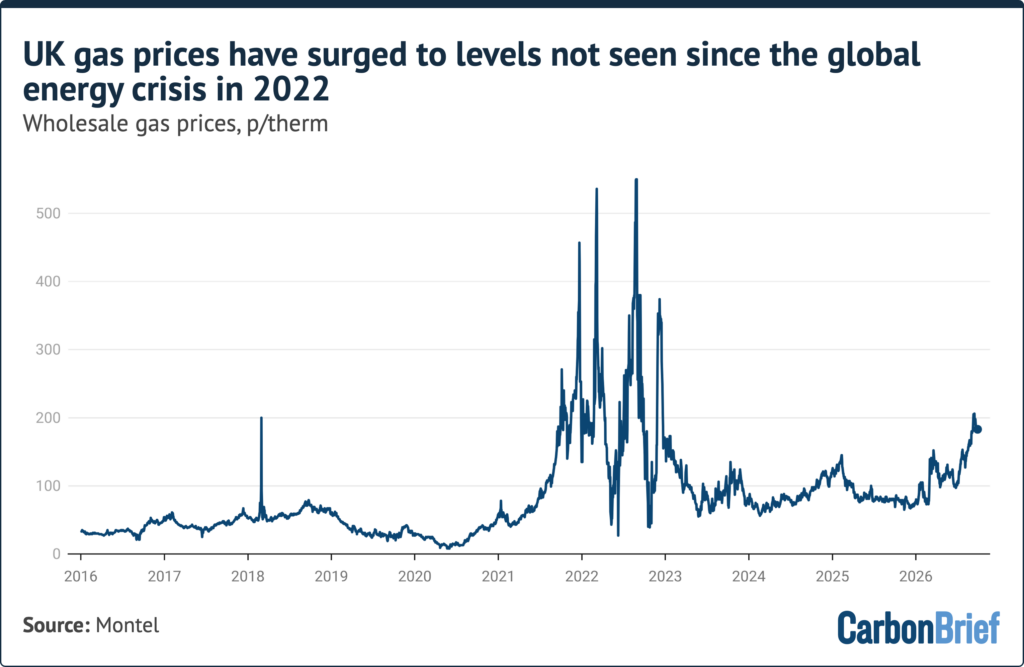
While gas prices are surging to levels not seen since the 2022 energy crisis, the UK has been generating record amounts of power from wind and solar, up 14% year-on-year.
This unprecedented clean-power generation is directly cutting the need for gas-fired electricity, which is down by nearly 10% year-on-year in 2026 to date.
In total, wind and solar have generated a record 41% share of the UK’s electricity needs in 2026 to date, compared with 25% from gas, according to Carbon Brief’s analysis.
The figure below shows that wind and solar has avoided the need for UK gas imports worth £5.9bn, since the outbreak of war between the US and Iran in February 2026.
These avoided gas imports would have required the UK to secure the equivalent of more than 100 additional tanker deliveries of liquefied natural gas (LNG).
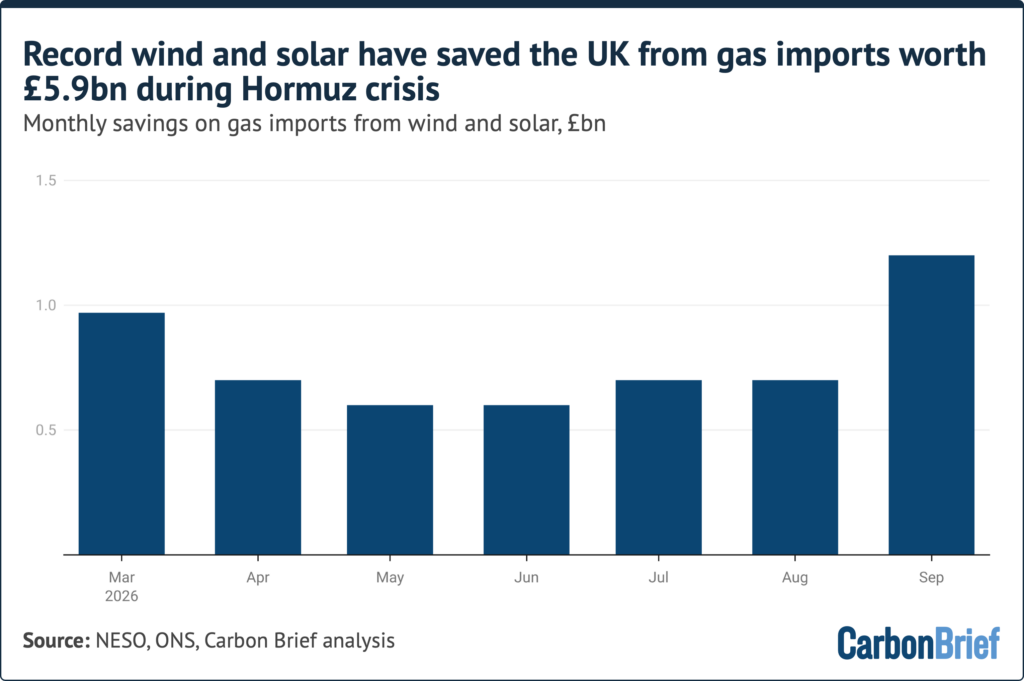
The £1.3bn import saving in September 2026 to date is the result of record wind and solar output, at nearly 10 terawatt hours (TWh), combined with surging gas prices.
The latest analysis updates figures published by Carbon Brief in April and May.
Wholesale gas prices in the UK have remained elevated ever since Russia cut off supplies to Europe in the wake of its invasion of Ukraine in 2022.
Gas averaged 90p per therm from 2023 until the start of this year, roughly three times above 2019 prices, before the Covid and Ukraine crises.
Since the outbreak of war in the Middle East in March, gas prices have climbed higher still, averaging 134p per therm or nearly four times the level seen in 2019.
In September 2026 to date, gas prices have averaged 189p per therm, reaching their highest level since the global energy crisis in 2022, as shown in the figure below.
UK gas prices are spiking again because winter is approaching – meaning higher demand for heating – and there is no end in sight for the Hormuz crisis.
At the same time, European gas stocks are low. This means Europe will have to compete with Asia to secure the cargoes of LNG needed to keep warm.
In the UK, high wholesale gas prices are hitting household gas bills under the price cap set by energy regulator Ofgem, whereas electricity bills have barely increased.
From this Thursday, 1 October, typical household gas bills will be 33% higher than they were in April, some £200 per year, according to thinktank Nesta.
In contrast, household electricity bills will only have risen 4%, according to Nesta’s analysis, as a result of growing generation from clean-energy sources.
Andrew Sissons, director for sustainable future at Nesta, explained in a social media post that “the link between electricity and gas prices has already begun to break”.
The UK and other fossil-fuel importing nations are being hit not only by high gas prices, but also by high prices for oil, diesel and other refined fuels.
The EU has reportedly had to pay an extra €100bn for fossil-fuel imports since the start of the crisis. Higher import bills have fallen particularly hard on low and middle-income countries, according to separate analysis.
In the UK, diesel prices have hit record levels of around £2 per litre. In contrast, recent Carbon Brief analysis shows that electric cars are up to nine times cheaper to drive.
In her speech to the Labour party conference, energy secretary Miatta Fahnbulleh said that energy bills were high because the UK is “exposed to global fossil-fuel markets”.
In his own conference speech, prime minister Andy Burnham said the expansion of clean energy was easing the impact of high gas prices on electricity bills. He said:
“We are already taking more control of our electricity prices with a massive expansion of home-grown renewables and nuclear. I have asked Miatta to speed up the breaking of the link between what we pay for power at home and the international gas market, to get bills down.”
var gform;gform||(document.addEventListener(“gform_main_scripts_loaded”,function(){gform.scriptsLoaded=!0}),document.addEventListener(“gform/theme/scripts_loaded”,function(){gform.themeScriptsLoaded=!0}),window.addEventListener(“DOMContentLoaded”,function(){gform.domLoaded=!0}),gform={domLoaded:!1,scriptsLoaded:!1,themeScriptsLoaded:!1,isFormEditor:()=>”function”==typeof InitializeEditor,callIfLoaded:function(o){return!(!gform.domLoaded||!gform.scriptsLoaded||!gform.themeScriptsLoaded&&!gform.isFormEditor()||(gform.isFormEditor()&&console.warn(“The use of gform.initializeOnLoaded() is deprecated in the form editor context and will be removed in Gravity Forms 3.1.”),o(),0))},initializeOnLoaded:function(o){gform.callIfLoaded(o)||(document.addEventListener(“gform_main_scripts_loaded”,()=>{gform.scriptsLoaded=!0,gform.callIfLoaded(o)}),document.addEventListener(“gform/theme/scripts_loaded”,()=>{gform.themeScriptsLoaded=!0,gform.callIfLoaded(o)}),window.addEventListener(“DOMContentLoaded”,()=>{gform.domLoaded=!0,gform.callIfLoaded(o)}))},hooks:{action:{},filter:{}},addAction:function(o,r,e,t){gform.addHook(“action”,o,r,e,t)},addFilter:function(o,r,e,t){gform.addHook(“filter”,o,r,e,t)},doAction:function(o){gform.doHook(“action”,o,arguments)},applyFilters:function(o){return gform.doHook(“filter”,o,arguments)},removeAction:function(o,r){gform.removeHook(“action”,o,r)},removeFilter:function(o,r,e){gform.removeHook(“filter”,o,r,e)},addHook:function(o,r,e,t,n){null==gform.hooks[o][r]&&(gform.hooks[o][r]=[]);var d=gform.hooks[o][r];null==n&&(n=r+”_”+d.length),gform.hooks[o][r].push({tag:n,callable:e,priority:t=null==t?10:t})},doHook:function(r,o,e){var t;if(e=Array.prototype.slice.call(e,1),null!=gform.hooks[r][o]&&((o=gform.hooks[r][o]).sort(function(o,r){return o.priority-r.priority}),o.forEach(function(o){“function”!=typeof(t=o.callable)&&(t=window[t]),”action”==r?t.apply(null,e):e[0]=t.apply(null,e)})),”filter”==r)return e[0]},removeHook:function(o,r,t,n){var e;null!=gform.hooks[o][r]&&(e=(e=gform.hooks[o][r]).filter(function(o,r,e){return!!(null!=n&&n!=o.tag||null!=t&&t!=o.priority)}),gform.hooks[o][r]=e)}});
Free weekly newsletter
.preheader p{
margin-top: 0;
font-family: ‘PT Sans’, sans-serif;
font-weight: var(–type–3–font-weight–bold);
color: var(–button–color);
font-size: var(–button–font-size, inherit);
}

.newsletter-inline{
display: flex;
border: solid 1px #333333;
padding: 1em;
background: #ffffff;
}
.inline-email{
display:inline-block;
margin-right:1em;
margin-top:0 !important;
margin-bottom:0.5em;
}
#field_submit{
display:inline-block;
margin-top:0 !important;
}
.gform_wrapper .gfield+.gfield{
margin-top:0
}
gform.initializeOnLoaded( function() {gformInitSpinner( 7, ‘https://www.carbonbrief.org/wp-content/plugins/gravityforms/images/spinner.svg’, false );jQuery(‘#gform_ajax_frame_7’).on(‘load’,function(){var contents = jQuery(this).contents().find(‘*’).html();var is_postback = contents.indexOf(‘GF_AJAX_POSTBACK’) >= 0;if(!is_postback){return;}var form_content = jQuery(this).contents().find(‘#gform_wrapper_7’);var is_confirmation = jQuery(this).contents().find(‘#gform_confirmation_wrapper_7’).length > 0;var is_redirect = contents.indexOf(‘gformRedirect(){‘) >= 0;var is_form = form_content.length > 0 && ! is_redirect && ! is_confirmation;var mt = parseInt(jQuery(‘html’).css(‘margin-top’), 10) + parseInt(jQuery(‘body’).css(‘margin-top’), 10) + 100;if(is_form){jQuery(‘#gform_wrapper_7’).html(form_content.html());if(form_content.hasClass(‘gform_validation_error’)){jQuery(‘#gform_wrapper_7’).addClass(‘gform_validation_error’);} else {jQuery(‘#gform_wrapper_7’).removeClass(‘gform_validation_error’);}setTimeout( function() { /* delay the scroll by 50 milliseconds to fix a bug in chrome */ jQuery(document).scrollTop(jQuery(‘#gform_wrapper_7’).offset().top – mt); }, 50 );if(window[‘gformInitDatepicker’]) {gformInitDatepicker();}if(window[‘gformInitPriceFields’]) {gformInitPriceFields();}var current_page = jQuery(‘#gform_source_page_number_7’).val();gformInitSpinner( 7, ‘https://www.carbonbrief.org/wp-content/plugins/gravityforms/images/spinner.svg’, false );jQuery(document).trigger(‘gform_page_loaded’, [7, current_page]);window[‘gf_submitting_7’] = false;}else if(!is_redirect){var confirmation_content = jQuery(this).contents().find(‘.GF_AJAX_POSTBACK’).html();if(!confirmation_content){confirmation_content = contents;}jQuery(‘#gform_wrapper_7’).replaceWith(confirmation_content);jQuery(document).scrollTop(jQuery(‘#gf_7’).offset().top – mt);jQuery(document).trigger(‘gform_confirmation_loaded’, [7]);window[‘gf_submitting_7’] = false;wp.a11y.speak(jQuery(‘#gform_confirmation_message_7’).text());}else{jQuery(‘#gform_7’).append(contents);if(window[‘gformRedirect’]) {gformRedirect();}}jQuery(document).trigger(“gform_pre_post_render”, [{ formId: “7”, currentPage: “current_page”, abort: function() { this.preventDefault(); } }]); if (event && event.defaultPrevented) { return; } const gformWrapperDiv = document.getElementById( “gform_wrapper_7” ); if ( gformWrapperDiv ) { const visibilitySpan = document.createElement( “span” ); visibilitySpan.id = “gform_visibility_test_7”; gformWrapperDiv.insertAdjacentElement( “afterend”, visibilitySpan ); } const visibilityTestDiv = document.getElementById( “gform_visibility_test_7” ); let postRenderFired = false; function triggerPostRender() { if ( postRenderFired ) { return; } postRenderFired = true; gform.core.triggerPostRenderEvents( 7, current_page ); if ( visibilityTestDiv ) { visibilityTestDiv.parentNode.removeChild( visibilityTestDiv ); } } function debounce( func, wait, immediate ) { var timeout; return function() { var context = this, args = arguments; var later = function() { timeout = null; if ( !immediate ) func.apply( context, args ); }; var callNow = immediate && !timeout; clearTimeout( timeout ); timeout = setTimeout( later, wait ); if ( callNow ) func.apply( context, args ); }; } const debouncedTriggerPostRender = debounce( function() { triggerPostRender(); }, 200 ); if ( visibilityTestDiv && visibilityTestDiv.offsetParent === null ) { const observer = new MutationObserver( ( mutations ) => { mutations.forEach( ( mutation ) => { if ( mutation.type === ‘attributes’ && visibilityTestDiv.offsetParent !== null ) { debouncedTriggerPostRender(); observer.disconnect(); } }); }); observer.observe( document.body, { attributes: true, childList: false, subtree: true, attributeFilter: [ ‘style’, ‘class’ ], }); } else { triggerPostRender(); } } );} );
The post Analysis: Wind and solar save UK from gas imports worth £5.9bn during Hormuz crisis appeared first on Carbon Brief.
Source: Analysis: Wind and solar save UK from gas imports worth £5.9bn during Hormuz crisis