AI Insight
Heavy monsoon rainfall in Nepal from September 24-28, 2026 triggered 285 landslides across the country, with concentration in central regions. The events resulted in 15 fatalities, three missing persons, and three injuries, with additional impacts in neighboring Sikkim, India, where 107 people were displaced after landslides destroyed residential structures. Documented landslide types include rotational failures on terraces and slope failures caused by river undercutting.
Why it matters
This event demonstrates the ongoing hazard posed by late monsoon rainfall in the Himalayan region and the vulnerability of communities to rainfall-triggered landslides. Nepal's Bipad portal tracking system provides valuable real-time hazard monitoring that can inform emergency response and future risk mitigation strategies.
Understand the Science
Heavy rainfall in Nepal since Thursday has triggered 285 landslides, leading to 15 fatalities with a further three people missing and three people injured.
Over the weekend, Nepal (and Sikkim in India) suffered a late monsoon rainfall event that has led to multiple landslides, some of which have to fatalities. The Kathmandu Post has a good article describing these events, whilst the Himalayan Times describes the ongoing rescue operations.
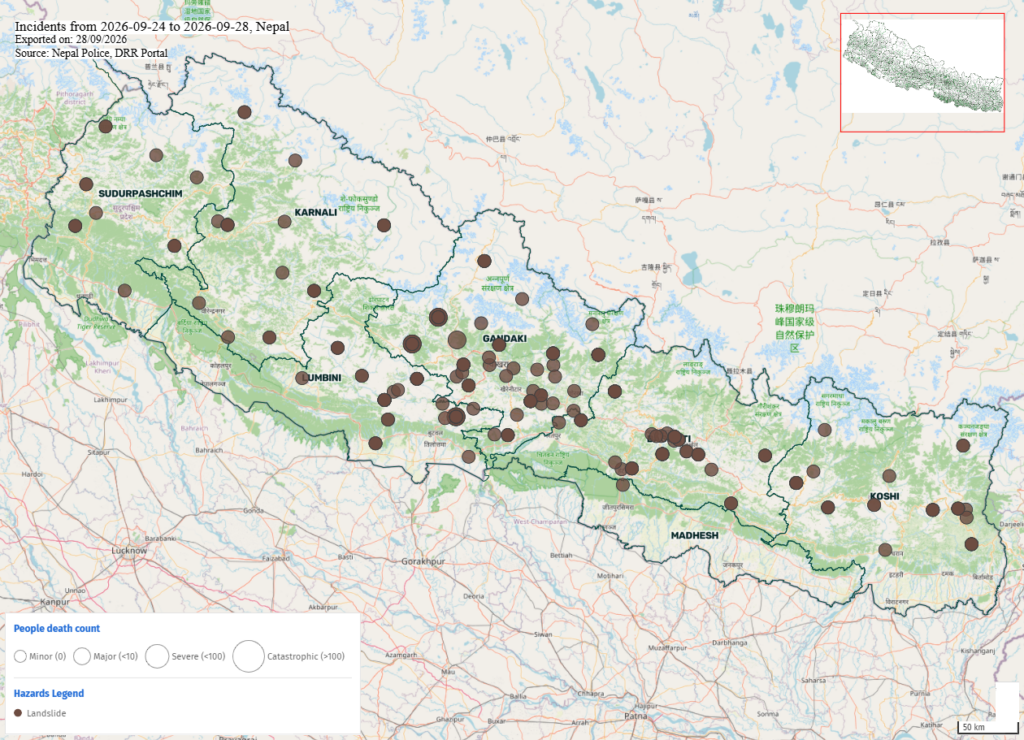
Nepal records all hazard events on its Bipad portal. This is the map of landslides since Thursday 24 September:-
Whilst all of the country has been affected, there is a distinct concentration in the central part of the country. Bipad has recorded 285 distinct landslides, leading to 15 fatalities with a further three people missing and three people injured. A total of ten fatal landslides have been recorded so far.
This appears to be a rotational landslide on the edge of a terrace. There is also extensive footage of slope failures occurring as a result of basal undercutting by a river in Galkot:-
Meanwhile, Sikkim has also experienced heavy rainfall and resultant landslides. The most serious event has occurred at Rimbi in West Sikkim, where 32 houses and four government accommodation blocks have been rendered uninhabitable. So far, 107 people have been displaced.
Text © 2026. The authors. CC BY-NC-ND 3.0
Except where otherwise noted, images are subject to copyright. Any reuse without express permission from the copyright owner is prohibited.