AI Insight
Researchers used seismic imaging to study the crustal structure beneath the Andreanof segment of the Aleutian Arc in Alaska, a region where new continental crust may be forming. The study found that current arc crust remains chemically distinct from typical continental crust, though localized zones of slower seismic velocity beneath certain volcanoes suggest pockets of hotter or more silica-rich material in the lower crust. These findings provide direct observational evidence that the transformation from volcanic arc to continental crust is a complex, multi-stage process that remains incomplete in this active system.
Why it matters
Understanding how continental crust forms is fundamental to explaining Earth's geological evolution and why our planet has stable landmasses. This research provides rare real-time observations of crustal formation processes that have shaped the continents over billions of years, helping scientists develop better models of plate tectonics and crustal evolution.
Editors’ Highlights are summaries of recent papers by AGU’s journal editors.
Source: Journal of Geophysical Research: Solid Earth
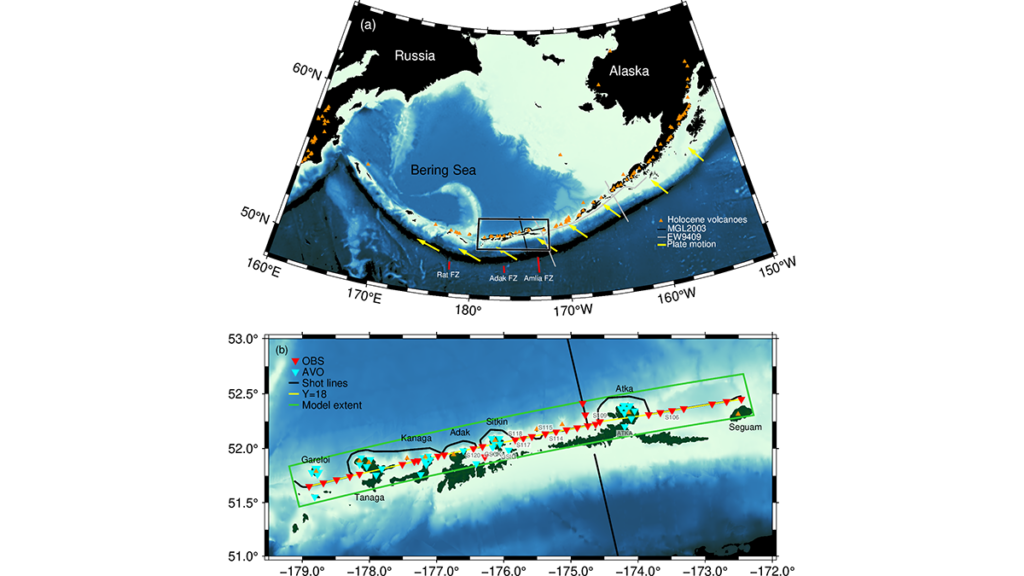
The formation of continental crust is a major unresolved question in Earth science. Volcanic arcs, such as the Aleutian Islands of Alaska, are thought to be an important source of new continental crust, but modern arc crust is usually more iron- and magnesium-rich than average continental crust. There are few places on Earth where scientists can directly observe the possible transition from mafic arc crust to more silica-rich, continent-like crust while an arc is still active. The Andreanof segment of the Aleutian Arc offers a rare opportunity to study this process because it is an active, relatively intact oceanic arc, without major disruption from back-arc spreading, and it contains several volcanic centers that may record different stages or styles of crustal evolution.
Mark et al. [2026] use seismic waves to image the crust beneath this arc segment. Their results show that this arc crust is still distinct from average continental crust, suggesting that additional chemical or physical changes are needed before arc crust becomes more continent-like. At the same time, localized zones of slower seismic velocity beneath the Atka and Tanaga volcanoes may indicate hotter and/or more silica-rich material in the lower crust. These findings provide an important in-place snapshot of early continental crust formation, while highlighting that the transformation from volcanic arc to continent is complex and still incomplete.
Citation: Mark, H. F., Lizarralde, D., Shillington, D. J., Cortés-Rivas, V., & Behn, M. D. (2026). Along-strike seismic structure of the Andreanof Aleutian Arc segment and implications for the formation of continental crust. Journal of Geophysical Research: Solid Earth, 131, e2025JB033339. https://doi.org/10.1029/2025JB033339
—Lindsay L. Worthington, Associate Editor, JGR: Solid Earth