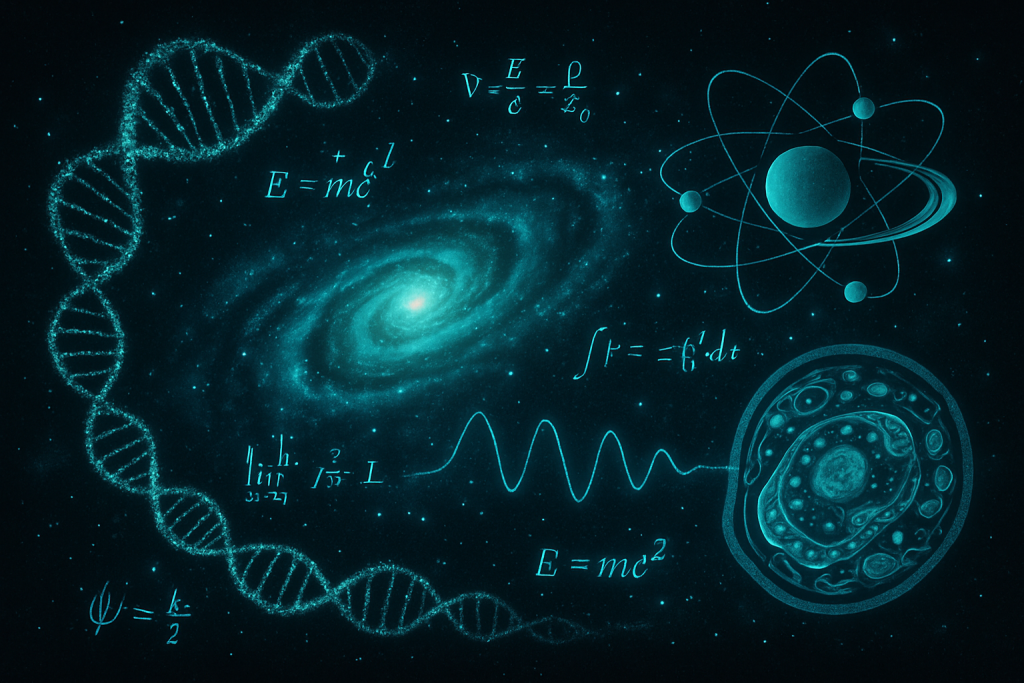
Image generated by AI
When we peer through a telescope at a distant galaxy, we’re not just observing light that traveled for millions of years—we’re witnessing a convergence of nearly every scientific discipline. A single astronomical observation can reveal insights about nuclear physics, chemistry, biology, and even geology, all happening simultaneously across the cosmos. This surprising reality reveals that astronomy isn’t simply the study of distant objects, but rather a master discipline that integrates knowledge from virtually every other field of science to answer humanity’s most fundamental questions.
Today, space exploration and astronomical research drive innovation in technologies that touch our daily lives, from the GPS in our phones to the medical imaging equipment in our hospitals. As we face existential challenges like climate change and resource scarcity, our understanding of planetary atmospheres, stellar evolution, and cosmic physics becomes increasingly urgent. The next generation of space-based observatories and lunar research stations promise discoveries that will reshape our understanding of chemistry, particle physics, and even the origins of life itself.
What Is Space and Astronomy?
Space and astronomy represent humanity’s systematic investigation of the universe beyond Earth’s atmosphere, encompassing everything from nearby asteroids to the most distant galaxies visible to our most powerful instruments. Astronomy is fundamentally the observational science of celestial objects—stars, planets, black holes, and nebulae—while the broader field of space science includes the technologies, methods, and theoretical frameworks we use to understand cosmic phenomena. These disciplines ask the biggest questions: How did the universe begin? Are we alone? What is the ultimate fate of all matter and energy? Yet answering these vast questions requires drawing upon physics, chemistry, mathematics, biology, geology, and engineering in carefully orchestrated ways.
The roots of modern astronomy extend back centuries, but the discipline transformed dramatically in the early 20th century when Albert Einstein’s theories of relativity revealed that space and time themselves are flexible, relative quantities affected by mass and energy. Edwin Hubble’s observations in the 1920s proved that our Milky Way was just one galaxy among billions, fundamentally reshaping our cosmic perspective. However, the true interdisciplinary revolution in space science emerged with the Space Age beginning in 1957, when the Soviet Union launched Sputnik, sparking a cascade of technological innovation that brought together physicists, chemists, engineers, biologists, and geologists in unprecedented collaboration to understand and explore the cosmos.
Across the Sciences
The interconnection between astronomy and other sciences operates through several fundamental mechanisms. When astronomers observe the light spectrum from a distant star, they’re simultaneously employing quantum mechanics (to understand how light is emitted), atomic physics (to identify which elements produced that light), and statistical analysis (to extract meaningful data from distant, faint signals). A single supernova explosion serves as a natural laboratory for nuclear physics, revealing how elements are forged in stellar furnaces and scattered throughout space. Meanwhile, the study of exoplanet atmospheres requires expertise in atmospheric chemistry, thermodynamics, and spectroscopy—the same tools that climate scientists use to understand Earth’s atmosphere and predict its future.
Consider the search for biosignatures on distant worlds, a domain that exemplifies this cross-disciplinary integration. When astronomers point telescopes at potentially habitable exoplanets, they’re asking questions that bridge biology and geology: What chemical signatures would indicate life? How do planetary atmospheres evolve when life is present? These questions require astrobiologists to understand biochemistry, planetary geology, microbiology, and atmospheric science simultaneously. The James Webb Space Telescope, launched in 2021, can now detect the composition of distant planetary atmospheres by analyzing how starlight filters through them—a technique that combines optics, chemistry, and computational modeling in service of a fundamentally biological question about life’s prevalence in the universe.
Why This Matters for the Future
The practical applications of space and astronomical research extend far beyond academic curiosity, generating technologies and insights that reshape civilization. Materials science has been revolutionized by research conducted in microgravity environments aboard the International Space Station, where scientists can grow crystals with perfection impossible on Earth, leading to breakthroughs in pharmaceuticals and semiconductors. The development of telecommunications satellites required breakthroughs in orbital mechanics, materials engineering, and signal processing that have become foundational to global internet infrastructure. Solar physics—the study of our nearest star—is now critical for predicting space weather events that could cripple power grids and communications networks, making this astronomical discipline essential for national security and economic stability.
Currently, pharmaceutical companies are using protein crystals grown in space to design more effective medications for diseases like cancer and Alzheimer’s. The development of advanced materials for spacecraft has led to lighter, stronger composites now used in aircraft construction, reducing fuel consumption and emissions. Meanwhile, climate science depends crucially on Earth observation satellites—themselves products of space technology—that provide the global data necessary to track climate change, manage water resources, and predict severe weather. As we develop new technologies for deep space exploration, we’re simultaneously advancing medical imaging, surgical techniques, and materials that improve healthcare on Earth.
Recent Breakthroughs in Space and Astronomy
The past few years have witnessed extraordinary astronomical discoveries that showcase the field’s interdisciplinary nature. In 2022, the James Webb Space Telescope began operations, providing unprecedented views of the early universe and exoplanet atmospheres with sensitivity that combines quantum optics, advanced materials science, and computational astrophysics. The direct imaging of a black hole’s shadow by the Event Horizon Telescope in 2019 and subsequent observations represented a triumph of radio astronomy, mathematical general relativity, and international scientific collaboration involving researchers from dozens of countries. Additionally, the detection of gravitational waves—ripples in spacetime itself—has opened an entirely new way to observe the universe, confirming Einstein’s century-old predictions while requiring expertise in laser physics, materials science, and data analysis from thousands of researchers.
Current research frontiers include using machine learning and artificial intelligence to analyze vast astronomical datasets that traditional methods cannot process, bridging computer science with observational astronomy. Scientists are actively searching for technosignatures—signs of advanced alien technology—by combining radio astronomy, data science, and astrobiology in the continued SETI (Search for Extraterrestrial Intelligence) efforts. The field of astroarcheology, which uses remote sensing and archaeological methods to study ancient human structures visible from space, represents yet another interdisciplinary boundary being explored. Meanwhile, lunar geology is being reinvigorated by plans for sustained human presence on the Moon, integrating field geology, engineering, biology, and physics to understand how humans can live and work beyond Earth.
Why Space and Astronomy Matters for the Future
Space and astronomy will likely become even more central to addressing humanity’s greatest challenges in the coming decades. Understanding exoplanet atmospheres and planetary habitability directly informs our comprehension of Earth’s climate systems, providing a cosmic perspective that helps us recognize how fragile and unique our planet’s biosphere truly is. The discovery of extraterrestrial life, should it occur, would represent perhaps the most profound scientific revolution in human history, fundamentally reshaping biology, philosophy, and our understanding of life’s place in the cosmos. Investment in space infrastructure and astronomical research correlates with broad technological advancement across society—nations that lead in space science typically lead in medicine, materials science, and engineering more broadly.
However, significant challenges remain. The James Webb Space Telescope cost over $10 billion and took decades to develop, raising questions about how many such mega-projects humanity can afford while addressing immediate global problems. Light pollution and radio frequency interference from satellite mega-constellations threaten ground-based astronomy, creating tension between commercial space interests and scientific research. Climate change itself impacts astronomical research facilities, with the Atacama Desert—home to some of Earth’s most important telescopes—facing potential water scarcity. Additionally, the militarization of space and concerns about space debris pose long-term risks to both scientific missions and all future space activities.
Key Takeaways
- Space and astronomy serve as a master discipline integrating physics, chemistry, biology, geology, mathematics, and engineering to answer fundamental questions about the universe
- Astronomical observations reveal the physical and chemical processes underlying stellar evolution, planetary formation, and the chemical origins of all known elements through spectroscopy and gravitational physics
- The search for life on exoplanets and biosignatures demonstrates astronomy’s capacity to bridge multiple disciplines, particularly astrobiology, atmospheric chemistry, and planetary geology
- Recent breakthroughs including the James Webb Space Telescope, gravitational wave detection, and black hole imaging showcase how modern astronomy requires collaboration across dozens of scientific fields and thousands of researchers
- Space research generates transformative technologies in materials science, medicine, communications, and climate monitoring while providing essential perspective on Earth’s uniqueness and fragility in the cosmos
Explore TED Talks on Space and Astronomy:
TED content is used under CC BY-NC-ND 4.0. © TED Conferences, LLC.
Frequently Asked Questions
How can a single astronomical observation reveal insights about multiple scientific disciplines like physics and chemistry?
When astronomers observe distant objects, they analyze electromagnetic radiation (light, radio waves, X-rays) that contains spectroscopic signatures revealing the chemical composition, temperature, density, and physical processes occurring in those objects. This data simultaneously provides information about nuclear fusion in stars, atomic physics, molecular chemistry, and particle interactions all encoded in the light that reaches Earth.
What role does stellar evolution play in understanding the chemistry found throughout the universe?
Stars create and distribute the heavy chemical elements (carbon, oxygen, iron, etc.) throughout the cosmos through nuclear fusion and supernovae explosions. By studying how stars evolve and die, astronomers understand how these elements form and spread, which directly explains the chemical composition of planets, asteroids, and the building blocks of life itself.
Why is studying planetary atmospheres from space important for understanding Earth's climate challenges?
Space-based observations of planetary atmospheres—including Earth's, Venus's, and Mars's—allow scientists to measure greenhouse gas concentrations, temperature patterns, and atmospheric dynamics that are directly applicable to climate modeling and predicting climate change on our own planet. These comparative studies reveal how atmospheric composition and stellar radiation interact to produce planetary-scale climate systems.
How do space-based technologies like GPS and medical imaging originate from astronomical research?
Astronomical research requires precise timekeeping, radiation detection, and miniaturized electronics for space-based instruments, which led to innovations like atomic clocks (essential for GPS accuracy) and sensitive imaging sensors that were adapted for medical applications such as PET and CT scanning. These technologies demonstrate how solving astronomical problems generates practical tools that benefit society on Earth.