AI Insight
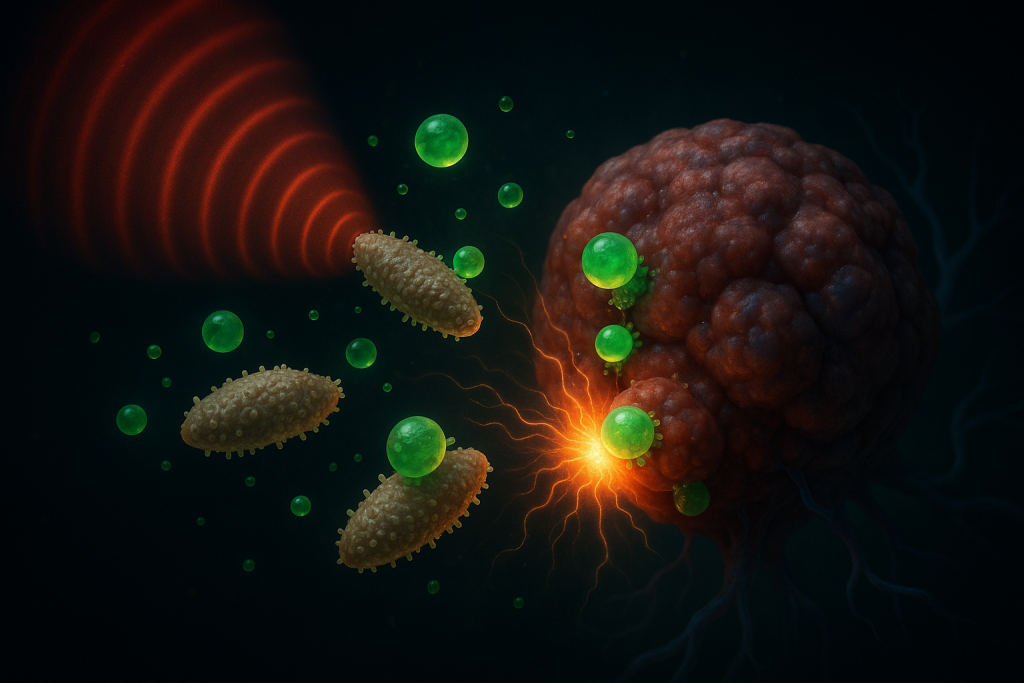
Researchers developed biosynthetic gas vesicles conjugated with indocyanine green (ICG-GVs), a nanoparticle system designed to overcome the clinical limitations of ICG as a photothermal agent, including poor stability and lack of tumor targeting. The ICG-GVs demonstrated a 58% ICG loading rate, prolonged blood circulation half-life, and enabled trimodal imaging through ultrasound, near-infrared fluorescence, and photoacoustic signals. In a subcutaneous murine bladder cancer model, ultrasound-triggered cavitation of the gas vesicles enhanced ICG delivery to tumors, generating temperatures exceeding 60 degrees Celsius upon laser irradiation and resulting in complete tumor regression and improved survival without detectable toxicity.
Why it matters
ICG is the only FDA-approved photothermal agent, and this platform addresses its core clinical limitations, offering a potentially translatable strategy for more precise and effective photothermal cancer therapy. If validated in larger preclinical and clinical studies, this approach could improve outcomes for patients with bladder cancer and potentially other solid tumors.
Understand the Science
by Jiaqi Zhang, Licong Huang, Shuhui Wang, Jingwen Ding, Yuping Yang, Chenhui Li, Ping Zhao, Qian Li, Fei Yan
Photothermal therapy (PTT) serves as a complementary strategy to conventional cancer treatments. Indocyanine green (ICG) is the only U.S. Food and Drug Administration (FDA)-approved photothermal agent. However, its clinical application is hindered by poor stability, short blood half-life, and lack of tumor targeting. Herein, we developed biosynthetic gas vesicles (GVs) covalently conjugated with ICG (ICG-GVs) for remotely controlled, visibly acoustic delivery of ICG to tumors in a subcutaneous xenograft model of MB49 murine bladder cancer in C57BL/6 mice. The resulting ICG-GVs exhibit uniform morphology (~200 nm) with an ICG loading rate of 58%, good colloidal stability, and enable trimodal imaging (ultrasound, near-infrared fluorescence, and photoacoustic) for real-time visualization of delivery. Pharmacokinetic analysis revealed that ICG-GVs significantly prolong ICG circulation half-life and increase AUC. Ultrasound-triggered GV cavitation enhanced intratumoral ICG delivery, achieving tumor temperatures >60 °C upon laser irradiation, leading to complete tumor regression and prolonged survival without detectable toxicity. This study provides a clinically translatable strategy for precise and effective ICG-based PTT.
Source: Acoustic delivery of indocyanine green via biosynthetic gas vesicles for tumor photothermal therapy