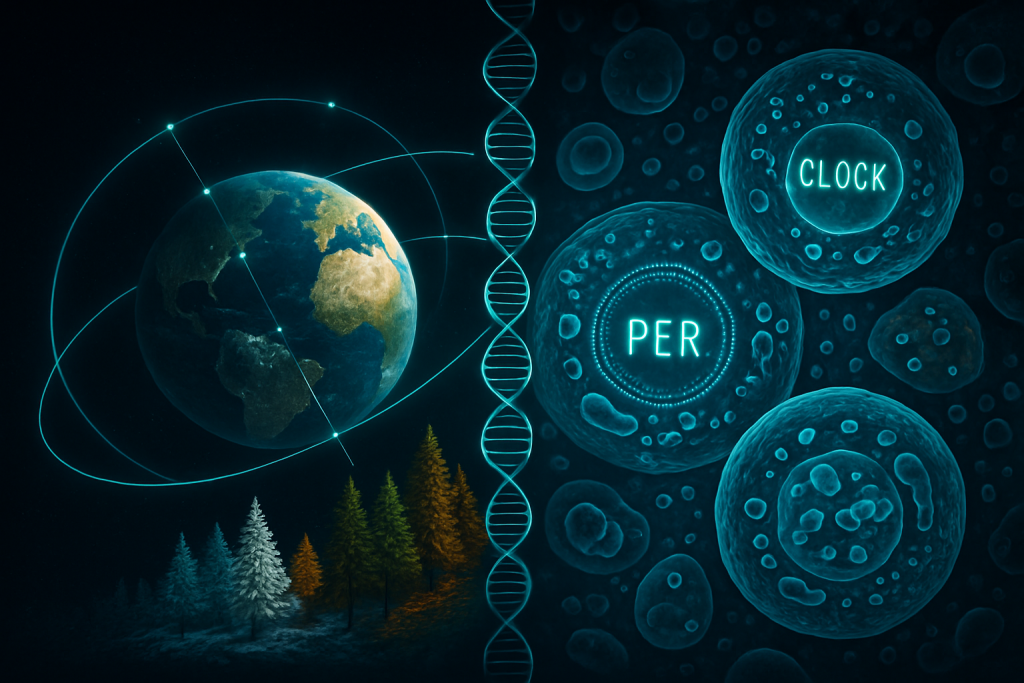
Image generated by AI
Every spring, a wood frog thaws from frozen dormancy and hops toward breeding pools. Every autumn, a monarch butterfly orients itself toward Mexican mountains it has never seen. Every morning, your body temperature dips slightly before dawn, preparing you to wake. These phenomena seem unrelated, yet they all emerge from the same fundamental truth: life on Earth is governed by nested rhythms, ticking at different timescales, all orchestrated by light. This is the hidden architecture of seasonal biology and circadian rhythms—two intimately connected systems that determine when organisms eat, sleep, reproduce, and migrate.
For decades, these biological clocks seemed like curiosities, worthy of academic interest but peripheral to medicine and technology. Today, that assumption has been overturned. Sleep disruption, seasonal affective disorder, metabolic disease, and even cancer risk have all been linked to circadian dysregulation. Climate change is misaligning seasonal cues with the biological calendars of countless species, threatening ecosystems from pole to equator. Understanding how organisms track time—and how they synchronize that internal timing with external seasons—has become urgent, touching everything from shift work safety to conservation biology to the design of pharmaceutical interventions.
What Is Seasonal Biology and Circadian Rhythms?
Circadian rhythms are self-sustaining biological cycles that repeat approximately every 24 hours, derived from the Latin “circa” (about) and “dies” (day). These rhythms regulate physiology and behavior across nearly all living organisms—from cyanobacteria to humans—controlling sleep-wake patterns, hormone secretion, body temperature, gene expression, and alertness. Seasonal biology, by contrast, describes how organisms respond to longer timescales: the annual cycles of photoperiod (day length), temperature, and resource availability that mark the turning of seasons. While circadian rhythms operate on a daily basis, seasonal biology captures how organisms prepare for and navigate spring, summer, fall, and winter, adjusting reproduction, migration, hibernation, and metabolism accordingly.
The story of circadian biology began in earnest in the 1960s, when researcher Colin Pittendrigh demonstrated that organisms maintain internal timing even in complete darkness—proving that circadian rhythms are endogenous, not merely reactions to external light. In 1984, the gene period was discovered in fruit flies by Seymour Benzer and colleagues, providing the first molecular handle on how cells keep time. This work culminated in the 2017 Nobel Prize in Physiology or Medicine, awarded to Jeffrey Hall, Michael Rosbash, and Michael Young for their discoveries of the molecular mechanisms controlling circadian rhythms. Seasonal biology followed a parallel trajectory, with researchers slowly unraveling how day length triggers cascades of neuroendocrine changes—particularly involving the hormone melatonin—that synchronize physiology with the seasons.
How It Works in Nature
At the heart of circadian biology lies a molecular clock found in virtually every cell. In mammals, the master clock resides in the suprachiasmatic nucleus (SCN), a tiny region of the hypothalamus containing roughly 20,000 neurons. Within these neurons, and throughout the body, circadian timing depends on a elegant genetic feedback loop: “clock genes” like CLOCK, BMAL1, PER, and CRY produce proteins that accumulate over hours, then inhibit their own transcription, causing levels to fall, before the cycle resets. This oscillation happens autonomously but is constantly fine-tuned by light input via specialized retinal cells containing melanopsin, a light-sensitive pigment. Light signals travel along the retinohypothalamic tract to the SCN, where they reset the molecular clock, synchronizing internal time with solar time. This process, called “entrainment,” ensures that your circadian rhythm stays locked to the external 24-hour day, even though your intrinsic period might be slightly longer or shorter than 24 hours.
Think of the circadian system as a network of interconnected clocks. The SCN acts as the conductor, but peripheral clocks in the liver, heart, muscles, and immune cells keep their own time and communicate with the master clock through neural and hormonal signals. The hormone melatonin, produced by the pineal gland in the dark, is one critical messenger: it tells the body “night is coming,” suppressing alertness and body temperature while promoting sleep and metabolic rest. When you cross time zones or work night shifts, these distributed clocks become desynchronized—some cells sense light and reset quickly, while others lag behind, creating internal discord. Seasonal biology engages this system at a different scale: the gradual lengthening of days in spring doesn’t alter the 24-hour circadian period, but it does shift when dawn and dusk occur, nudging all these peripheral clocks toward new phase relationships and altering downstream physiology.
Medical and Scientific Relevance
The clinical consequences of circadian disruption are far from trivial. Rotating shift workers show elevated risks of cardiovascular disease, cancer, diabetes, and obesity—partly because their circadian clocks remain entrained to daytime (when they sleep) while their behavior and feeding patterns follow nighttime schedules. This internal misalignment triggers a cascade of dysregulation: cortisol (normally highest at dawn) surges at the wrong time, insulin sensitivity declines, inflammation rises, and the immune system becomes less responsive. Seasonal affective disorder (SAD), which strikes millions in northern latitudes during winter, involves dysregulation of the melatonin system and circadian timing—shorter days delay the circadian phase, leading to depression, fatigue, and metabolic changes. In cancer, circadian disruption promotes tumor progression; chemotherapy efficacy varies dramatically depending on the time of day it is administered, a principle called chronotherapy that many oncologists are now incorporating into treatment protocols.
The pharmaceutical industry has begun targeting circadian biology directly. Melatonin agonists and antagonists are already on the market for sleep disorders and shift work. Recently, circadian-targeting drugs have entered trials for metabolic diseases, cardiovascular conditions, and even neuropsychiatric disorders. Agricultural scientists are using seasonal and circadian biology to optimize crop growth under artificial lighting, predicting that controlled-environment agriculture will increasingly depend on lighting schedules that mimic natural photoperiods. Chronotherapy—adjusting drug timing, feeding schedules, and medical procedures to align with circadian phases—is becoming standard in some cancer centers. Aerospace and military organizations use circadian science to schedule crew rest and optimize alertness during critical operations.
Recent Breakthroughs in Seasonal Biology and Circadian Rhythms
In the past three years, several discoveries have deepened our understanding of how these systems work. In 2022-2023, researchers published landmark studies on “social jetlag”—the internal desynchrony experienced by people with irregular sleep schedules—showing that even short periods of circadian misalignment impair glucose tolerance and increase cardiovascular risk. A 2023 study in Nature identified a previously unknown photoreceptor pathway in the mammalian retina that enhances circadian entrainment to seasonal day-length changes, suggesting that the eye transmits more refined temporal information to the brain than previously suspected. Work on the “clock-controlled genome” has revealed that roughly 10-15 percent of all genes show circadian oscillation in expression, far more than initially believed, suggesting that circadian dysfunction may have ramifications across nearly every biological system. Additionally, researchers have begun mapping how seasonal photoperiod changes interact with circadian clocks to trigger hibernation, migration, and reproductive physiology in animals ranging from hamsters to birds to fish.
Open questions abound at the frontier of this research. How do plants, which lack centralized nervous systems, implement seasonal and circadian biology through purely cellular mechanisms? Can we predict individual differences in circadian timing (chronotypes—whether someone is a “morning person” or “night owl”) from genetic and environmental data, and will personalized circadian medicine become feasible? How are seasonal cues—particularly in a rapidly warming climate—becoming decoupled from circadian timing in wild populations, and what are the ecological consequences? Researchers are also investigating whether circadian-based interventions might ameliorate psychiatric disorders like bipolar disorder and depression, which show strong seasonal and circadian components.
Why Seasonal Biology and Circadian Rhythms Matters for the Future
Climate change poses an unprecedented challenge to the synchrony between circadian-seasonal systems and the external environment. Many organisms rely on photoperiod (day length) as a reliable cue for timing migration, hibernation, and reproduction, because day length at a given latitude changes predictably every year. However, temperature is shifting independently of photoperiod—spring now arrives earlier in many regions, but day length does not accelerate. Species are becoming “out of phase” with their environment: plants flower before pollinators emerge; migratory birds arrive at breeding grounds after peak insect abundance; predators and prey no longer synchronize their life cycles. This phenological mismatch could destabilize food webs and reduce reproductive success across ecosystems. Understanding how organisms prioritize conflicting seasonal cues and whether they can adapt quickly enough to changing conditions is a central ecological question.
For human health and productivity, the stakes are equally high. As work becomes increasingly 24/7 and global, circadian disruption will intensify unless we develop better interventions. Future cities may incorporate “circadian lighting” design—dynamically adjusting artificial light to match natural spectral changes through the day—to promote sleep, cognitive function, and metabolic health. Personalized medicine will likely include circadian profiling, with treatments timed to individual chronotypes and circadian phases for maximum efficacy and minimal side effects. Yet significant barriers remain: the neurobiology linking circadian disruption to disease remains incompletely understood, most circadian research uses laboratory rodents that may not generalize to humans, and the economic and social pressures driving around-the-clock activity show no signs of abating.
Key Takeaways
- Circadian rhythms are self-sustaining ~24-hour biological cycles present in nearly all organisms, controlling sleep, hormone secretion, metabolism, and gene expression, while seasonal biology describes how organisms respond to annual cycles of photoperiod and temperature.
- At the molecular level, circadian timing depends on feedback loops of clock genes that oscillate over 24 hours, synchronized by light signals to the brain’s suprachiasmatic nucleus, with melatonin serving as a key hormonal messenger linking the master clock to peripheral tissues.
- The most promising near-term applications include chronotherapy (timing medications and treatments to circadian phases) for cancer and metabolic disease, circadian-optimized lighting in workplaces and homes, and personalized medicine based on individual chronotypes.
- Recent research has revealed that a larger fraction of the genome shows circadian regulation than previously known, identified novel photoreceptor pathways for seasonal entrainment, and documented widespread social jetlag and its health consequences in modern populations.
- As climate change misaligns photoperiodic cues with actual seasonal changes, ecosystems face phenological mismatch, while human health and productivity increasingly depend on designing environments and work schedules that respect rather than override circadian biology.
Explore TED Talks on Seasonal Biology and Circadian Rhythms:
TED content is used under CC BY-NC-ND 4.0. © TED Conferences, LLC.
Frequently Asked Questions
How do circadian rhythms remain self-sustaining if an organism is kept in constant darkness?
Circadian rhythms are endogenously generated by biological clocks and continue to cycle even without external light cues, though they typically drift slightly from a 24-hour period. However, light exposure is crucial for synchronizing (entraining) these internal rhythms to the actual day-night cycle in nature.
What is the mechanism by which light orchestrates both circadian rhythms and seasonal biology?
Light acts as the primary environmental signal (zeitgeber) that synchronizes circadian rhythms through photoreceptors in the eye and skin, while the duration and timing of light exposure also inform seasonal timing systems that regulate reproduction, migration, and dormancy. These nested systems allow organisms to align daily activities with immediate conditions and long-term seasonal changes.
Why does circadian dysregulation increase disease risk such as metabolic disease and cancer?
When circadian rhythms become misaligned with the external environment (through shift work, poor sleep, or other disruptions), hormone secretion, metabolic processes, and immune function become desynchronized, leading to metabolic dysfunction and increased cellular stress that can promote disease progression. Circadian disruption also impairs DNA repair mechanisms, which increases cancer susceptibility.
How does climate change create a mismatch between seasonal cues and an organism's biological calendar?
Climate change alters the timing of environmental events like plant flowering and insect emergence, but many organisms' seasonal biology is genetically programmed based on historical light and temperature cues that no longer align with food availability. This phenological mismatch can cause organisms to arrive at breeding grounds before food sources are available or migrate at times when environmental conditions are unfavorable.