AI Insight
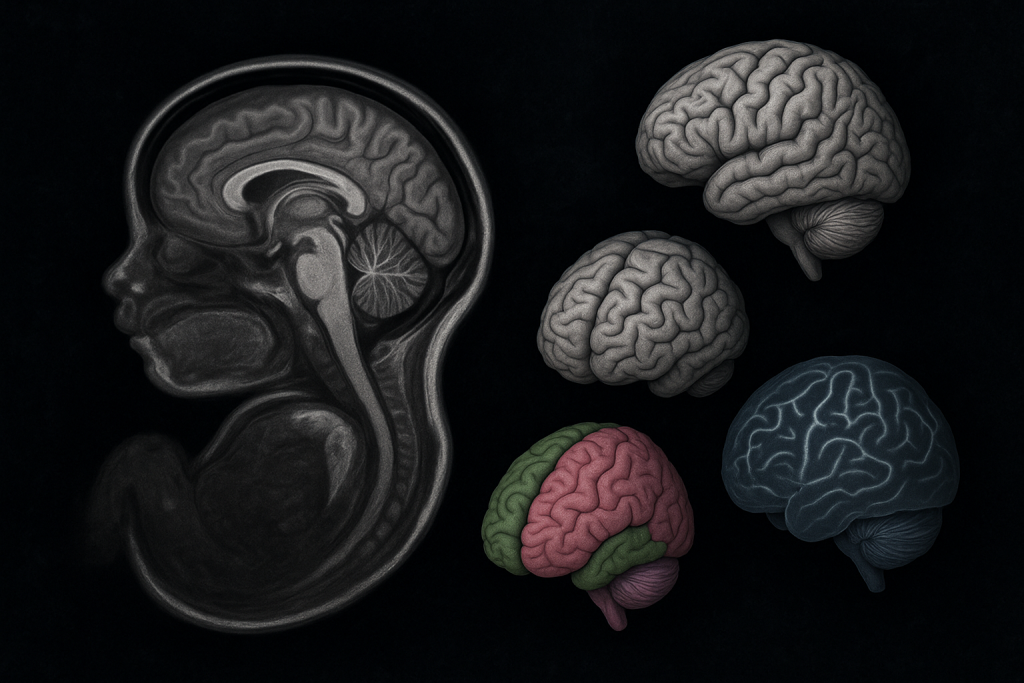
The CRL-2025 atlas is a four-dimensional spatiotemporal reference atlas of the developing human fetal brain, covering gestational weeks 21 through 37 and constructed from MRI scans of 159 typically developing fetuses. It employs diffeomorphic deformable registration combined with kernel regression on age to generate detailed tissue segmentations, transient white matter compartments, and parcellation into 126 anatomical regions, representing a substantial improvement over its predecessor, the CRL-2017 atlas. The authors also release FetalSEG, a deep learning tool for automated multiclass fetal brain segmentation, along with de-identified subject-level datasets to support reproducibility.
Why it matters
This atlas provides researchers and clinicians with a standardized, high-resolution reference framework for studying typical and atypical fetal neurodevelopment, which could improve the detection and characterization of developmental brain anomalies in utero. The open release of data and automated segmentation tools lowers barriers to entry for large-scale neuroimaging studies in fetal populations.
Understand the Science
Abstract: Characterizing in-utero brain development is essential for understanding typical and atypical neurodevelopment. Building on prior spatiotemporal fetal brain MRI atlases, we present the CRL-2025 fetal brain atlas, a spatiotemporal (4D) atlas of the developing fetal brain between 21 and 37 gestational weeks. This atlas is constructed from MRI scans of 159 fetuses with typically developing brains using a diffeomorphic deformable registration framework integrated with kernel regression on age. CRL-2025 uniquely includes detailed tissue segmentations, transient white matter compartments, and parcellation into 126 anatomical regions. It offers significantly enhanced anatomical details over the CRL-2017 atlas and is presented along with a re-release of the CRL diffusion MRI atlas featuring newly created tissue segmentation and labels. We release de-identified, processed subject-level fetal MRI datasets used to generate CRL-2025, providing input-output transparency and reproducibility. We also provide FetalSEG, a deep learning-based multiclass segmentation tool to facilitate automatic fetal brain MRI segmentation. The CRL-2025 atlas and its tools enable scalable fetal brain MRI segmentation, analysis, and neurodevelopmental research for the broader community.
Source: An MRI Atlas of the Human Fetal Brain: Reference and Segmentation Tools for Fetal Brain MRI Analysis