AI Insight
This composite photograph captures bright Perseid meteors observed near Grisslehamn, Sweden during the shower's peak on August 12, 2026. The Perseid meteor shower occurs annually when Earth passes through debris left by comet 109P/Swift-Tuttle, causing dust grains to vaporize in the atmosphere and create visible streaks across the night sky. The 2026 display was particularly favorable as the New Moon phase eliminated lunar interference, allowing meteor flashes to be seen clearly against the Milky Way backdrop.
Why it matters
The Perseid meteor shower is one of the most reliable and spectacular annual celestial events, providing opportunities for public engagement with astronomy and atmospheric science. The timing with a New Moon and following a total solar eclipse made 2026 an exceptional year for skywatchers to observe both phenomena.
Understand the Science
APOD
Astronomy Picture of the Day
Discover the cosmos! Each day a different image or photograph of our fascinating universe is featured, along with a brief explanation written by a professional astronomer.
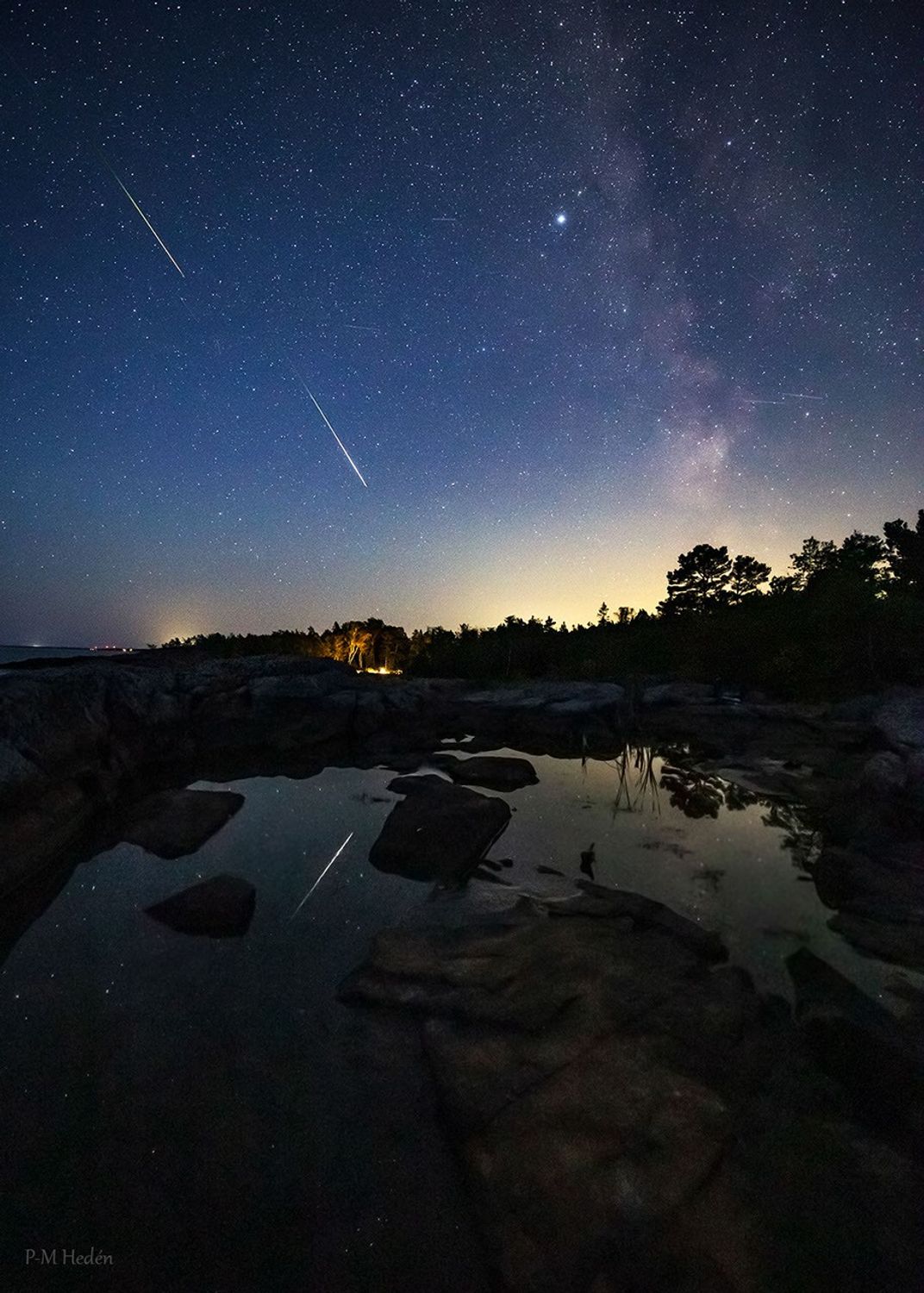
Bright Perseids from Sweden
Explanation: Known for its bright and fast meteors, the annual Perseid Meteor Shower comes to planet Earth’s skies from a radiant in the heroic constellation Perseus. The popular northern summer celestial spectacle is created as grains of dust cast off along the orbit of periodic comet 109P/Swift-Tuttle vaporize in Earth’s dense atmosphere, tracing brief, but beautiful streaks through the night. Taken near the shower’s peak of activity on August 12, this composite image recorded two bright perseid meteors and one meteor’s watery reflection from a location near the coastal village of Grisslehamn, Sweden. Almost as bright as Altair, brightest star on the scene, the meteors appear along with the faint, diffuse background of the Milky Way. This year, the shower’s peak activity coincided with a New Moon, so perseid meteor flashes were undiminished by bright moonlight. And for many skywatchers, this night of bright perseid meteors followed their viewing of the silhouette of the New Moon in a much anticipated solar eclipse.
Growing Gallery: Solar Eclipse of 2026 August 12
Tomorrow’s picture: Milky Way over Yellowstone
| Date | August 15, 2026 |
|---|---|
| Credit & Copyright: | P-M Hedén (Clear Skies, TWAN) |
| Authors & editors: | Jerry Bonnell, Cecilia Chirenti, Robert Nemiroff, Keighley Rockcliffe |
| A service of: |
ASD at NASA / GSFC, NASA Science Activation & Michigan Tech. U. |