AI Insight
The James Webb Space Telescope has captured detailed composite images of the Lion's Head Nebula (NGC 2392), a planetary nebula formed from a Sun-like star that exhausted its nuclear fuel and shed its outer layers. The nebula features a central white dwarf remnant whose intense radiation ionizes the surrounding expanding gas, creating an irregular bubble structure, while dust clumps and ionized gas form the nebula's distinctive appearance. These high-resolution observations will enable scientists to better understand the interactions between ejected gas, dust, and stellar radiation during late-stage stellar evolution.
Why it matters
This observation provides insight into the likely fate of our own Sun in approximately 5 billion years when it exhausts its fuel and becomes a planetary nebula. The detailed imagery will advance understanding of stellar death processes and the chemical enrichment of interstellar space through mass loss from dying stars.
Understand the Science
APOD
Astronomy Picture of the Day
Discover the cosmos! Each day a different image or photograph of our fascinating universe is featured, along with a brief explanation written by a professional astronomer.
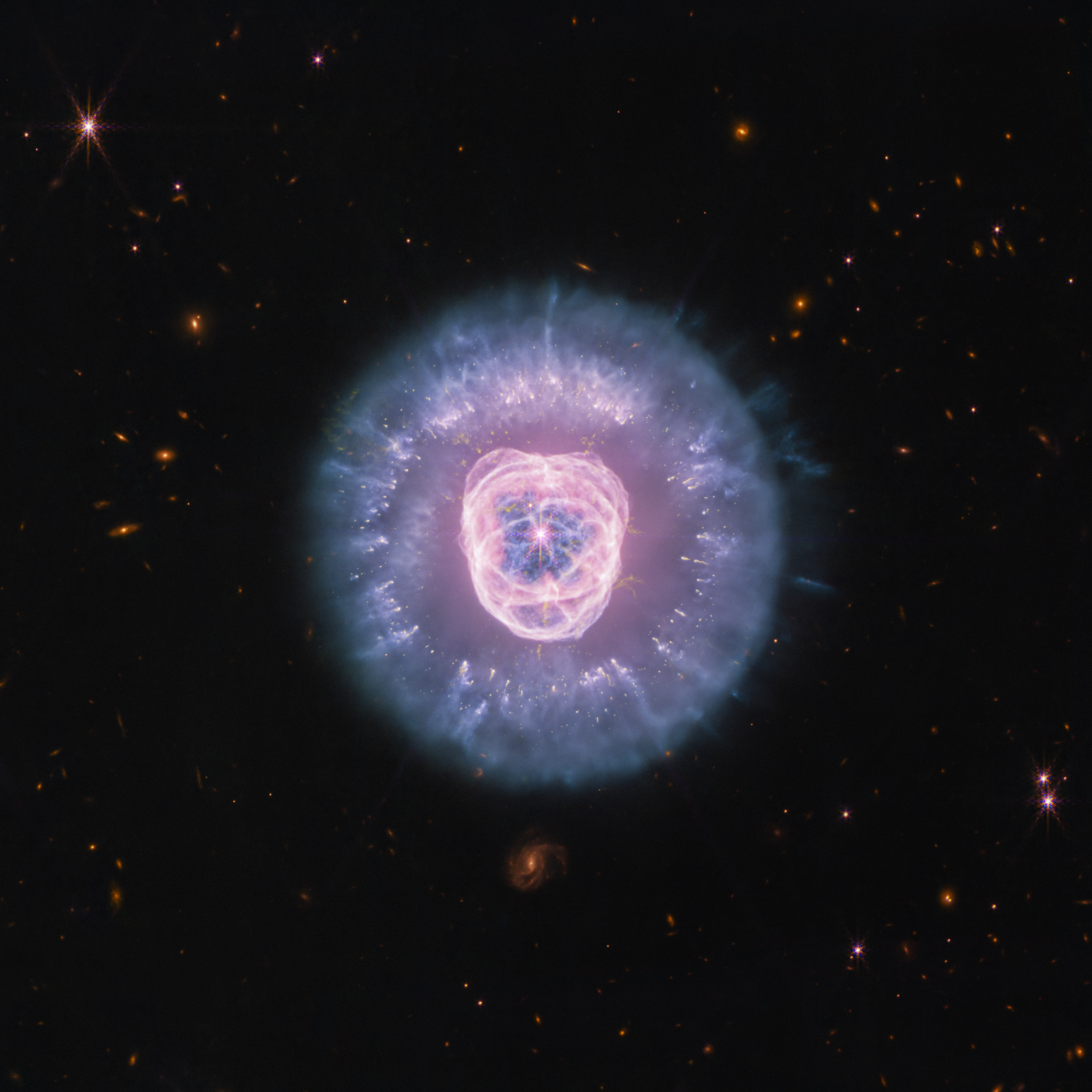
JWST Images The Lion’s Head Nebula
Explanation: Are we looking at the future of our Sun? The James Webb Space Telescope captured today’s composite image of the Lion’s Head Nebula (NGC 2392) with its NIRCam and MIRI instruments. The Lion’s Head Nebula is the remnant of a Sun-like star. This star was unable to sustain the nuclear fusion in its core needed to remain stable. It began to shed layers of gas and dust into space, forming this planetary nebula. A hot stellar core, called a white dwarf, is left behind within the lion’s nose. Do not boop this nose! Intense radiation from the white dwarf is ionizing the gas as it expands, creating the irregular bubble that makes up the lion’s face. Dust clumps that have survived the white dwarf’s radiation and a cloud of ionized gas make up the lion’s mane. This new and more detailed view of the nebula will help humanity learn more about how the gas and dust interact with each other and the white dwarf radiation.
Tomorrow’s picture: a waterfall of light
| Date: | August 26, 2026 |
|---|---|
| Credit: | Image: NASA, ESA, CSA, STScI; Image Processing: Alyssa Pagan (STScI) |
| Authors & editors: | Keighley Rockcliffe, Robert Nemiroff, Jerry Bonnell, Cecilia Chirenti |
| A service of: |
ASD at NASA / GSFC, NASA Science Activation & Michigan Tech. U. |
Source: APOD: 2026 August 26 – JWST Images The Lion’s Head Nebula