AI Insight
The Moon's apparent color varies significantly depending on atmospheric conditions and viewing circumstances. A composite image documenting the full moon over 10 years from Italy shows the Moon appears brown-tinged gray from space, but can appear red, yellow, blue, or even purple from Earth's surface. These color variations result from atmospheric scattering of sunlight: red/yellow hues occur when viewed near the horizon due to blue light scattering, blue coloration indicates larger dust particles in the atmosphere, and the reddish appearance during total lunar eclipses results from light refracted through Earth's atmosphere.
Why it matters
Understanding lunar color variations helps explain atmospheric optical phenomena and demonstrates how Earth's atmosphere affects our perception of celestial objects. This knowledge is relevant for atmospheric science, astronomy education, and interpreting observational data.
Understand the Science
APOD
Astronomy Picture of the Day
Discover the cosmos! Each day a different image or photograph of our fascinating universe is featured, along with a brief explanation written by a professional astronomer.
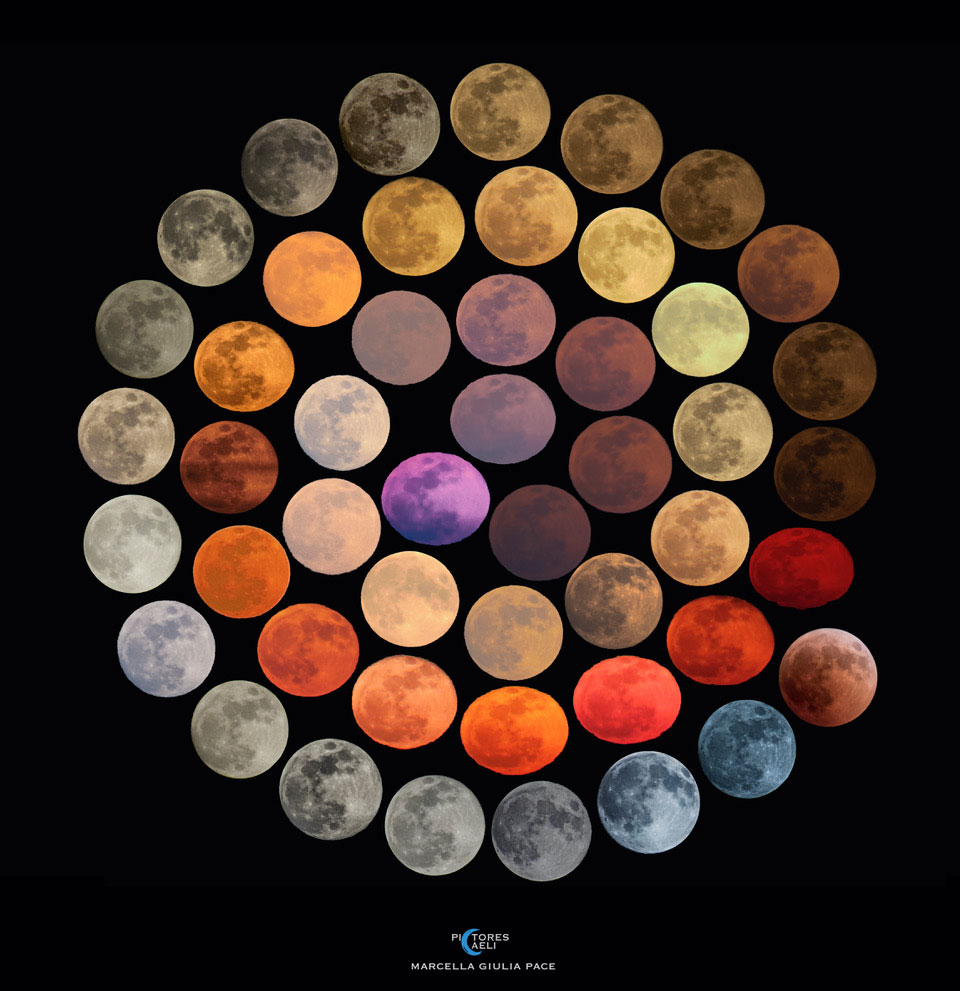
Colors of the Moon
Explanation: What color is the Moon? It depends on the night — and the time. Outside of the Earth’s atmosphere, the dark Moon, which shines by reflected sunlight, appears a magnificently brown-tinged gray. The featured image highlights a collection of apparent colors of the full moon on Earth, documented by one astrophotographer over 10 years from different locations across Italy. A red– or yellow-colored moon usually indicates a moon seen near the horizon. There, some of the blue light has been scattered away by a long path through the Earth’s atmosphere, sometimes laden with fine dust. A blue-colored moon is more rare and can indicate an atmosphere carrying larger dust particles. What created the purple moon is unclear — it may be a combination of several effects. The last image captures the total lunar eclipse of 2018 July — where the moon, in Earth’s shadow, appeared a faint red — due to light refracted through air around the Earth. Have you ever seen an unusually colorful Moon?

Tomorrow’s picture: open space
| Date: | November 1, 2026 |
|---|---|
| Credit & Copyright: | Marcella Giulia Pace |
| Authors & editors: | Robert Nemiroff, Jerry Bonnell, Cecilia Chirenti, Keighley Rockcliffe |
| A service of: |
ASD at NASA / GSFC, NASA Science Activation & Michigan Tech. U. |