AI Insight
This Cassini spacecraft image from November 1, 2009 captures Saturn's moon Enceladus backlit by the Sun, revealing plumes of icy material continuously ejecting from its south polar region. These plumes, discovered by Cassini in 2005, are believed to originate from a subsurface ocean beneath the moon's ice shell and supply material to Saturn's E ring. The 500-kilometer diameter moon's surface is highly reflective due to the constant deposition of ice particles from these plumes.
Why it matters
The presence of subsurface liquid water combined with organic compounds and energy sources makes Enceladus one of the most promising locations in our solar system to search for extraterrestrial life. The accessible plumes allow spacecraft to sample subsurface ocean material without landing, making future astrobiology missions technically feasible.
Understand the Science
APOD
Astronomy Picture of the Day
Discover the cosmos! Each day a different image or photograph of our fascinating universe is featured, along with a brief explanation written by a professional astronomer.
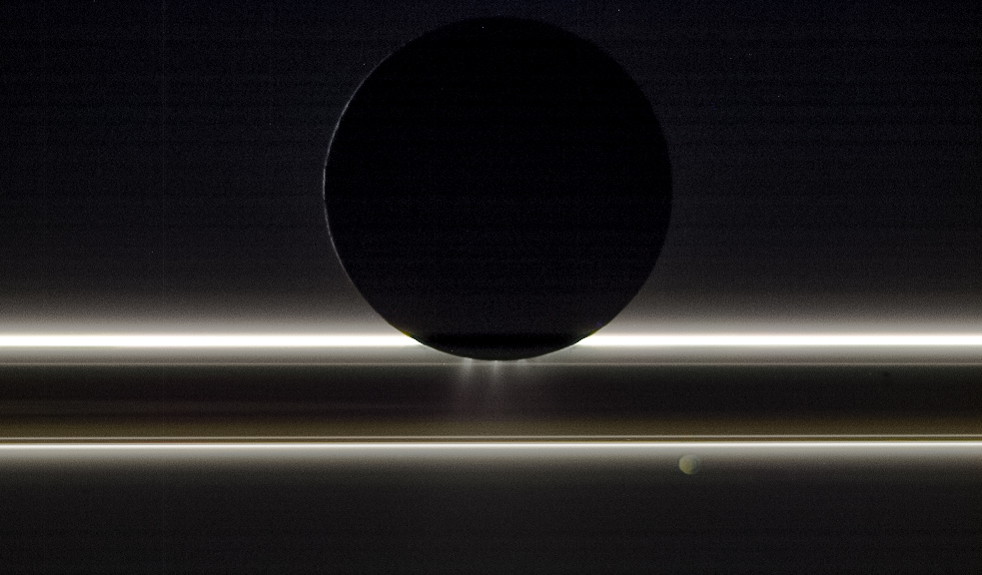
Enceladus in Silhouette
Explanation: One of our Solar System’s most tantalizing worlds, Enceladus is backlit by the Sun in this Cassini spacecraft image from November 1, 2009. The dramatic illumination reveals the plumes that continuously spew into space from the south pole of Saturn’s 500 kilometer diameter moon. Discovered by Cassini in 2005, the icy plumes are likely connected to an ocean beneath the ice shell of Enceladus. They supply material directly to Saturn’s outer, tenuous E ring and make the surface of Enceladus as reflective as snow. Across the scene, Saturn’s icy rings scatter sunlight toward Cassini’s cameras. Beyond the rings (lower right), the night side of 80 kilometer diameter moon Pandora is faintly lit by Saturnlight.
Tomorrow’s picture: pixels in space
| Date: | November 5, 2026 |
|---|---|
| Credit: | Cassini Imaging Team, SSI, JPL, ESA, NASA |
| Authors & editors: | Jerry Bonnell, Cecilia Chirenti, Robert Nemiroff, Keighley Rockcliffe |
| A service of: |
ASD at NASA / GSFC, NASA Science Activation & Michigan Tech. U. |