AI Insight
Noctilucent clouds, also known as polar mesospheric clouds, are the highest clouds in Earth's atmosphere that become visible after sunset when illuminated by sunlight from below the horizon. These clouds float at extreme altitudes and appear as blue networks in the sky during summer months, remaining bright even when the ground is in darkness due to their elevation above the shadow of Earth's curvature. This image captures noctilucent clouds over Linköping, Sweden in early August, demonstrating the phenomenon where these typically dim clouds become visible through solar illumination from beneath the horizon.
Why it matters
Noctilucent clouds serve as indicators of upper atmospheric conditions and climate change, with their formation and behavior still under active scientific investigation. Most discoveries about these clouds have occurred only within the past two decades, making continued observation important for understanding atmospheric dynamics at mesospheric altitudes.
Understand the Science
APOD
Astronomy Picture of the Day
Discover the cosmos! Each day a different image or photograph of our fascinating universe is featured, along with a brief explanation written by a professional astronomer.
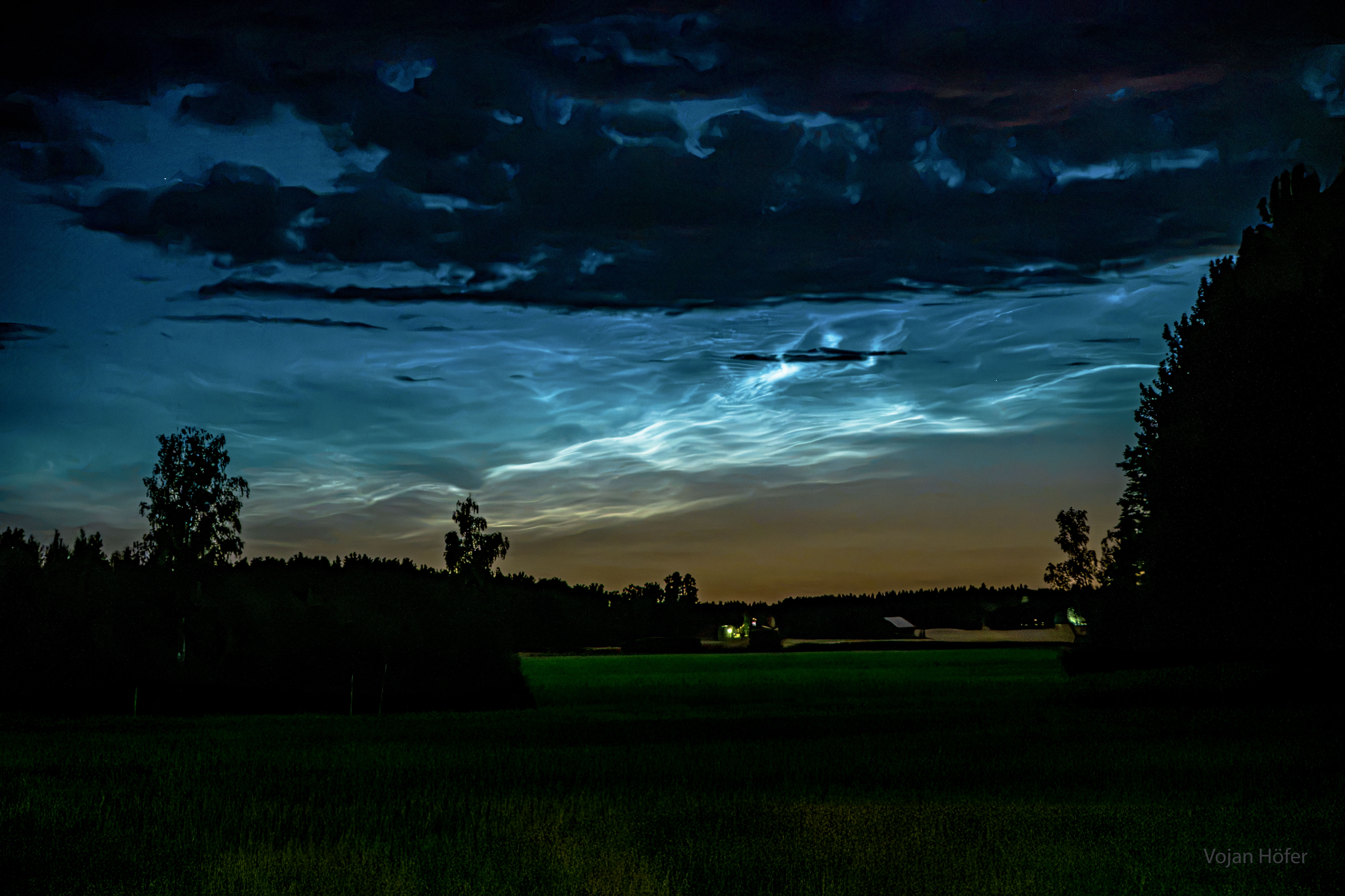
Noctilucent Clouds over Sweden
Explanation: Sometimes it’s night on the ground but day in the air. As the Earth rotates to eclipse the Sun, sunset rises upfrom the ground. Therefore, at sunset on the ground, sunlight still shines on clouds above. Under usual circumstances, a pretty sunset might be visible, but unusual noctilucent clouds float so high up they can be seen well after dark. Normally too dim to be seen, they may become visible just after sunset during the summer when illuminated by sunlight from below the horizon. Noctilucent clouds are the highest clouds and are known more technically as polar mesospheric clouds. Featured here as they appeared in early August, a network of blue noctilucent clouds was captured in the distant sky above a field of green grass near Linköping, Sweden, with trees in stark silhouette across the horizon. Much about noctilucent clouds has been discovered only in the past two decades, while how they form and evolve remains a topic of active research.

Tomorrow’s picture: round and round
| Date | October 27, 2026 |
|---|---|
| Credit & Copyright | V. Höfer, D. Večerník & B. Večerníková |
| Authors & editors: | Robert Nemiroff, Jerry Bonnell, Cecilia Chirenti, Keighley Rockcliffe |
| A service of: |
ASD at NASA / GSFC, NASA Science Activation & Michigan Tech. U. |
Source: APOD: 2026 October 27 – Noctilucent Clouds over Sweden