AI Insight
Astrophotographer Tom Williams captured exceptionally detailed images of the Saturn system from the United Kingdom by exploiting rare atmospheric conditions with minimal turbulence. He employed the "lucky imaging" technique, which involves taking thousands of rapid short-exposure photographs with a high-speed camera and combining only the clearest frames to minimize atmospheric distortion. The resulting composite image reveals fine details of Saturn's moons including Titan and Enceladus, as well as gaps and spokes in Saturn's rings, captured near the planet's opposition on October 4, 2026.
Why it matters
This demonstrates how amateur astronomers can achieve professional-quality planetary imaging by combining favorable atmospheric conditions with advanced imaging techniques, making detailed solar system observations more accessible without requiring space-based telescopes.
Understand the Science
APOD
Astronomy Picture of the Day
Discover the cosmos! Each day a different image or photograph of our fascinating universe is featured, along with a brief explanation written by a professional astronomer.
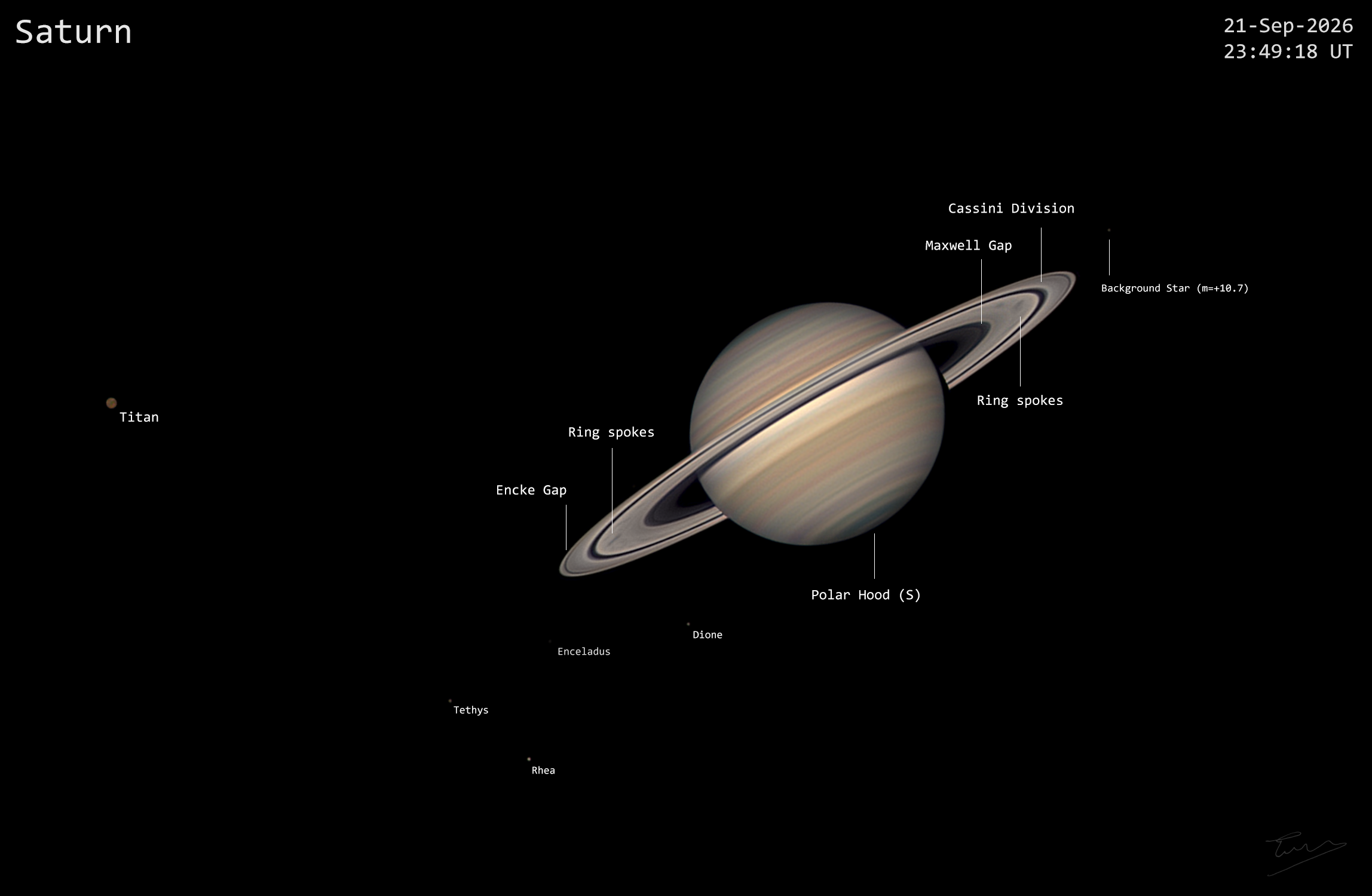
The Saturn System Smörgåsbord
Explanation: How was the Saturn system imaged so clearly? Astrophotographer Tom Williams captured such exquisite details due to one night of exceptional atmospheric conditions above the United Kingdom. This means more than a cloudless sky. Pockets of air at different temperatures and densities move around and bend light as it travels through Earth’s atmosphere, distorting astronomy images. This is called “seeing”. Less atmospheric turbulence means clearer images. The astrophotographer reduced the impact of seeing with the lucky imaging technique: thousands of short-exposure images are taken very quickly with a high-speed camera and the clearest images are added up. Which object in this smörgåsbord interests you? Perhaps Titan or the icy stripes of Enceladus? Maybe the gaps and spokes in Saturn’s rings? Saturn’s opposition, when Earth passes in between the planet and the Sun, occurred on October 4th. Due to the planet’s proximity and full illumination from the Sun, now is a great time of year to observe it!
Tomorrow’s picture: bumpy
| Date: | October 8, 2026 |
|---|---|
| Credit: | Tom Williams |
| Authors & editors: | Keighley Rockcliffe, Robert Nemiroff, Jerry Bonnell, Cecilia Chirenti |
| A service of: |
ASD at NASA / GSFC, NASA Science Activation & Michigan Tech. U. |
Source: APOD: 2026 October 8 – The Saturn System Smörgåsbord