AI Insight
NASA's James Webb Space Telescope has captured an image of a dust pillar in the Carina Nebula, located approximately 7,500 light-years from Earth. The pillar, shaped by stellar winds and radiation from nearby massive stars including the Eta Carinae system, contains a compact cluster of roughly 70 young stars estimated to be only 1.3 million years old. The cluster includes a massive star approximately 19 times the mass of our Sun, with the ongoing star formation process creating an opening at the pillar's head that resembles a treasure chest.
Why it matters
This observation provides insights into active star formation processes and how massive stellar systems shape their surrounding environments through radiation and stellar winds. Studying young stellar clusters helps astronomers understand stellar evolution, particularly how massive stars form and develop in dense interstellar environments.
Understand the Science
APOD
Astronomy Picture of the Day
Discover the cosmos! Each day a different image or photograph of our fascinating universe is featured, along with a brief explanation written by a professional astronomer.
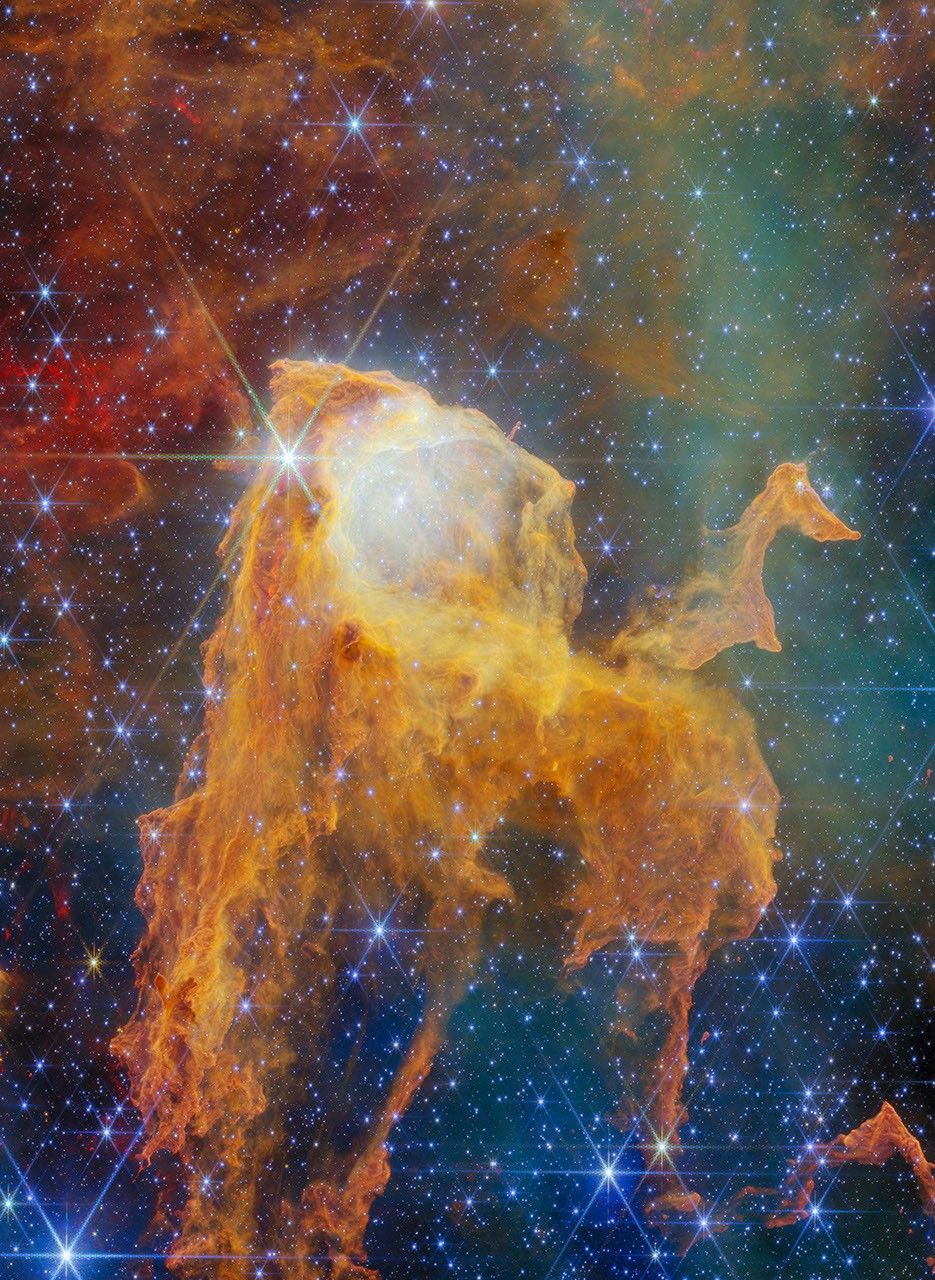
A Treasure Chest in the Carina Nebula
Explanation: This treasure chest is full of stars. The featured image was obtained with NASA‘s James Webb Space Telescope and shows a dust pillar in the Carina Nebula inside our Galaxy, roughly 7500 light-years away. It is formed by interstellar gas and dust, and shaped by powerful stellar winds and radiation from neighboring stars like the nearby Eta Carinae stellar system which is more luminous than 5 million suns. The star formation inside the pillar is excavating its head, creating the open lid of the chest. Astronomers estimate that there are about 70 stars in a compact cluster inside the pillar. This cluster is now thought to be only around 1.3 million years old. Its bounty of young stars includes a massive star approximately 19 times as massive as the Sun. More massive stars are rarer, shine brighter and evolve faster than less massive stars. They are the shiniest jewels in the treasure chest.
APOD’s main NASA site is moving : From apod.nasa.gov to science.nasa.gov/apod
Tomorrow’s picture: The Triangulum Galaxy
| Date | September 17, 2026 |
|---|---|
| Credit | ESA/Webb, NASA & CSA, M. Reiter; Acknowledgement: M. H. Özsaraç |
| Authors & editors: | Cecilia Chirenti, Robert Nemiroff, Jerry Bonnell, Keighley Rockcliffe |
| A service of: |
ASD at NASA / GSFC, NASA Science Activation & Michigan Tech. U. |
Source: APOD: 2026 September 17 – A Treasure Chest in the Carina Nebula