AI Insight
This Astronomy Picture of the Day documents an analemma—a figure-8 pattern created by photographing the Sun from the same location at the same time daily over one year. The composite image was captured at noon near the Callanish Stones, a Bronze Age stone circle in Scotland's Outer Hebrides built around 2700 BC. The analemma's distinctive shape results from Earth's axial tilt and its elliptical orbit around the Sun, with the Sun appearing at the pattern's extremes during solstices and near the middle during equinoxes.
Why it matters
This visualization demonstrates fundamental celestial mechanics—Earth's axial tilt and orbital characteristics—in an accessible way. The juxtaposition with ancient standing stones highlights humanity's long-standing interest in astronomical phenomena and seasonal changes, which many cultures commemorate during equinoxes and solstices.
Understand the Science
APOD
Astronomy Picture of the Day
Discover the cosmos! Each day a different image or photograph of our fascinating universe is featured, along with a brief explanation written by a professional astronomer.
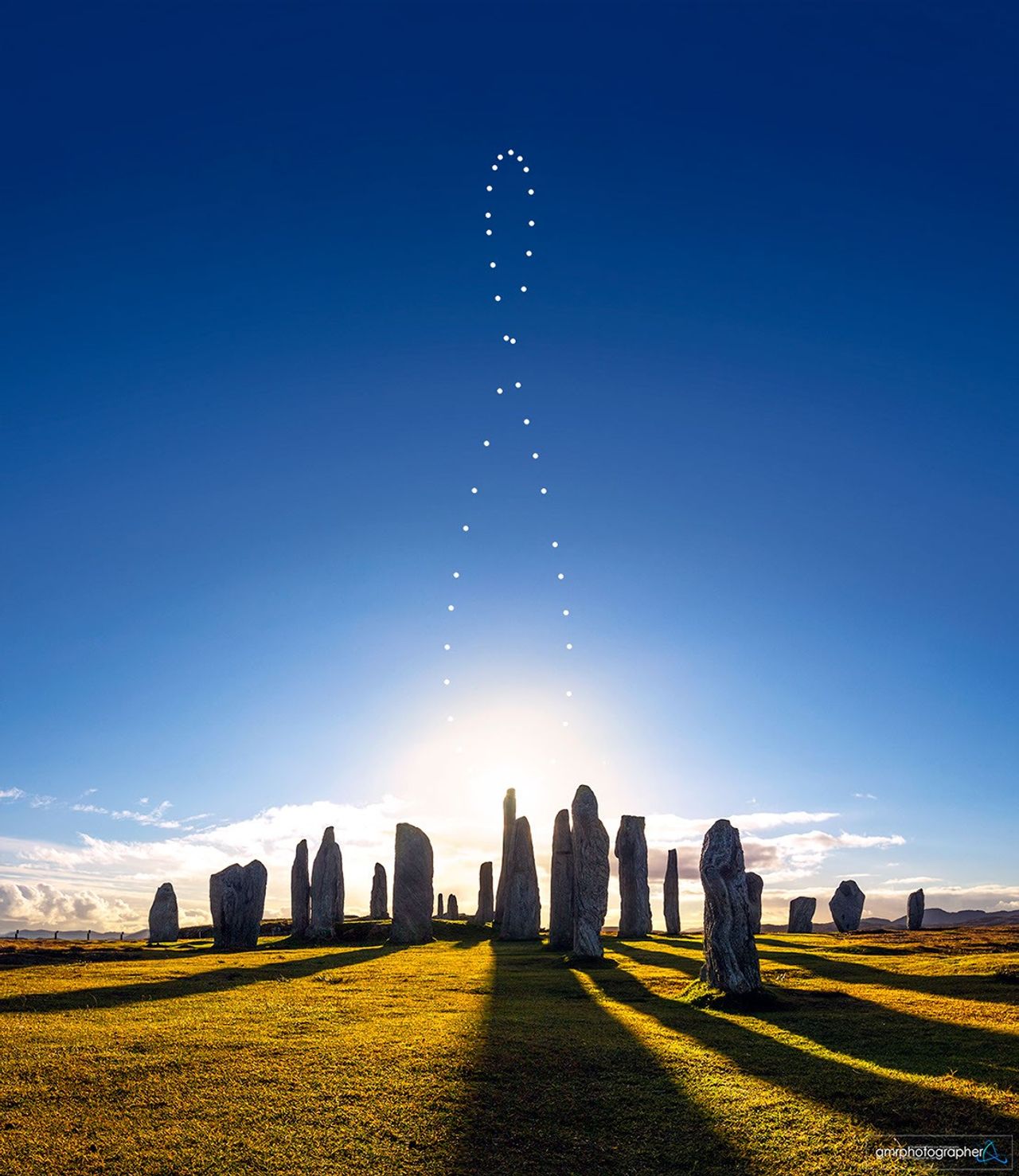
Analemma over the Callanish Stones
Explanation: If you went outside at the same time every day and took a picture that included the Sun, how would the Sun’s position change? A visual answer to that question is an analemma, a composite image taken from the same spot at the same time over the course of a year. The featured analemma was composed from images taken every few days at noon near the village of Callanish in the Outer Hebrides in Scotland, UK. In the foreground are the Callanish Stones, a stone circle built around 2700 BC during humanity’s Bronze Age. It is not known if the placement of the Callanish Stones has or had astronomical significance. The ultimate causes for the figure-8 shape of this and all analemmas are the tilt of the Earth axis and the ellipticity of the Earth’s orbit around the Sun. At the solstices, the Sun will appear at the top or bottom of an analemma. The featured image was taken near the December solstice and so the Sun appears near the bottom. Equinoxes, however, correspond to analemma middle points — not the intersection point. In two days there will be an equinox (“equal night”), when day and night are equal over all of planet Earth. Many cultures celebrate a change of season at an equinox.
APOD’s main NASA site is moving: From apod.nasa.gov to science.nasa.gov/apod
Tomorrow’s picture: open space
| Date | September 20, 2026 |
|---|---|
| Credit & Copyright: | Giuseppe Petricca |
| Authors & editors: | Robert Nemiroff, Jerry Bonnell, Cecilia Chirenti, Keighley Rockcliffe |
| A service of: |
ASD at NASA / GSFC, NASA Science Activation & Michigan Tech. U. |
Source: APOD: 2026 September 20 – Analemma over the Callanish Stones