AI Insight
This article documents animal behavioral responses during a total solar eclipse, featuring observations of a stork in Poland and describing various wildlife reactions to the temporary darkness. During totality, animals exhibit nocturnal behaviors including birds roosting, waterfowl preparing to sleep, and nighttime insects becoming active, while songbirds resume dawn choruses when sunlight returns. The phenomenon demonstrates how the brief alignment of the Sun and Moon triggers circadian-related behavioral changes across multiple species.
Why it matters
Understanding animal responses to solar eclipses provides insights into circadian rhythm mechanisms and how wildlife uses environmental light cues for behavior regulation. These observations can inform studies of animal cognition, temporal awareness, and adaptation to rapid environmental changes.
Understand the Science
APOD
Astronomy Picture of the Day
Discover the cosmos! Each day a different image or photograph of our fascinating universe is featured, along with a brief explanation written by a professional astronomer.
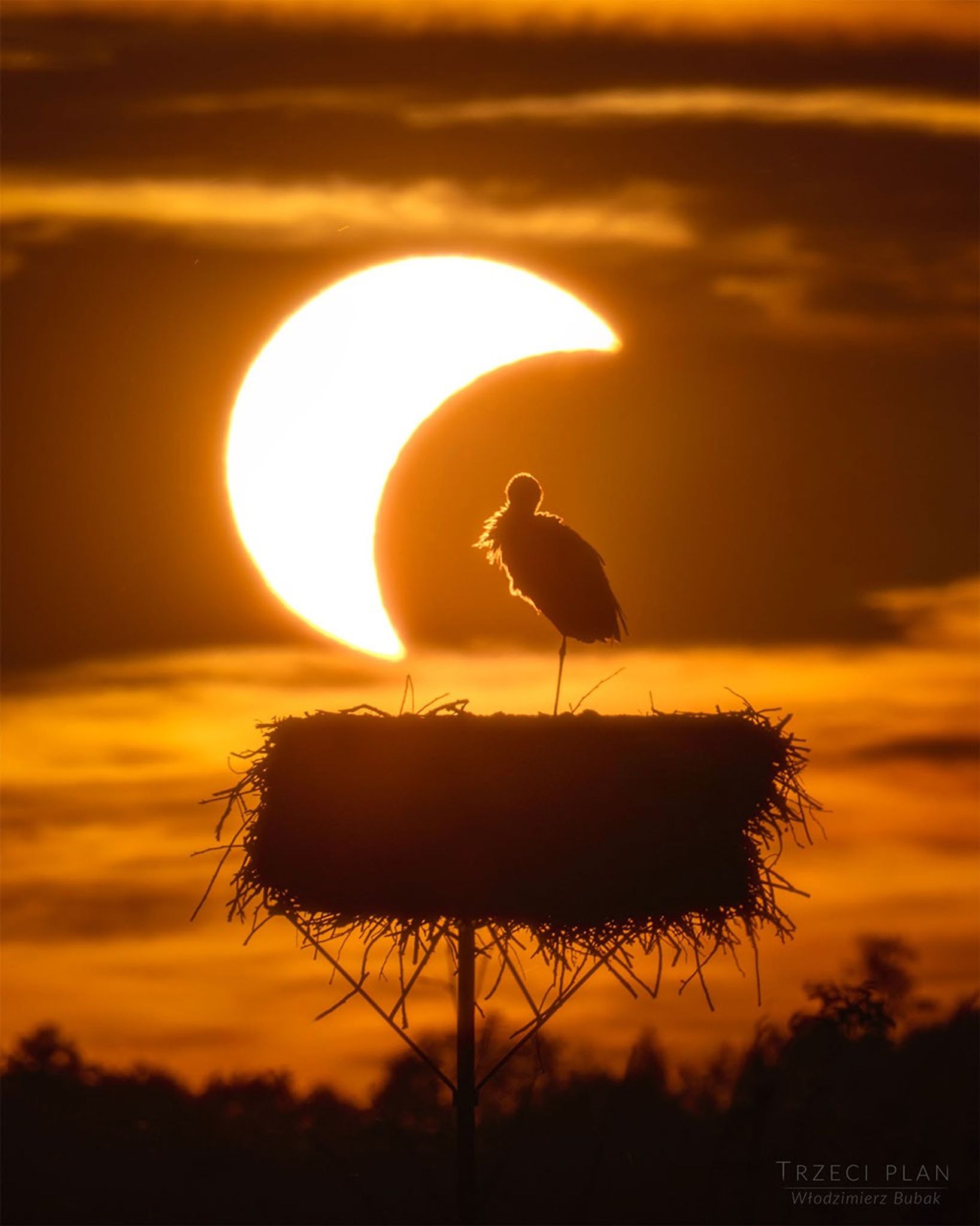
The Eclipse and the Stork
Explanation: How do animals react to a total solar eclipse? The featured image shows a stork roosting on her nest in Poland at a partial phase of the recent total solar eclipse. If you are lucky enough to experience a total eclipse somewhere quiet and close to nature, you may be able to notice unusual daytime animal behaviors. During totality, you may hear nighttime sounds like crickets and frogs and see fireflies. In the dark, most birds are quiet. Thinking that it is time to go to bed, ducks and other waterfowl prepare to sleep on one leg, with their heads turned around and their beaks tucked into their back feathers (they don’t really sleep with their heads tucked under one wing). When sunlight returns at the end of totality, songbirds greet the new “morning” with their dawn songs. The crickets and frogs go quiet again. Animals and people resume their lifes, only briefly disturbed by the chance alignment of our Sun and Moon.
APOD’s main NASA site is moving : From apod.nasa.gov to science.nasa.gov/apod
Tomorrow’s picture: What’s next?
| Date | September 3, 2026 |
|---|---|
| Credit & Copyright | Włodzimierz Bubak |
| Authors & editors: | Cecilia Chirenti, Robert Nemiroff, Jerry Bonnell, Keighley Rockcliffe |
| A service of: |
ASD at NASA / GSFC, NASA Science Activation & Michigan Tech. U. |