AI Insight
During the Artemis II mission from April 1-10, 2026, NASA astronauts Reid Wiseman, Victor Glover, and CSA astronaut Jeremy Hansen observed and documented five faint light flashes on the Moon's surface while aboard the Orion spacecraft at a distance of 46,000 miles. These flashes were caused by rocky fragments impacting the lunar surface and were captured with annotated photographs and crew observations. The complete lunar science dataset from the mission has been released to the global science community and public for further analysis.
Why it matters
Documenting impact events on the Moon helps scientists understand the frequency and distribution of meteoroid strikes in the Earth-Moon system, which has implications for understanding space hazards and the Moon's geological evolution. The crew observations provide valuable human-verified data that complements automated detection systems for future lunar exploration and habitat planning.
Understand the Science
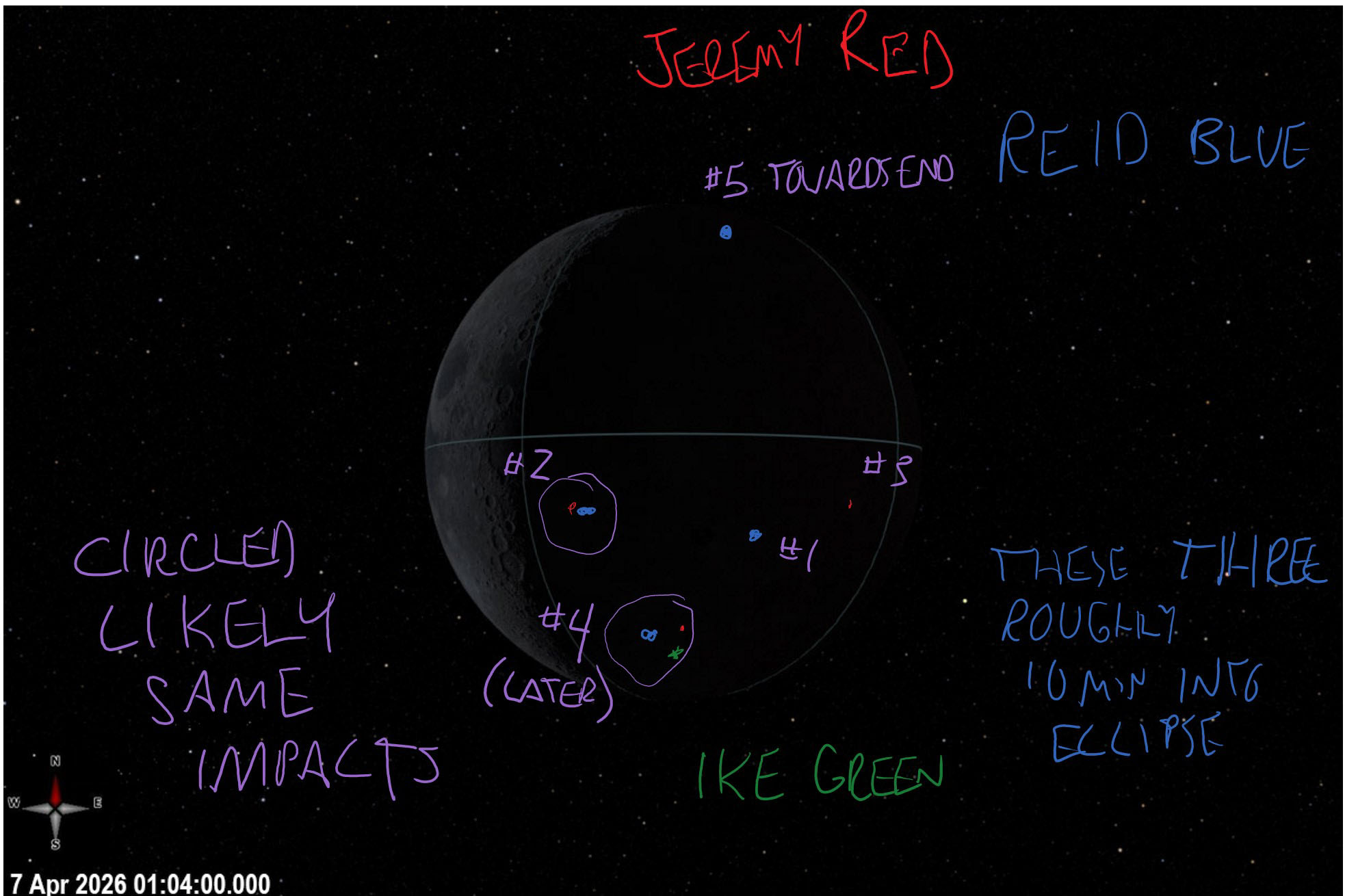
A visualization of a dark Moon eclipsing the Sun is marked with handwritten notes in this April 6, 2026, screenshot from an Artemis II crew member’s tablet.
NASA astronauts Reid Wiseman (in blue) and Victor “Ike” Glover (in green) and CSA (Canadian Space Agency) Jeremy Hansen (in red) observed impact flashes and their locations, which are noted on the image. Overall, the astronauts reported seeing five extremely faint “pinprick” bursts of light from their view aboard Orion, which was 46,000 miles away from the Moon at the time. These flashes are sparked by rocky fragments hitting the Moon.
From April 1 through April 10, 2026, NASA’s Artemis II crew traveled to the Moon and back and along the way, captured stunning imagery and scientific observations of our nearest neighbor. Now, the full lunar science dataset from their journey is available to the global science community, and to the public, for further study. Read about the report, listen to crew audio observations, and explore more.
Image credit: NASA
Source: Artemis II Crew Moon Photo Annotations