AI Insight
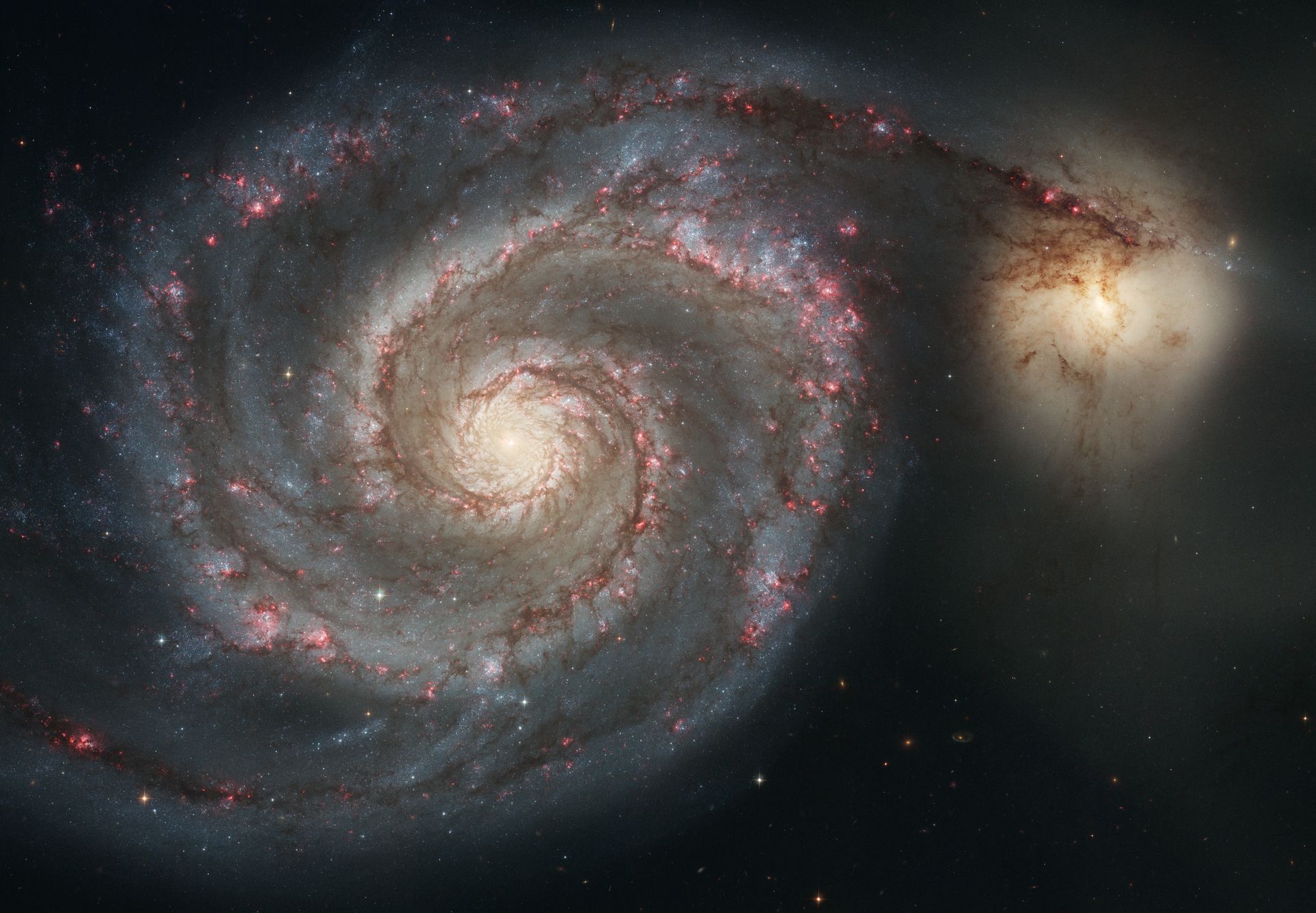
On October 13, 1773, French astronomer Charles Messier discovered the Whirlpool Galaxy (M51) while cataloging celestial objects that could be mistaken for comets. Messier could not discern its spiral structure or identify it as a galaxy; it took until 1845 for William Parsons to observe its whirlpool shape, and Edwin Hubble later confirmed that M51 and similar objects were actually distant galaxies. The Whirlpool Galaxy is located approximately 31 million light-years from Earth and is considered a classic example of a spiral galaxy, with its distinctive shape likely resulting from gravitational interaction with neighboring galaxy NGC 5195.
Why it matters
This discovery represents a pivotal moment in astronomical history, as Messier's catalog of non-comet objects became fundamental to understanding the universe beyond our solar system. The Whirlpool Galaxy remains an important subject for studying galactic formation, spiral structure development, and how gravitational interactions between galaxies can trigger increased star formation.
Understand the Science
On Oct. 13, 1773, a French astronomer named Charles Messier discovered the “Whirlpool Galaxy,” also known as Messier 51, or M51.
Charles Messier was scanning the sky for objects that could confuse comet hunters when he catalogued the galaxy as M51. However, Messier wasn’t able to see the spiral structure, and he didn’t identify it as a galaxy.
Seventy-two years later, another astronomer named William Parsons saw the whirlpool shape, but he thought it was a spiral nebula. Eventually, Edwin Hubble found out that M51 and other features like it were actually galaxies.
Why it mattered
The Whirlpool Galaxy is located about 31 million light-years from Earth and just might be the textbook case of a spiral galaxy. But in 1773, it was just one of 51 (at the time of its discovery) of “comet-like ‘objects to avoid'” in the night sky.
The Whirlpool Galaxy’s designation as M51 marks it as the 51st non-comet object catalogued by Messier, who was the chief astronomer of the Marine Observatory in Paris dedicated to studying comets. According to a NASA account, Messier stumbled across his first non-comet object, M1 (also known as the Crab Nebula), while studying a comet in 1758. The objects looked like fuzzy blobs like comets, but didn’t move like a comet. By 1773, at the time he first spotted M51, he had catalogued over four dozen such objects to help prevent astronomers from mistaking them for comets.
The Whirlpool Galaxy appears as a dazzling spiral in images by the Hubble Space Telescope, and has a magnitude of 8.4 on the brightness scale used by astronomers. That means it can be observed through a small telescope (“most easily during May,” NASA says) in the constellation Venatici (the Hunting Dogs) in the northern sky, just below the handle of the Big Dipper star pattern.
Scientists suspsect the Whirpool Galaxy gets is striking spiral shape from a close interaction with its neighbor galaxy NGC 5195, which may have passed through M51’s main disk about 500 million years ago, scientists with NASA’s Spitzer Space Telescope have said.
“This gravitational tug of war may also have triggered an increased level of star formation in M51,” they added in a statement. “The companion galaxy’s pull would be inducing extra starbirth by compressing gas, jump-starting the process by which stars form.”
Want more space history? Check out our full On This Day In Space Story archive and watch our On This Day In Space videos on YouTube.