AI Insight
This astronomical photograph captures Mars appearing in close proximity to the Beehive star cluster (M44/Praesepe) beneath an aurora display in Sweden on October 14, 2026. The aurora was caused by a solar eruption that reached Earth on October 10th, releasing energetic particles that collided with atmospheric molecules and produced the colorful light display. The apparent alignment of Mars with the Beehive cluster, a group of young stars whose rotation periods help scientists understand stellar aging through mass loss, was a coincidental occurrence.
Why it matters
This observation demonstrates the connection between solar activity and Earth's magnetic field disturbances, which can affect satellite communications and power grids. The study of star clusters like the Beehive provides valuable data on stellar evolution, particularly how stars slow their rotation over time through stellar wind mass loss.
Understand the Science
APOD
Astronomy Picture of the Day
Discover the cosmos! Each day a different image or photograph of our fascinating universe is featured, along with a brief explanation written by a professional astronomer.
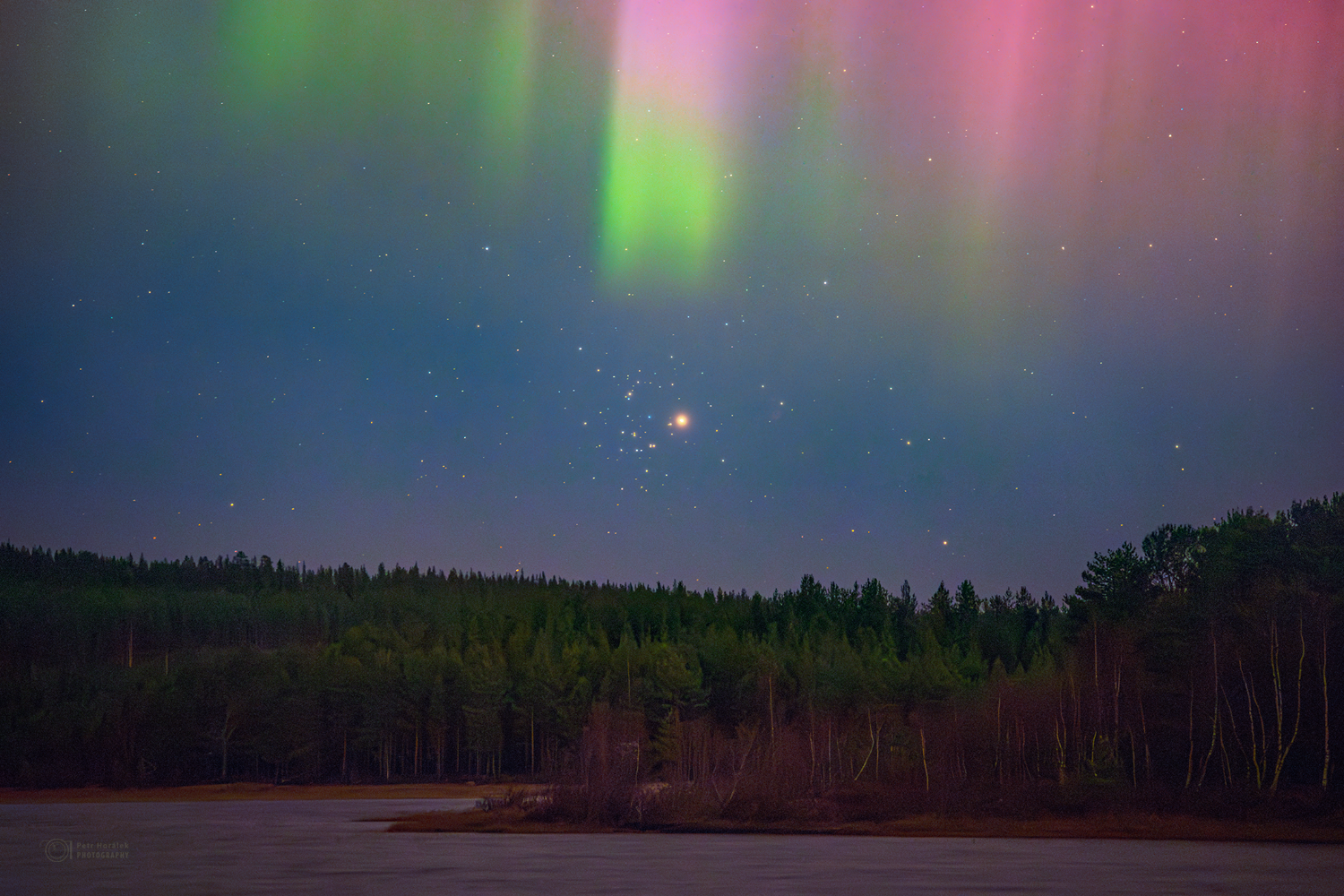
Mars and the Beehive Under an Aurora
Explanation: What a cosmic coincidence! In today’s image, Mars joins the Beehive cluster (M44 or Praesepe) below an auroral curtain and above a horizon of happy little trees near Lansjärv, Sweden. An eruption off the Sun reached Earth on October 10th, 2026 causing strong disturbances in Earth’s magnetic field. Energetic particles from the eruption collide with and energize the molecules in Earth’s atmosphere, which release that extra energy as the colorful aurora captured here. Auroras, or guovssahasat in North Sámi, is traditionally viewed with respect by the Sámi people indigenous to Sweden and other Arctic regions. Coincidentally, Mars appeared closest to the center of the Beehive cluster in the sky at the time. Although bees have been to space, the Beehive cluster is actually a swarm of young stars. Their rotation periods have helped humanity learn about how stars spin slower over time as they lose mass through their stellar winds.
Tomorrow’s picture: open space
| Date: | October 14, 2026 |
|---|---|
| Credit: | Petr Horálek (Institute of Physics in Opava), Josef Kujal, Vojan Höfer |
| Authors & editors: | Keighley Rockcliffe, Robert Nemiroff, Jerry Bonnell, Cecilia Chirenti |
| A service of: |
ASD at NASA / GSFC, NASA Science Activation & Michigan Tech. U. |
Source: APOD: 2026 October 14 – Mars and the Beehive Under an Aurora