Could a cosmic uncertainty principle help explain dark matter?
The universe may have its own version of Heisenberg’s uncertainty principle, and that might be enough to explain dark energy without invoking any new physics at all.
The universe may have its own version of Heisenberg’s uncertainty principle, and that might be enough to explain dark energy without invoking any new physics at all.
The source of the significant water ice deposits hidden in Mercury’s polar regions has been a topic of debate among researchers. A new study, published in the Journal of Geophysical Research:…
The Payload for Ultrahigh Energy Observations (PUEO) is a NASA Astrophysics Pioneers Program mission designed to detect the most energetic particles in the universe.
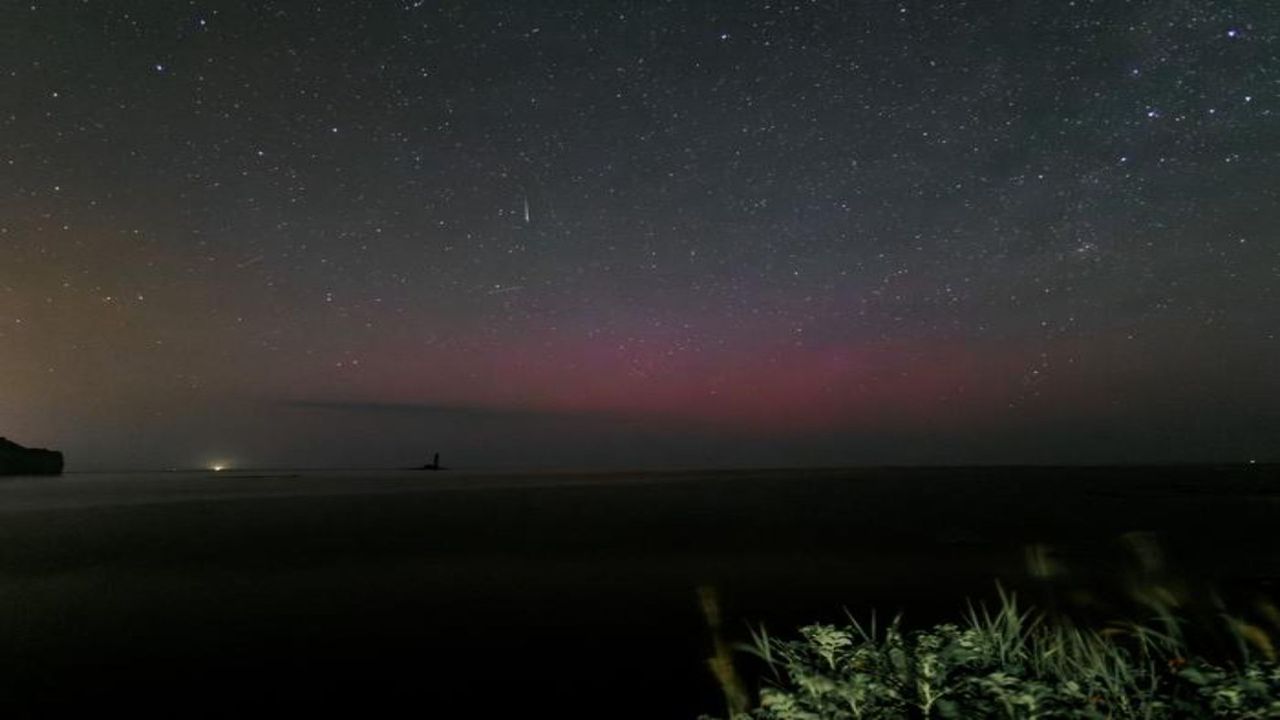
Researchers analyzing crimson auroras over Japan found the glowing displays stretched hundreds of miles higher into Earth’s atmosphere than expected, challenging long-held assumptions about the…
Researchers analyzing crimson auroras over Japan found the glowing displays stretched hundreds of miles higher into Earth’s atmosphere than expected, challenging long-held assumptions about the…
Using NASA’s Transiting Exoplanet Survey Satellite (TESS), astronomers have discovered a triply-eclipsing star system. The newfound system, designated TIC 295741342, consists of two sun-like stars in…
Mars holds a special place in the solar system. It represents marginal habitability. This means it transitioned from warm and wet and potentially hospitable, to cold and dry and inhospitable.
“This ring? It’s the most powerful weapon in the universe.”
“This ring? It’s the most powerful weapon in the universe.”
Data from NASA’s MAVEN spacecraft revealed a never-before-seen atmospheric effect on Mars, revealing how solar storms may shape planets without strong magnetic fields.