AI Insight
NASA's Juno spacecraft captured detailed images of Jupiter's northern hemisphere during its 61st flyby on May 12, 2024, showing turbulent cloud formations in a folded filamentary region. These areas occur where Jupiter's normal zonal jets break down, creating chaotic patterns of cyclonic storms and clouds that evolve rapidly over just a few days. The color-enhanced image was processed by citizen scientist Gary Eason using raw data from the JunoCam instrument.
Why it matters
This observation helps scientists understand the complex atmospheric dynamics of Jupiter, particularly how and why the planet's characteristic banded structure breaks down in certain regions. The involvement of citizen scientists in processing and analyzing spacecraft data demonstrates how public participation can contribute to planetary science research.
Understand the Science
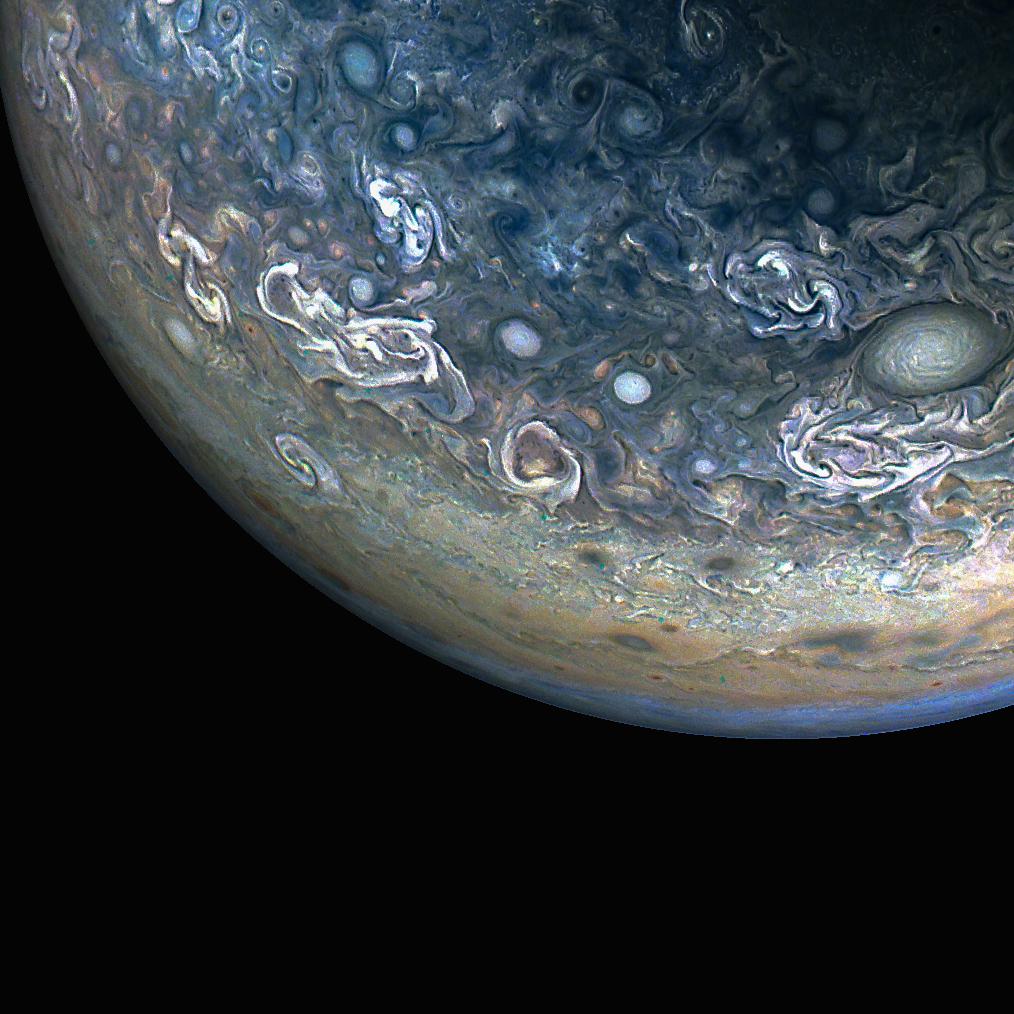
NASA’s Juno spacecraft captured this color-enhanced view of Jupiter’s northern hemisphere during its 61st close flyby of the giant planet on May 12, 2024.
Citizen scientist Gary Eason made this image using raw data from the JunoCam instrument, applying digital processing techniques to enhance color and clarity. It provides a detailed view of chaotic clouds and cyclonic storms in an area known to scientists as a folded filamentary region. In these regions, the zonal jets that create the familiar banded patterns in Jupiter’s clouds break down, leading to turbulent patterns and cloud structures that rapidly evolve over the course of only a few days.
Learn more about opportunities to do NASA science with citizen science projects.
Image credit: NASA/JPL-Caltech/SwRI/MSSS; Image processing by Gary Eason © CC BY
Source: Colorful, Chaotic Jupiter