AI Insight
Researchers compared three machine learning models for simulating raindrop formation in clouds, finding that the simplest approach—a polynomial-based sparse identification of nonlinear dynamics (SINDy) framework—outperformed more complex neural network models. All three models were trained using autoencoding techniques on data from large eddy simulations incorporating the superdroplet method, successfully reproducing key features like increasing droplet size over time and bimodal distributions, though they struggled with sharp peaks and noise. The study demonstrates that increased model complexity does not necessarily improve predictive performance in simulating cloud microphysics.
Why it matters
Improved models of raindrop formation could enhance the accuracy of weather forecasts and climate projections by better representing cloud processes. The finding that simpler machine learning architectures can outperform complex ones may guide future development of computationally efficient models for atmospheric science applications.
Understand the Science
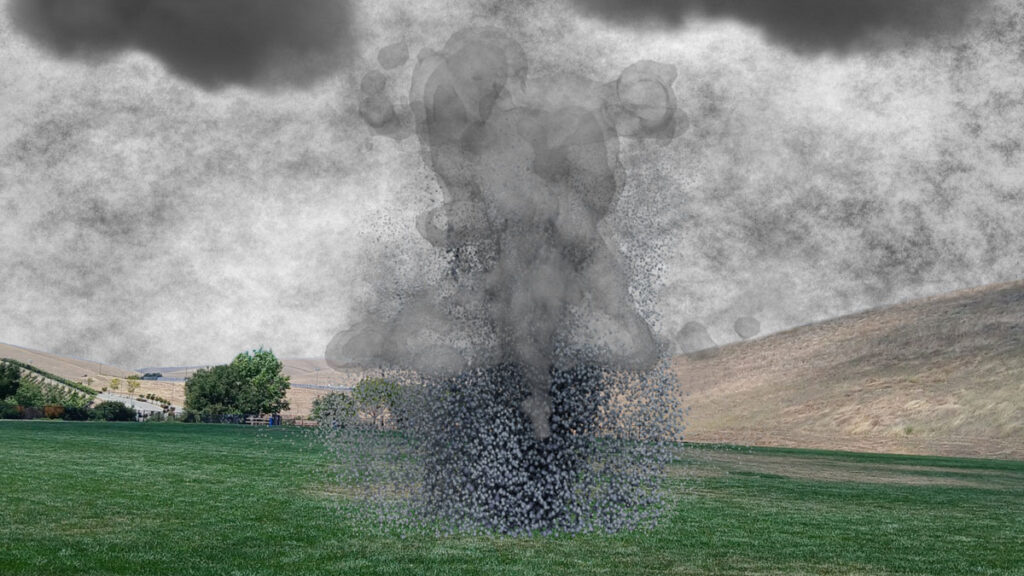
Source: Journal of Geophysical Research: Machine Learning and Computation
Raindrops form inside clouds when tiny particles of water collide and stick together, forming larger droplets that eventually fall to Earth. This process is hard to model accurately, with current approaches being either imprecise or computationally intensive. Better simulations of raindrop formation could help improve climate and weather models.
de Jong et al. present and compare three new models of droplet coalescence inside clouds that were created using machine learning techniques: a polynomial-based sparse identification of nonlinear dynamics (SINDy) framework, a neural network–driven time derivative, and a discrete-time autoregressive neural network. Of the three, the SINDy framework (the simplest model) performed best, yielding less uncertainty and better generalization to out-of-sample data than the other two approaches.
The key takeaway, the authors say, is that adding flexibility or complexity to models doesn’t always lead to better performance.
The authors used a machine learning technique called autoencoding to train the models, using data from large eddy simulations that incorporated an approach called the superdroplet method (SDM). By using modeled droplets that represent collections of real droplets, SDM approximates the size distribution and interactions of particles within a cloud more accurately than traditional methods.
The autoencoders successfully reconstructed many aspects of droplet size distributions under coalescence. For example, they were able to effectively reproduce the way mean droplet size increases over time as particles coalesce. They could also accurately simulate bimodal distributions, or datasets with two peaks. In this case, the data’s two peaks indicated that two approximate particle size ranges, often distinguished as being “cloud” or “rain” drops, stand out for being more common than other sizes. However, the autoencoders struggled with re-creating certain features, such as noise or very sharp and narrow peaks in the droplet distributions.
Further work will be necessary to prepare each model for general use, the authors caution, including online testing and the inclusion of other processes, such as condensational growth and evaporation and mixed-phase processes. Future work should focus on pairing simulations with atmospheric observations to impose realistic constraints on models and better tune them for applications in climate and weather modeling, they add. (Journal of Geophysical Research: Machine Learning and Computation, https://doi.org/10.1029/2025JH001103, 2026)
—Nathaniel Scharping (@nathanielscharp), Science Writer

Citation: Scharping, N. (2026), Comparing machine learning models of raindrop formation, Eos, 107, https://doi.org/10.1029/2026EO260219. Published on 8 July 2026.
Text © 2026. AGU. CC BY-NC-ND 3.0
Except where otherwise noted, images are subject to copyright. Any reuse without express permission from the copyright owner is prohibited.
Source: Comparing Machine Learning Models of Raindrop Formation