AI Insight
NASA's COSI (Compton Spectrometer and Imager) telescope is being assembled, with its detector assembly successfully raised in July 2026 at UC Berkeley. COSI is a wide-field gamma-ray telescope designed to observe high-energy phenomena including matter-antimatter interactions and stellar death processes in the Milky Way and beyond. The mission involves a collaboration between multiple universities, NASA centers, aerospace contractors, and international space agencies.
Why it matters
This telescope will provide crucial observations of some of the universe's most energetic events, helping scientists understand fundamental processes like the creation and annihilation of matter and antimatter, as well as stellar evolution. The data collected could advance our knowledge of high-energy astrophysics and the dynamic processes shaping our galaxy.
Understand the Science
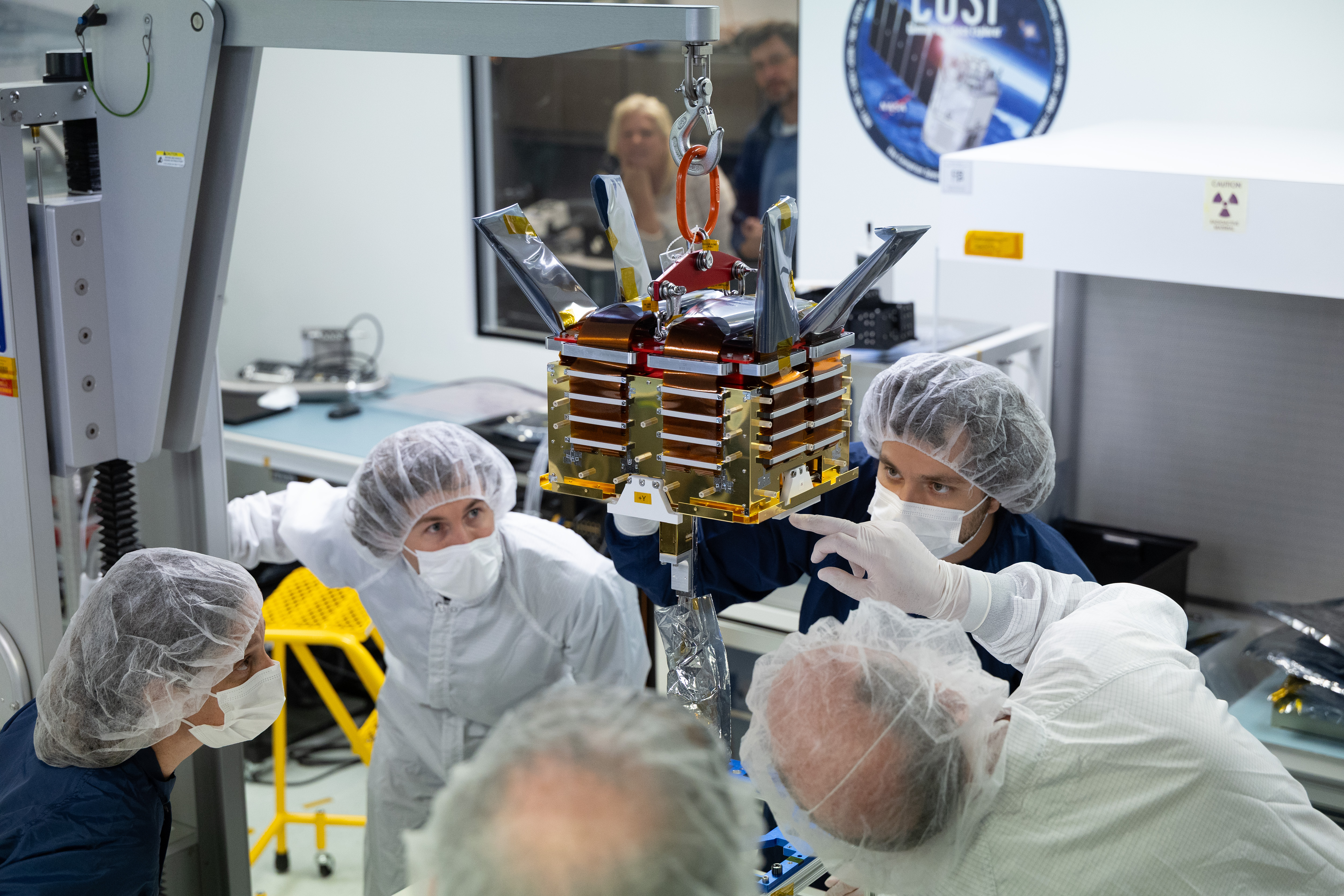
UC Berkeley engineers and managers watch as the COSI (Compton Spectrometer and Imager) detector assembly is slowly raised from a table in this July 8, 2026, image. The four pieces of silver material on the top of the detector box cover the flex circuits, which carry signals from the detectors to the readout electronics.
COSI is a wide-field gamma-ray telescope that will study energetic phenomena in the Milky Way and beyond, including the creation and destruction of matter and antimatter and the final stages of the lives of stars. The mission is a collaboration between the University of California, Berkeley’s Space Sciences Laboratory; the University of California, San Diego; the Naval Research Laboratory; NASA’s Goddard Space Flight Center; Northrop Grumman; Space Dynamics Laboratory; the Italian Space Agency; and a number of research institutions.
Image credit: UC Berkeley/Alan Toth
Source: COSI Telescope Comes Together