AI Insight
Researchers propose a refundable $200,000 bond system that satellite operators would pay before launch and recover with interest only after successfully deorbiting their spacecraft. The scheme aims to address the growing space debris problem and prevent the Kessler Syndrome, a cascading collision scenario that could make Earth's orbit unusable. Currently, 60% of satellites remain in orbit after their missions end despite international guidelines, as there are no enforcement mechanisms or financial consequences for non-compliance.
Why it matters
With companies planning to launch hundreds of thousands of satellites in coming years, the space around Earth risks becoming an unusable junkyard. This policy could be implemented at the national level without requiring international coordination, and could generate billions of dollars for active debris removal while creating financial incentives for responsible satellite disposal.
Understand the Science
The space around Earth is turning into a junkyard. Researchers think a refundable deposit scheme could force satellite operators to clean up their act before a tipping point is reached.
For years, space sustainability experts have warned that the growing number of satellites in orbit and the quantity of dead metal left behind threatens to trigger a dangerous cascade of collisions known as the Kessler Syndrome. Predicted in the 1970s by NASA physicist Donald Kessler, this chain of orbital smashups could make the space around Earth unusable and unsafe.
The dangerous tipping might be nearer than some think. Humankind’s utilization of space is at an inflection point, as companies such as SpaceX, Blue Origin and Amazon plan to launch constellations of hundreds of thousands of telecommunication satellites and orbiting data centers in the coming years.
“Low Earth orbit looks like lots of other resources that we have trashed as economic actors,” Daniel Kaffine, a professor of environmental and resource economics at University of Colorado Boulder, told Space.com.
“Waiting until it gets really, really bad to start implementing any of these types of policy interventions has historically been what we have done,” Kaffine added. “But maybe we can think about things we can do right now.”
In a paper published last month in the journal Nature Communications, Kaffine and his collaborators propose a scheme that would require satellite operators to post a bond of $200,000 before launch, refundable with interest upon the completion of a successful deorbit. Companies that fail to remove their junk would lose the money, which could go toward a shared pool funding active debris-removal missions, the researchers said.
“You could possibly raise billions of dollars by that,” said Kaffine. “We think it’s a very neat policy that doesn’t require international coordination.”
International bodies, such as the Inter-Agency Space Debris Coordination Committee, ask satellite operators to remove their spacecraft from orbit within 25 years after the mission’s end. The American Federal Communications Commission (FCC) imposes an even stricter standard — a five-year requirement for satellites in low Earth orbit. Still, a staggering 60% of satellites remain in place when their propellant runs out, the researchers say, as no consequences ensue if they fail to deorbit.
Solving the problem on the international level would be difficult, as international bodies have no powers to enforce compliance. Moreover, the United Nations Committee on the Peaceful Uses of Outer Space (COPUOS), which sets down rules for the peaceful exploration of outer space, requires the unanimous support of every member state to pass new regulations, which is nearly impossible to achieve.
“The policy we propose could be implemented on a national level, which is why we think it’s interesting,” Indigo Brownhall, a space sustainability researcher at University College London and the paper’s lead author, told Space.com. “Any country in Europe can request satellites registered with them to follow this bond policy.”
To put it simply, no satellite registered in a given country gets to space before putting the money into the kitty. The researchers acknowledge that it might be hard to persuade major players historically averse to regulations, such as the U.S., to roll out such a scheme. But they say a more environmentally conscious block, like the European Union (EU), could enforce compliance by limiting market access to those who observe their rules.
“The consumer market in Europe is massive, like 300 to 400 million people,” Brownhall said. “And the EU can request anyone who wants to sell space data or any products in the EU to follow their rules. They did this with GDPR [General Data Protection Regulation]. And you can imagine that somebody like Starlink [SpaceX’s satellite-internet subsidiary] surely wants to sell Starlink terminals to Europeans.”
The authors estimate that, even if the scheme only covered 20% of global satellite launches, it would reduce the number of derelict satellites careening around the planet by 18%.
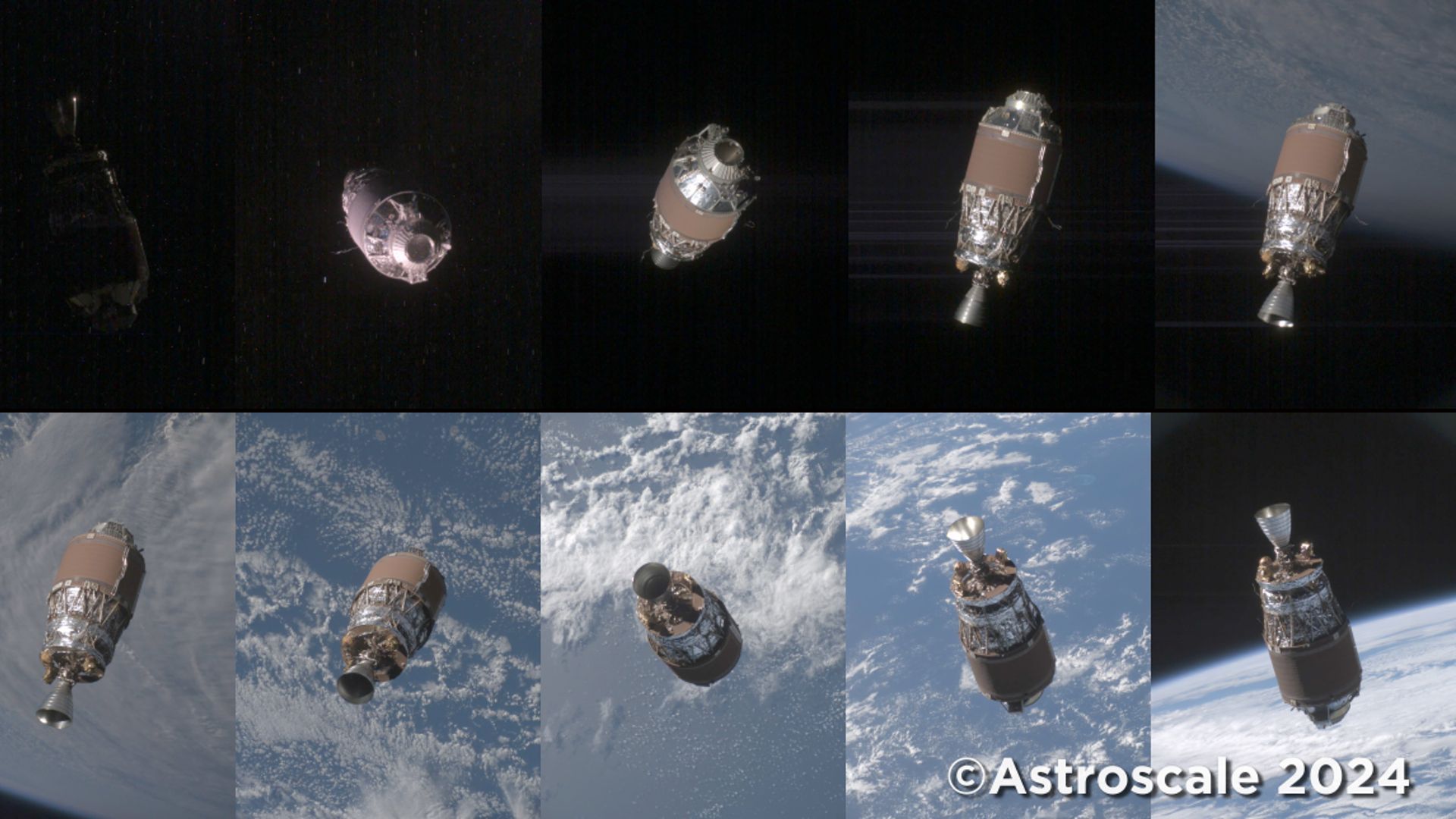
Currently, more than 57,000 pieces of space debris larger than 4 inches (10 centimeters) hurtle around Earth completely out of control, according to estimates by the European Space Agency. That’s double the figure from less than 10 years ago. Most of these fragments were generated by explosions and orbital collisions that shattered satellites and used rocket stages into clouds of dangerous debris.
“Leaving big satellites that no longer work up there is like a ticking time bomb,” Brownhall said. “Active satellites can move out of the way, but when two derelict satellites are going to hit each other, there is nothing you can do but watch it.”
Kaffine said the policy could be modelled on U.S. oil operators’ bond scheme, in place since the 1960s, which ensures that oil giants plug used oil wells after ceasing extraction.
“If the oil operators clean up after completing the oil production job, they get the money back,” said Kaffine. “If they don’t, the money goes into a fund, which the government then uses to clean up orphan wells. It’s quite an analogous situation to what we see in space.”
In the meantime, evidence of the worsening orbital situation is coming thick and fast. Space situational awareness companies such as U.S.-based LeoLabs, which use networks of ground-based radars and telescopes to monitor traffic in space, report increasing numbers of disintegration events — incidents involving either an explosion or a collision between old satellites, fragments and rocket bodies. In the past six months, LeoLabs has reported at least four fragmentation events in space, which together created hundreds of new pieces of space debris.