AI Insight
The Hubble Space Telescope captured an edge-on view of NGC 1827, an intermediate spiral galaxy located approximately 37 million light-years from Earth. The image shows the galaxy's sparkling edge dotted with bright blue stars and interwoven with dust ribbons, revealing its structure between barred and unbarred spiral galaxies. This observation is part of a larger Hubble survey examining 260 satellite galaxies gravitationally bound to larger host galaxies similar to the Milky Way.
Why it matters
Studying low-mass satellite galaxies like NGC 1827 helps researchers understand the complex gravitational dynamics within galaxies and their interactions with host galaxies. The survey aims to observe 260 satellites near Milky Way-like hosts, with 111 already identified, providing insights into galactic evolution and structure formation.
Understand the Science
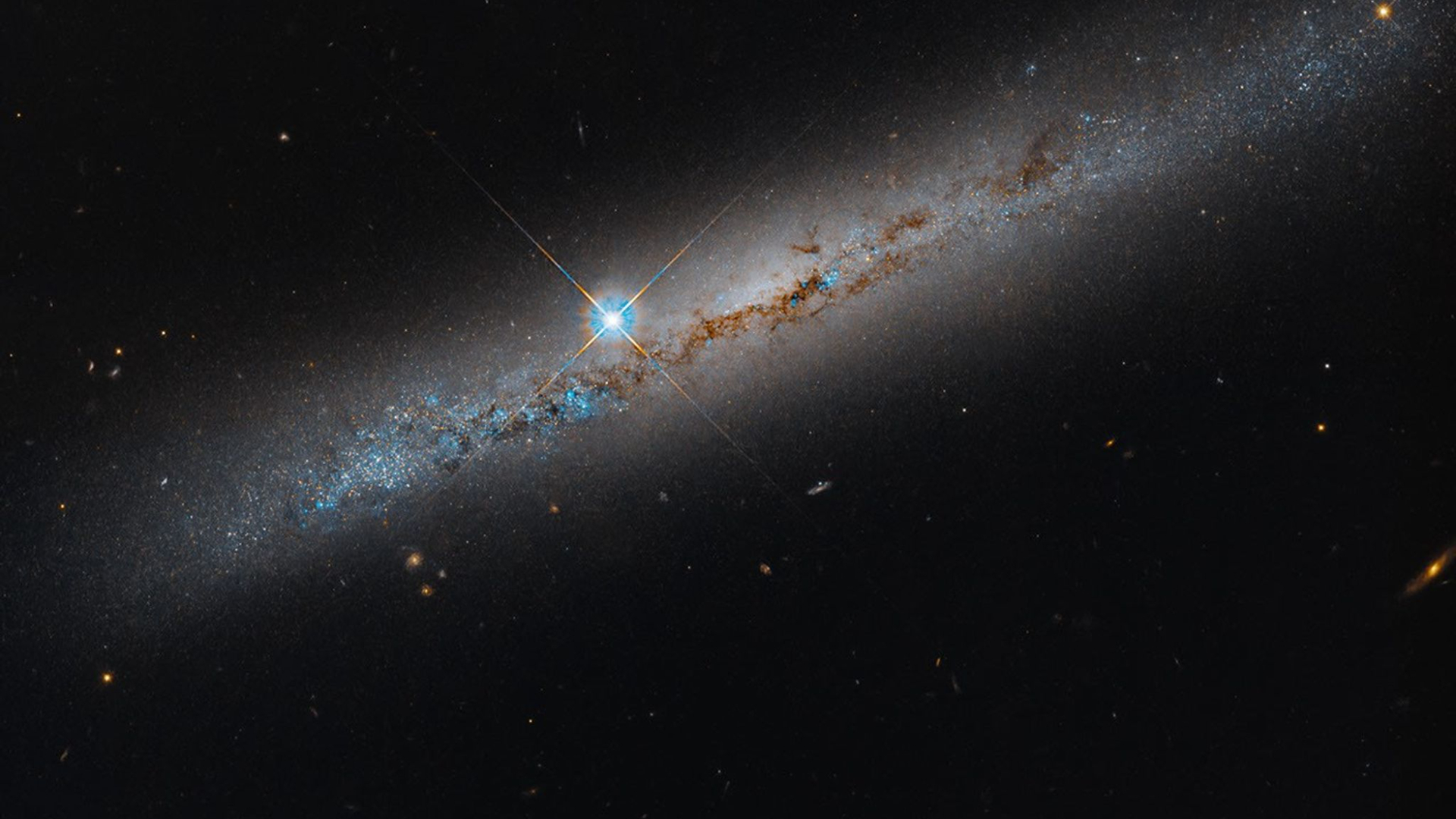
If you were approaching the edge of a spiral galaxy, arriving from afar through the cosmos, it might look something like this.
What is it?
In this new snapshot by the Hubble Space Telescope‘s Advanced Camera for Surveys (ACS), we can see the edge of the spiral galaxy NGC 1827. Found about 37 million light-years from Earth, this galaxy sparkles in this side-on view.
Not all spiral galaxies are the same. This galaxy is what is known as an “intermediate” spiral, which means that its structure sits somewhere between that of a barred and unbarred spiral galaxy. Barred galaxies have a distinctive central, bar-shaped structure, while the unbarred variety lacks this bar and can look more like circular spirals.
NGC 1827’s spiral shape isn’t clear from the side, however. From this perspective, we see its twinkling edge, speckled with stars and woven together with brown ribbons of dust.
Why is it incredible?
Beneath the beauty of this spiral edge lies an expansive, cosmic landscape. Bright blue stars dot the spiral’s side, with one particularly luminous star taking the spotlight with four diffraction spikes — created by light bending through the inner workings of Hubble’s camera — emanating from its center.
This image was captured as part of a larger Hubble survey that’s exploring 260 satellite galaxies, which are galaxies gravitationally bound to larger hosts. Hubble is specifically looking to survey satellite galaxies that lie near host galaxies similar to our own Milky Way.
So far, Hubble has spotted 111 such satellites and will continue to observe, hunting for the rest.
By studying satellite galaxies like this one, which also happens to be an especially low-mass galaxy, researchers could better understand the complicated dynamics both within the galaxies themselves and between them and their host galaxies.
Source: The view from the edge of a sparkling spiral galaxy | Space photo of the day for Oct. 20, 2026