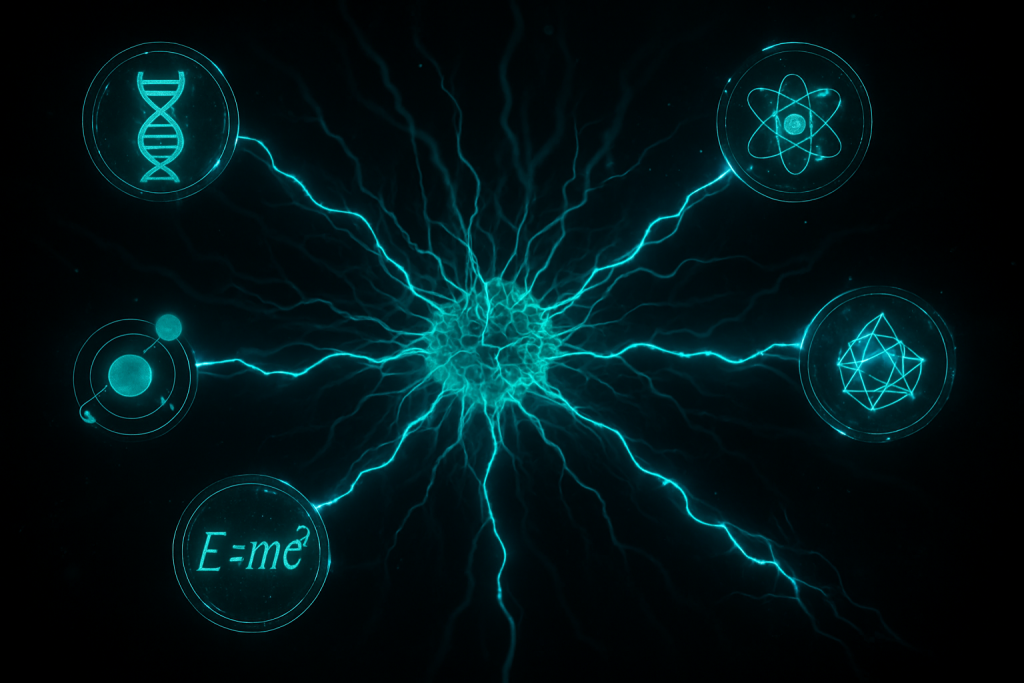
Image generated by AI
AI Insight
Artificial intelligence and machine learning have emerged as universal tools that connect multiple scientific disciplines by identifying patterns in data across physics, biology, chemistry, and other fields. AI enables collaboration between disciplines by requiring researchers to translate domain-specific knowledge into mathematical frameworks, revealing unexpected connections and creating new subdisciplines. This approach has accelerated scientific discovery in areas ranging from protein structure prediction to climate modeling, making previously intractable problems solvable.
Why it matters
The integration of AI with traditional sciences enables faster drug discovery, more efficient renewable energy development, and improved diagnosis of rare diseases. More fundamentally, machine learning is transforming the scientific method itself by blurring boundaries between theoretical and experimental work, creating feedback loops where computational predictions guide laboratory experiments that in turn refine predictive models.
Understand the Science
Artificial intelligence has become the unexpected lingua franca of modern science—a universal translator that speaks fluently across physics, biology, chemistry, and beyond. From predicting protein structures to discovering new materials, machine learning isn’t just another tool; it’s fundamentally reshaping how scientists across disciplines ask and answer questions.
Across the Sciences
Machine learning thrives at the intersection of multiple fields because it operates on a simple principle: finding patterns in data. A neural network trained to recognize medical images in radiology borrows mathematical principles from statistical mechanics. The algorithms that predict protein folding—earning a recent Nobel Prize—emerged from decades of work in computer science, structural biology, and physics combined. In materials science, AI models trained on quantum mechanical principles help researchers design better batteries and solar cells without synthesizing hundreds of candidates in the lab.
This interdisciplinary power extends to climate science, where machine learning models integrate atmospheric physics, oceanography, and computational mathematics to improve weather prediction and climate modeling. Neuroscience relies on AI to decode the activity patterns of millions of brain cells simultaneously—a task requiring expertise from computer science, statistics, and cognitive science. Even pure mathematics benefits, with AI systems discovering novel theorems and suggesting new research directions that human mathematicians might have overlooked.
What makes AI truly exceptional is its role as a bridge-builder. When a biologist, physicist, and computer scientist collaborate on an AI project, they’re forced to translate domain-specific knowledge into mathematics that machines can process. This translation often reveals unexpected connections between fields and creates entirely new subdisciplines, like computational chemistry and digital pathology.
Why This Matters for the Future
The convergence of AI with traditional sciences accelerates discovery at an unprecedented pace. Problems that would take years to solve through conventional experimentation—or might seem intractable altogether—become tractable when machine learning joins the toolkit. This has immediate applications: faster drug discovery, more efficient renewable energy, better diagnosis of rare diseases.
More profoundly, AI is changing how science itself is conducted. The traditional boundary between theoretical and experimental science blurs when machine learning can generate testable predictions directly from data. This creates a feedback loop where computational insights guide laboratory experiments, which generate data that improves models, which suggest new experiments.
As scientific challenges grow more complex—from understanding consciousness to reversing climate change—solutions will inevitably require expertise from multiple disciplines working in concert. Machine learning has become the scaffold upon which these collaborative structures rest.
Key Takeaways
- Machine learning serves as a universal translator across sciences, enabling discoveries in biology, physics, chemistry, and beyond.
- AI accelerates scientific progress by identifying patterns humans might miss and enabling predictions that guide experimental research.
- The future of science depends on interdisciplinary collaboration—and machine learning is the essential tool making that collaboration possible.
Explore TED Talks on AI and Machine Learning Applications:
TED content is used under CC BY-NC-ND 4.0. © TED Conferences, LLC.
Frequently Asked Questions
How do neural networks trained on medical imaging tasks apply principles from statistical mechanics?
Neural networks use mathematical frameworks similar to statistical mechanics to identify patterns in high-dimensional data, such as detecting anomalies in X-rays or MRI scans by learning probability distributions across pixel values. Both domains rely on optimization algorithms that find low-energy (or low-error) states through iterative refinement of system parameters.
What specific advantage does machine learning provide over traditional laboratory synthesis in materials science?
Machine learning models trained on quantum mechanical principles can predict material properties computationally, allowing researchers to screen thousands of candidate compounds virtually before synthesizing only the most promising ones. This reduces experimental time and costs by orders of magnitude compared to synthesizing and testing hundreds of physical samples.
Why is decoding simultaneous brain cell activity particularly suited to AI approaches?
Brain imaging techniques generate massive datasets with millions of simultaneous neural recordings, creating patterns too complex for manual analysis but ideal for machine learning's pattern-recognition strengths. AI systems can identify correlations and activity signatures across this high-dimensional data that reveal functional brain organization across different cognitive tasks.
How do machine learning models improve climate prediction by integrating multiple scientific disciplines?
Machine learning models ingest data from atmospheric physics, oceanography, and computational mathematics simultaneously, learning non-linear relationships between variables like temperature, pressure, and ocean currents that traditional physics-based equations struggle to capture. This multi-scale integration enables better prediction of weather patterns and long-term climate trends by capturing complex interactions across systems.