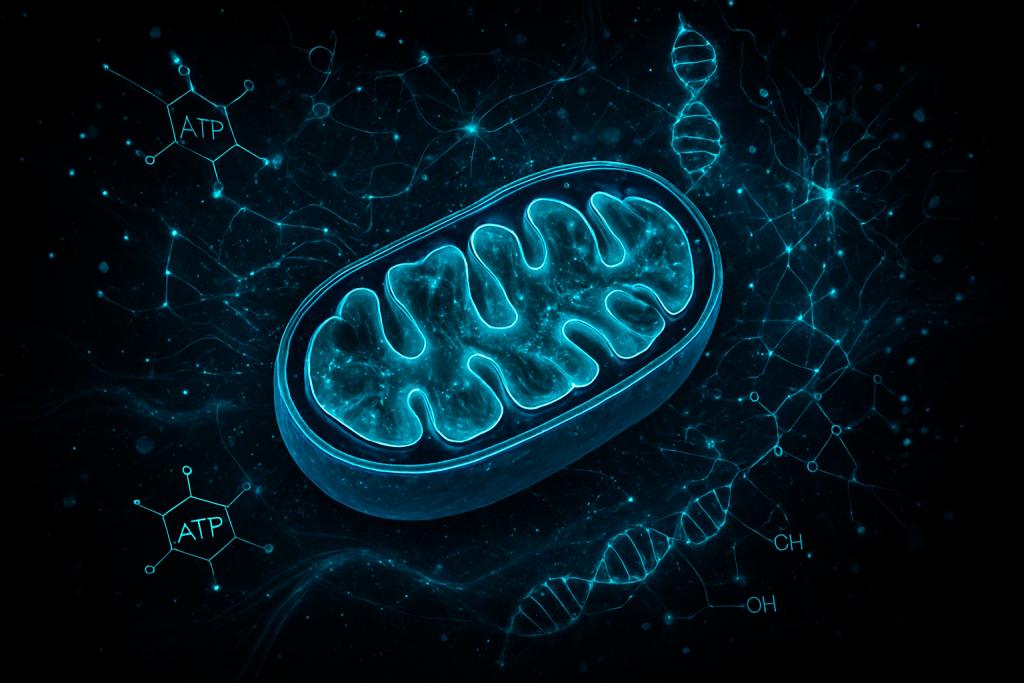
Image generated by AI
Inside nearly every cell in your body sits a tiny structure roughly the size of a bacterium, yet it holds the secret to why you can think, move, and feel. Mitochondria are often called the “powerhouses of the cell,” but that metaphor barely captures their true significance. They are, in essence, the reason complex life exists at all—transforming chemical bonds into usable energy through a process so elegant that physicists, chemists, biologists, and physicians continue to discover new dimensions of how they work.
Understanding mitochondrial function is not merely an academic exercise confined to cell biology textbooks. Diseases ranging from type 2 diabetes to Parkinson’s disease, aging itself, and even the efficiency of athletic performance all trace back to how well our mitochondria function. As researchers uncover the deep connections between energy metabolism and virtually every aspect of human health, mitochondrial science has become a crucial nexus where multiple disciplines converge—offering insights that could revolutionize medicine, biotechnology, and our fundamental understanding of life.
What Is Mitochondrial Function and Energy Metabolism?
Mitochondria are double-membraned organelles found in the cytoplasm of eukaryotic cells—essentially compartments within cells that serve as the primary site of energy production. At the heart of mitochondrial function lies aerobic respiration, a biochemical process that takes nutrients like glucose and fatty acids and extracts their chemical energy in a form the cell can use: adenosine triphosphate, or ATP. The process occurs in stages: glycolysis (in the cytoplasm), the citric acid cycle or Krebs cycle (in the mitochondrial matrix), and crucially, the electron transport chain (embedded in the inner mitochondrial membrane). Energy metabolism, the broader concept, encompasses all the chemical pathways by which cells break down nutrients and generate ATP, with mitochondria orchestrating the most efficient and powerful of these pathways.
The story of mitochondrial discovery is itself a fascinating scientific journey. In the 1840s and 1850s, scientists using early microscopes observed small, thread-like structures in cells and named them “mitochondria” from the Greek words for “thread” and “granule.” However, it wasn’t until the early 20th century that biochemists like Albert Szent-Györgyi and Hans Krebs began to understand the actual chemistry happening inside these structures. The true revolutionary moment came in 1961 when Peter Mitchell proposed the chemiosmotic theory, explaining how mitochondria create an electrochemical gradient across their membrane to power ATP synthesis—a concept so profound it earned him the Nobel Prize in Chemistry in 1978. Today, more than 60 years later, researchers continue to refine our understanding of the intricate mechanisms Mitchell described.
Across the Sciences
The mitochondria represents a stunning convergence of multiple scientific disciplines, each offering essential insights into how these organelles function. From a biochemistry perspective, the electron transport chain—a series of protein complexes embedded in the inner mitochondrial membrane—operates as an incredibly sophisticated molecular machine. Electrons pass from one protein complex to the next in a carefully choreographed dance, losing energy at each step. This lost energy pumps protons across the membrane, creating a gradient. But understanding how electrons move requires the physics of quantum tunneling and electron transfer theory. Meanwhile, chemists must grapple with the thermodynamics of ATP synthesis, calculating free energy changes and understanding how the potential energy stored in proton gradients powers the ATP synthase enzyme—a molecular turbine that spins to attach phosphate groups to ADP, forming ATP. Biologists examine genetic regulation, asking how cells decide how many mitochondria to make or which metabolic pathway to activate. Medical researchers investigate how mitochondrial dysfunction contributes to disease, while physiologists measure how energy demand changes during exercise.
Consider the mitochondrion as a living contradiction: a microscopic power plant operating with an efficiency that rivals the best engineered systems humans have created. A single ATP synthase enzyme—the molecular turbine that generates ATP—spins approximately 100 times per second, with each rotation producing one ATP molecule. This is comparable to the efficiency of human-made industrial turbines, yet this protein is operating in a warm, wet cellular environment filled with noise and chaos. A human muscle cell contains thousands of mitochondria, and during intense exercise, your muscles might consume your entire body weight in ATP each day, only possible because each ATP molecule is recycled and remade roughly 300 to 500 times daily. When you sprint, your mitochondria don’t just work harder—they transform their internal organization, changing their shape and structure to maximize efficiency.
Why This Matters for the Future
The intersection of mitochondrial science with modern medicine is generating breakthroughs that could transform how we treat some of humanity’s most challenging diseases. Mitochondrial dysfunction has been implicated in conditions ranging from neurological disorders like Parkinson’s and Alzheimer’s disease to metabolic diseases like type 2 diabetes and obesity. Recent research suggests that aging itself may fundamentally be a story of declining mitochondrial function—as we grow older, our mitochondria become less efficient at producing energy, accumulate damage, and trigger inflammatory responses that damage tissues. Understanding these mechanisms opens new therapeutic avenues: researchers are exploring compounds that improve mitochondrial efficiency, drugs that enhance the cell’s ability to clear damaged mitochondria (a process called mitophagy), and even gene therapies that could replace mutated mitochondrial DNA. The emerging field of mitochondrial medicine treats diseases caused directly by mutations in mitochondrial genes, which affect roughly 1 in 4,000 people worldwide.
The practical applications extend far beyond treating disease. Athletic performance companies are investigating mitochondrial optimization—how certain supplements, training protocols, and altitude exposures can enhance mitochondrial density and efficiency in muscles. The longevity and aging research community views mitochondrial health as one of the most promising targets for extending human lifespan. In the biotech industry, researchers are engineering cells with enhanced mitochondrial function for regenerative medicine applications. Cancer researchers are discovering that cancer cells often have dysfunctional mitochondria and exploring how to exploit this weakness to kill malignant cells selectively. Even in agriculture, improving photosynthetic efficiency—which depends on the chloroplast, a mitochondrial cousin—could increase crop yields to feed a growing global population.
Recent Breakthroughs in Mitochondrial Function and Energy Metabolism
The past few years have witnessed extraordinary advances in our ability to study and manipulate mitochondria at unprecedented resolution. In 2022 and 2023, cryo-electron microscopy (cryo-EM) techniques allowed researchers to visualize the entire electron transport chain and ATP synthase in atomic detail, revealing previously unknown structural features that explain how protons flow through the enzyme. These structural insights have enabled researchers to identify new targets for drugs and to understand how mutations in these proteins cause disease. Simultaneously, advanced two-photon microscopy and genetically encoded biosensors have allowed scientists to watch energy metabolism happening in living cells and intact organisms in real time, revealing that mitochondrial function varies dramatically depending on a cell’s immediate environment and metabolic state. A particularly striking discovery emerged from studies of exercise physiology: researchers found that intense, short bursts of exercise trigger more mitochondrial growth than traditional steady-state cardio, providing a molecular explanation for why high-intensity interval training appears so effective.
The current frontier involves understanding mitochondrial dynamics—how mitochondria constantly fuse and divide, how they communicate with the nucleus and other organelles, and how these processes influence health and disease. Researchers are investigating whether certain diseases involve problems with mitochondrial quality control, where damaged organelles aren’t properly removed. Others are exploring the fascinating discovery that mitochondria can transfer genetic material between cells, suggesting a form of cellular communication we barely understand. A major open question involves clarifying exactly why aging impairs mitochondrial function and whether interventions that improve mitochondrial health can genuinely extend lifespan in humans, not just in laboratory organisms.
Why Mitochondrial Function and Energy Metabolism Matters for the Future
As we face challenges ranging from an aging global population to climate change to pandemic preparedness, mitochondrial science sits at the intersection of nearly every major future challenge. An aging population will increasingly suffer from age-related diseases intimately connected to mitochondrial decline. The obesity and diabetes epidemics sweeping the globe both involve fundamental problems with how cells metabolize energy. Even climate resilience may depend on understanding how organisms optimize their energy use and adaptation—knowledge derived from mitochondrial biology. Beyond medicine, the agricultural and environmental sectors face pressure to produce more food and energy with fewer resources; insights from how nature achieves maximum energy efficiency in tiny mitochondria could inform new biotechnologies. The field of synthetic biology increasingly aims to engineer cells and organisms with enhanced capabilities—capabilities that fundamentally depend on controlling energy metabolism.
However, significant challenges remain. Most current treatments for mitochondrial diseases are supportive rather than curative—we can manage symptoms but cannot yet reliably repair or replace damaged mitochondria. Translating discoveries in simple organisms and cell cultures to effective human therapies has proven surprisingly difficult. Additionally, the mitochondrion’s dual genetic system—possessing its own DNA inherited from maternal ancestry alongside nuclear genes—creates unique genetic and ethical complexities. The question of how to safely and ethically modify mitochondrial genes to treat disease remains unsettled in many jurisdictions.
Key Takeaways
- Mitochondria are the primary energy-producing organelles in cells, generating ATP through a process that requires understanding biochemistry, physics, genetics, and physiology simultaneously.
- The electron transport chain and chemiosmotic process represent a convergence of quantum physics, thermodynamics, and molecular biology, showing how microscopic machines achieve remarkable efficiency.
- Mitochondrial dysfunction contributes to aging, neurological diseases, metabolic disorders, and cancer, making mitochondrial medicine one of the most promising frontiers for treating multiple human diseases.
- Recent breakthroughs in cryo-EM and real-time cellular imaging have revealed atomic-level details of mitochondrial machinery and enabled unprecedented insight into how these organelles respond to cellular demands.
- Understanding and optimizing mitochondrial function holds transformative potential for extending healthy human lifespan, treating age-related diseases, improving athletic performance, enhancing agricultural productivity, and addressing fundamental questions about the nature of life itself.
Explore TED Talks on Mitochondrial Function and Energy Metabolism:
TED content is used under CC BY-NC-ND 4.0. © TED Conferences, LLC.
Frequently Asked Questions
How do mitochondria convert chemical bonds into usable energy for cells?
Mitochondria convert chemical bonds through aerobic respiration, a process where glucose and other molecules are broken down in a series of enzymatic reactions across the inner mitochondrial membrane. These reactions ultimately drive the production of ATP (adenosine triphosphate), the primary energy currency that cells use to power virtually all biological functions.
Why are mitochondria considered crucial to understanding diseases like type 2 diabetes and Parkinson's disease?
Mitochondrial dysfunction impairs the cell's ability to produce sufficient ATP, leading to metabolic dysregulation and cellular damage in tissues that demand high energy—such as pancreatic cells (diabetes) and neurons (Parkinson's). When mitochondria fail to work efficiently, cells cannot maintain proper glucose metabolism or protect themselves from oxidative stress.
What role does the double membrane structure of mitochondria play in energy production?
The inner mitochondrial membrane is the critical site where the electron transport chain and oxidative phosphorylation occur, allowing the stepwise extraction of energy from molecules and the generation of the electrochemical gradient necessary for ATP synthesis. The outer membrane encloses these reactions and helps regulate the import of metabolic substrates.
How does mitochondrial function relate to athletic performance and physical endurance?
Athletes with highly efficient mitochondria can produce ATP more effectively during sustained exercise, enabling greater oxygen utilization and endurance performance. The density and function of mitochondria in muscle cells directly determine aerobic capacity and the body's ability to meet the energy demands of prolonged physical activity.