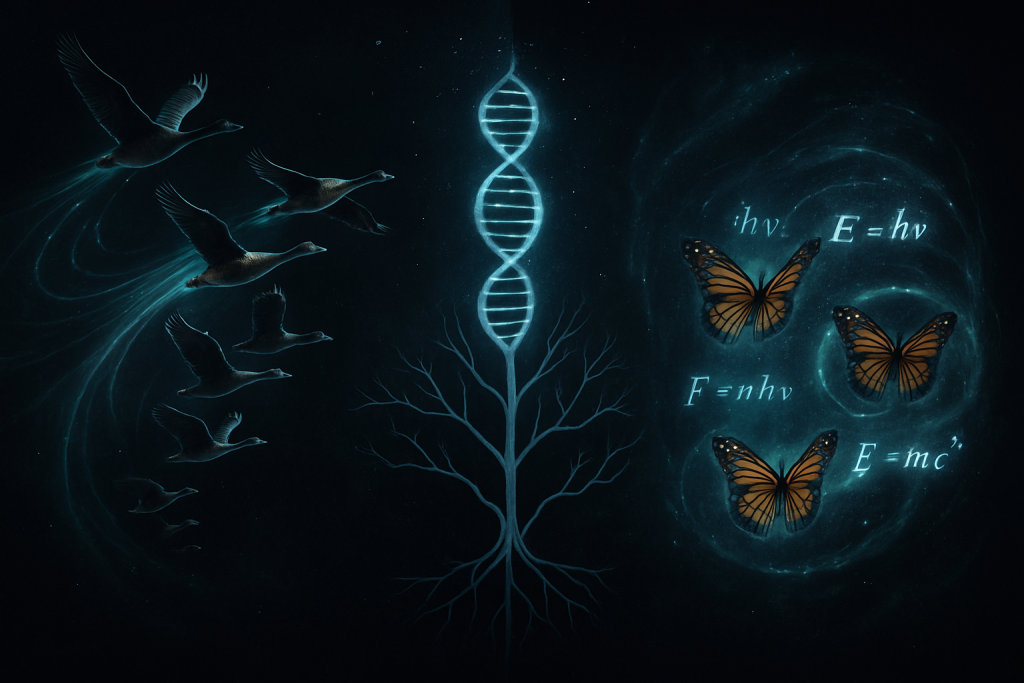
Image generated by AI
Every spring, a bar-tailed godwit launches itself from Alaska, beginning an 11,000-kilometer nonstop flight to New Zealand—a journey so arduous that the bird arrives weighing half what it did when it departed. Yet this same species skips meals for weeks during migration, shrinking its organs, living on stored fat reserves alone. What drives an animal to literally consume itself for survival? The answer lies at the intersection of evolutionary biology, physics, ecology, and neuroscience, where migration represents one of nature’s most profound biological compromises.
Animal migration is fundamentally a study in tradeoffs—and understanding these tradeoffs is reshaping how scientists across disciplines think about evolution, energy, risk, and adaptation. As climate change alters migration corridors, ecosystems face unprecedented disruption, and researchers must now synthesize insights from molecular biology to climate science to predict which species will adapt and which will collapse. This convergence of scientific fields reveals that migration is far more than just movement; it is a lens through which we can see how organisms navigate the deepest constraints of being alive.
What Is Animal Migration Tradeoffs and Evolution?
Animal migration represents a repeating cycle of long-distance movement, typically between breeding and feeding grounds. But migration is never free. Every migrating animal faces fundamental tradeoffs: energy expended versus survival gained, reproductive investment versus immediate mortality risk, accuracy of navigation versus metabolic cost. These tradeoffs are the evolutionary crucible where natural selection continuously reshapes which animals migrate, how far they travel, when they depart, and how they navigate. A migratory creature must balance competing demands—fuel its body for months of flight while maintaining enough reserves to reproduce upon arrival, navigate across featureless terrain using imperfect internal compasses, and time its departure to match seasonal food availability that itself is shifting with climate change.
The modern study of migration tradeoffs emerged in the 1960s and 1970s, when ecologists like Peter Berthold and William Cochran began using novel tracking technologies—first geolocators, then satellite tags, and now miniaturized GPS devices and light-level loggers—to follow individual animals across continents. Before this era, scientists could only study migration through incomplete observations: netting birds at specific locations, analyzing stomach contents, or noting seasonal disappearances. These pioneers demonstrated that migration was not random wandering but a finely tuned strategy shaped by predictable ecological and evolutionary pressures. Their work opened a profound realization: to understand migration, you must understand physics (how far can a body fly?), ecology (where is food?), evolution (what pressure favors migration over staying?), and physiology (how can an organism sustain such extremes?).
Across the Sciences
Migration tradeoffs represent a genuine convergence point for multiple scientific disciplines, each offering essential explanatory power that none possesses alone. Evolutionary biology asks: why do some species migrate while closely related species do not? What selective pressures maintain migration behavior across generations, especially when migration carries enormous mortality risk? Physics and biomechanics ask: what is the theoretical maximum distance an organism can travel given its body size, muscle composition, and metabolic rate? Ecology asks: how do shifting food availability, predation pressure, and habitat quality at breeding and wintering grounds determine whether migration is advantageous? Neuroscience asks: how do animal brains process navigational information, track time, and trigger the physiological changes that enable migration? Climate science asks: how will changing conditions along migration routes affect the reliability of seasonal cues that animals depend on? Genetics asks: which genes control migratory behavior, and how do they spread through populations?
Consider the gray whale, which migrates 12,000 miles annually from Arctic feeding grounds to Mexican breeding lagoons. A physicist can calculate that the whale’s body size and muscle mass should theoretically limit its range to perhaps 8,000 miles given basal metabolic rates. Yet whales exceed this by storing enormous quantities of blubber—an evolutionary solution to a physics problem. An ecologist observes that Arctic waters are exceptionally rich in krill and zooplankton during summer; the whale’s migration is a solution to an ecological problem: breeding grounds are productive but remote. An evolutionary biologist notes that gray whale populations that attempted to breed in the Arctic would face freezing water, diminished visibility, and overwhelming predation pressure on calves. Thus migration, despite its enormous energetic cost, is the lesser evil. A neurobiologist studying gray whale brains finds magnetic sensing capabilities and complex temporal processing that allow whales to synchronize their movements with magnetic field variations and tidal patterns. A climate scientist warns that Arctic warming is altering the timing of plankton blooms, creating a mismatch problem: if whales arrive at their traditional feeding grounds after peak food availability has passed, they cannot store sufficient energy for the return journey. This cascade illustrates how migration tradeoffs generate genuine scientific problems that demand interdisciplinary solutions.
Why This Matters for the Future
Climate change is rapidly converting animal migration from an ancient, finely tuned behavior into an increasingly risky proposition. As growing seasons shift, migration corridors fragment, stopover sites dry up, and the temporal synchronization between predators and prey dissolves, migratory animals face a crisis. Many species face a brutal evolutionary choice: evolve new migration timing (which requires rapid genetic change), shift to sedentary strategies (which may be impossible given local resource limitations), or face extinction. Scientists studying migration tradeoffs are now becoming central to conservation biology, because predicting which species survive climate change requires understanding their energetic constraints, behavioral flexibility, and evolutionary capacity—precisely the questions that migration research answers. Understanding these tradeoffs also provides insights into broader evolutionary principles: how do organisms respond to imposed constraints? What determines the limits of adaptation? When do populations face trade-offs that are genuinely impossible to resolve, triggering evolutionary dead-ends?
The pharmaceutical and biotechnology industries are beginning to mine migratory animal physiology for innovation. Researchers have discovered that migratory birds undergo controlled changes in metabolic rate, immune function, and muscle composition that appear to suspend normal aging processes during migration seasons. Companies are investigating whether these physiological mechanisms might inform treatments for muscle wasting, metabolic disorders, and aging-related diseases. Additionally, the neurobiological mechanisms underlying animal navigation—particularly magnetic sensing and path integration—are inspiring new approaches to GPS-denied navigation systems for autonomous vehicles, drones, and robotic systems. The U.S. military and technology companies are funding research into animal navigation specifically to develop bio-inspired navigation algorithms that don’t depend on satellite signals. Understanding how migratory animals process and integrate multiple sensory streams to generate robust navigation is yielding fundamental insights into perception and decision-making that extend far beyond animal biology.
Recent Breakthroughs in Animal Migration Tradeoffs and Evolution
In 2022 and 2023, researchers published a series of studies revealing that climate-driven phenological mismatches—the divergence between when predators and prey, or migrating animals and food resources, are active—are causing population-level crashes in migratory species far faster than evolutionary adaptation can compensate. A landmark study in Nature Climate Change tracked 700 bird species across decades and found that species unable to shift their migration timing to match earlier spring peaks were experiencing catastrophic breeding failures. Simultaneously, studies of Arctic migratory species revealed that rapid permafrost thaw is destabilizing traditionally productive feeding grounds, forcing some species to undertake longer migrations to less predictable alternatives. These findings have galvanized the field, demonstrating that migration tradeoffs are no longer abstract evolutionary concepts but immediate conservation crises. Additionally, advances in genomic sequencing have identified specific genes controlling migration distance, direction, and timing in birds, providing the first molecular-level understanding of how migratory behavior is encoded and inherited—opening possibilities for tracking evolutionary responses to climate change in real time.
Cutting-edge research is now exploring whether animals can evolve new migration strategies faster than previously thought possible. Recent work with European pied flycatchers, a species showing rapid shifts in migration timing, suggests that behavioral flexibility and standing genetic variation may allow populations to adapt to changing conditions within just a few generations—though this remains an open question that researchers are intensely pursuing. Other teams are using machine learning to analyze millions of migration tracking data points, revealing previously unknown migration routes, stopover sites, and seasonal behaviors that traditional observation methods missed. The most speculative and exciting frontier involves synthetic biology: could researchers design organisms or populations with modified migration strategies to help species adapt to rapidly changing conditions? This raises profound ethical and ecological questions that the field is only beginning to grapple with.
Why Animal Migration Tradeoffs and Evolution Matters for the Future
As planetary systems continue to destabilize, animal migration becomes a barometer of broader ecosystem health and a testing ground for fundamental questions about evolution’s capacity to respond to rapid change. Migration tradeoffs illuminate a crucial scientific truth: organisms don’t evolve in isolation, but within webs of dependencies and constraints. Understanding these webs is essential for predicting how ecosystems will reorganize as climate changes. If migratory species collapse, their removal cascades through food webs—insectivorous birds that control pest populations vanish, ocean predators lose access to migratory fish, and ecological communities structured around predictable seasonal pulses dissolve. Conversely, successful adaptation by migratory species demonstrates that evolution can occur rapidly enough to track environmental change, a finding with profound implications for assessing broader extinction risk. Migration research is thus becoming central to the emerging field of “evolutionary rescue,” where scientists investigate whether populations can adapt quickly enough to avoid extinction.
The current challenge is integrating insights across scales—from molecular mechanisms of gene expression controlling migration to population-level demographic modeling to continental-scale climate projections. No single scientific discipline can address these questions alone. Evolutionary biologists must collaborate with climate modelers who themselves must work with ecologists, physiologists, and conservation practitioners. This integration remains incomplete, with persistent gaps in communication and methodology across disciplines. Additionally, many migratory species remain poorly studied; researchers have detailed tracking data for some seabirds and whales but virtually no information about the migration patterns of thousands of insect, fish, and reptile species that may be equally threatened by climate change. The sheer complexity of migration systems—the number of variables, the nonlinear relationships, the emergent properties—means that predicting outcomes remains uncertain even with current scientific knowledge.
Key Takeaways
- Animal migration is a supreme biological tradeoff, requiring organisms to balance energy expenditure, survival risk, and reproductive success across continental distances—making migration a natural laboratory for studying evolutionary constraints and adaptation.
- Migration tradeoffs generate scientific questions that span evolutionary biology, physics, ecology, neuroscience, and climate science; no single discipline can fully explain why animals migrate, how they navigate, or whether they can adapt to rapid environmental change.
- Climate change is creating phenological mismatches where migratory animals arrive at breeding or feeding grounds at times when food availability has shifted, forcing rapid evolutionary change that populations may be unable to achieve, leading to population-level crashes in some species.
- Recent breakthroughs in genomic sequencing, animal tracking technology, and machine learning are revealing the genetic basis of migration behavior and identifying previously unknown migration routes, while simultaneously demonstrating that some populations can adapt migration timing within just a few generations.
- Understanding animal migration tradeoffs has applications extending far beyond ecology—from biotechnology seeking insights into metabolic regulation and aging to military and commercial development of bio-inspired navigation systems that function without satellite signals.
Explore TED Talks on Animal Migration Tradeoffs and Evolution:
TED content is used under CC BY-NC-ND 4.0. © TED Conferences, LLC.
Frequently Asked Questions
Why do bar-tailed godwits shrink their organs during migration?
Organ shrinkage reduces body mass and metabolic demands, allowing the bird to sustain long nonstop flights on stored fat reserves alone. This physiological adaptation represents a tradeoff between maintaining organ function and achieving the energy efficiency necessary for extreme endurance migration.
How do evolutionary pressures shape migration strategies across different animal species?
Species evolve migration patterns based on tradeoffs between energy costs, predation risk, breeding success, and food availability in different seasonal locations. Natural selection favors individuals whose migration timing and route maximize reproductive output relative to the physical costs of the journey.
What role does physics play in understanding animal migration constraints?
Physics determines the energetic costs of movement through air or water, the forces acting on migrating bodies, and the relationship between body size, speed, and fuel consumption. These physical constraints directly influence which migration routes are physiologically possible and how organisms must adapt their bodies and behaviors.
How might climate change disrupt the evolutionary stability of migration patterns?
Climate change alters timing of food availability and breeding conditions at traditional migration destinations, potentially creating mismatches between when animals arrive and when resources are present. Species face rapid evolutionary pressure to shift migration timing or routes, but some populations may lack the genetic variation or physiological flexibility to adapt quickly enough.