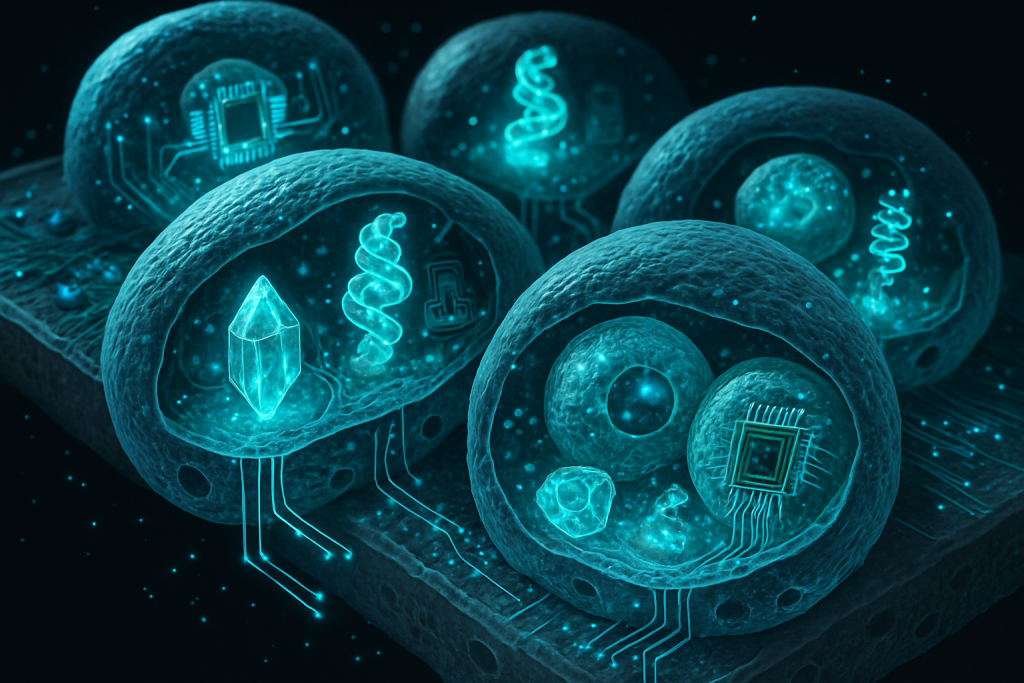
Image generated by AI
Your body right now is performing billions of measurements. Cells are detecting oxygen levels, neurons are sensing electric fields, immune cells are identifying molecular signatures of invaders, and your inner ear is measuring the acceleration of your head. Yet most of us never think about how these biological sensors work—or that they share fundamental principles with the technologies we design in laboratories and factories. The truth is that living systems have solved the measurement problem in ways that rival, and often surpass, our best human-engineered instruments.
Measurement and sensing technologies in living systems represent one of science’s most profound bridges between disciplines. At the intersection of molecular biology, biophysics, neuroscience, biomedical engineering, and environmental science lies a unifying question: How do organisms extract information from their environment with such precision and speed? Understanding this question has transformed not only how we think about life itself, but also how we design new technologies—from biosensors that detect disease to artificial organs that mimic biological function.
What Is Measurement and Sensing Technologies in Living Systems?
Measurement and sensing technologies in living systems refer to the physical and chemical mechanisms by which organisms detect, quantify, and respond to signals from their environment and from within their own bodies. These systems span scales from individual molecules to entire ecosystems, and include everything from the olfactory receptors that let you smell coffee to the pressure sensors in your arteries that regulate blood pressure. At their core, biological sensors convert physical or chemical stimuli—light, sound, temperature, molecular concentration, electromagnetic fields—into signals that the organism can interpret and act upon.
The concept emerged formally in the mid-20th century when scientists like Kenneth Cole and Alan Hodgkin began measuring electrical potentials across cell membranes, revealing how neurons communicate. Their work, building on earlier discoveries by physicists and biologists, showed that biological measurement wasn’t mystical but mechanistic. Since then, the field has exploded into a true interdisciplinary endeavor. Molecular biologists discovered ion channels that act as sensors, physicists developed tools to measure forces at the molecular scale, engineers created artificial cells and biosensors, and neuroscientists mapped how the brain processes sensory information. Today, the study of biological measurement is impossible without expertise from all these fields simultaneously.
Across the Sciences
The mechanism of biological sensing begins with a fundamental principle: signal transduction, the conversion of one form of energy into another. When a photon enters your eye and hits a rhodopsin molecule in a retinal photoreceptor cell, it triggers a cascade of chemical reactions. This light energy is transduced into electrical energy—a change in membrane voltage. That electrical signal is then transduced into a chemical signal when it causes the release of neurotransmitters. Finally, the brain processes this cascade of signals to generate the perception of light. What makes this process remarkable is its speed, sensitivity, and reliability. A single photon can trigger a measurable electrical response; some organisms can detect a handful of photons and distinguish them from darkness.
Consider how a bacterium like E. coli senses chemicals in its environment. The bacterium has receptor proteins on its surface that bind specific molecules—say, glucose or aspartate. When these receptors are activated, they trigger a chain of protein interactions inside the cell that ultimately affects the rotation of the bacterium’s flagella, its tail-like propeller. The genius is in the measurement system: the bacterium compares the current concentration of attractants with the concentration from moments before, allowing it to detect whether it’s moving toward or away from food. It’s performing calculus—specifically, computing a temporal derivative. This same principle, measuring change over time rather than absolute values, appears throughout biology, from how our ears detect motion to how our skin senses touch.
Why This Matters for the Future
Understanding how biological systems measure and sense has already revolutionized medicine and biotechnology. Glucose monitors for diabetics work because we’ve learned to replicate, in miniaturized form, the glucose-sensing capabilities of biological cells. Continuous glucose monitors now use enzymes to detect blood sugar levels in real time, giving patients unprecedented control over their condition. Similarly, new diagnostic tools exploit biological recognition: biosensors that use antibodies or receptor proteins can detect cancer biomarkers, COVID-19 antigens, or pathogenic bacteria in minutes rather than days. The field of synthetic biology is now attempting to design entirely new sensing and measurement systems from scratch, creating cells programmed to detect pollutants, produce insulin on demand, or identify tumor cells and attack them.
In clinical settings, understanding tissue-level sensing has enabled innovations like smart bandages that change color when a wound is infected, implantable sensors that monitor heart function, and neural interfaces that allow paralyzed patients to control prosthetic limbs with thought alone. In environmental science, researchers are developing biosensors to monitor water quality, air pollution, and pesticide residues—essentially using engineered organisms as living detectors. Consumer technology companies are integrating biological sensing principles into wearables that track heart rate variability, blood oxygen, and even stress levels through skin conductance. Each of these applications succeeds because it bridges understanding from multiple scientific domains: the biochemistry of molecular recognition, the physics of signal propagation, the engineering of device miniaturization, and the neuroscience of information processing.
Recent Breakthroughs in Measurement and Sensing Technologies in Living Systems
The last few years have witnessed extraordinary advances in our ability to measure biological signals at unprecedented scales and speeds. In 2022 and 2023, researchers developed new optogenetic sensors—tools that use light-sensitive proteins to both stimulate and record neural activity simultaneously. These technologies allow neuroscientists to measure the activity of thousands of neurons in real time, revealing how populations of brain cells encode information about the world. Simultaneously, advances in cryo-electron microscopy have allowed scientists to visualize individual ion channels and receptor proteins in atomic detail, showing exactly how they change shape in response to stimuli. These structural insights have enabled computational biologists to predict how proteins will respond to signals they’ve never encountered before.
Beyond the laboratory, researchers are increasingly moving sensing technologies into living organisms. In 2023, teams published work on implantable, biodegradable sensors that can measure various biomarkers as they dissolve harmlessly into the body. Others have engineered cells to produce fluorescent signals when they detect specific molecules—creating living biosensors that could eventually be used as medical diagnostics or therapeutic agents. A particularly exciting frontier involves organoid technology, where scientists grow miniaturized organs in dishes that maintain many of the sensing capabilities of real tissues. These micro-livers, micro-kidneys, and micro-brains can detect toxic compounds, measure drug responses, and potentially predict how individual patients will react to medications—personalized medicine enabled by understanding biological measurement.
Why Measurement and Sensing Technologies in Living Systems Matters for the Future
As we face unprecedented challenges—climate change, pandemic preparedness, aging populations, antibiotic resistance—the ability to measure what’s happening in biological systems becomes increasingly critical. Climate scientists rely on biological sensors embedded in ocean buoys to track plankton communities and detect harmful algal blooms before they become catastrophic. Public health officials use genetic sequencing and biosensing to track pathogen evolution and spread in real time. Agricultural researchers develop soil sensors and plant-based biosensors to optimize crop yields while minimizing water and pesticide use. In all these cases, the underlying principle is identical: converting biological information into actionable data through measurement and sensing.
Yet significant challenges remain. Most current biological sensors work best under carefully controlled laboratory conditions; translating them to the messy real world of living tissues, contaminated water, or soil remains difficult. The engineering of multimodal sensors—devices that can simultaneously measure multiple properties like temperature, pH, and molecular concentration—is still in early stages. There are also fundamental questions about measurement limits: How sensitive can a biological sensor be before random molecular noise overwhelms signal? How fast can biological systems respond while still maintaining accuracy? How can we design sensors that don’t disrupt the very systems they’re meant to measure? These questions span biology, physics, information theory, and engineering in ways that demand true interdisciplinary collaboration.
Key Takeaways
- Biological measurement systems convert physical and chemical stimuli into signals through signal transduction, achieving sensitivity and speed that often exceed human-engineered instruments.
- Living organisms measure not absolute values but changes over time, computing temporal derivatives through molecular cascades—a principle that appears from bacteria to brains.
- Understanding biological sensing has enabled revolutionary medical technologies including continuous glucose monitors, implantable biosensors, and neural interfaces for prosthetic control.
- Recent breakthroughs in optogenetics, cryo-electron microscopy, and organoid technology are advancing our ability to measure biological signals at cellular and subcellular scales in real time.
- The future of medicine, environmental monitoring, and biotechnology depends on engineering new measurement systems based on biological principles, a challenge requiring expertise from physics, chemistry, biology, neuroscience, and engineering working in genuine interdisciplinary collaboration.
Explore TED Talks on Measurement and Sensing Technologies in Living Systems:
TED content is used under CC BY-NC-ND 4.0. © TED Conferences, LLC.
Frequently Asked Questions
How do cells detect and measure oxygen levels in their environment?
Cells use oxygen-sensing proteins, such as hypoxia-inducible factors (HIFs), that bind to oxygen molecules and undergo conformational changes to trigger gene expression cascades. These molecular sensors allow cells to respond rapidly to hypoxic conditions by activating metabolic pathways suited to low-oxygen environments.
What physical principles do biological sensory systems share with engineered instruments?
Both biological and engineered sensors rely on transduction mechanisms that convert external signals (chemical, mechanical, or electromagnetic) into measurable responses, and both employ amplification, filtering, and threshold-detection strategies to extract meaningful information from noisy environments. This convergence reflects optimization for sensitivity, specificity, and speed under resource constraints.
How do neurons sense and measure electric fields across cell membranes?
Neurons use ion channels and voltage-sensing proteins embedded in their membranes that respond to changes in electrical potential by opening or closing, allowing selective ion flow that generates action potentials. These molecular devices can detect millivolt-scale changes in membrane voltage and translate them into chemical signals that propagate along neural circuits.
Can biological sensing mechanisms be engineered into synthetic biosensors for disease detection?
Yes; researchers engineer biosensors by isolating natural sensing proteins (such as antibodies or metabolite-binding receptors) and coupling them to measurable outputs like fluorescence or electrical signals. These synthetic devices leverage billions of years of biological optimization to detect pathogens, biomarkers, and toxins with sensitivity often exceeding conventional laboratory instruments.