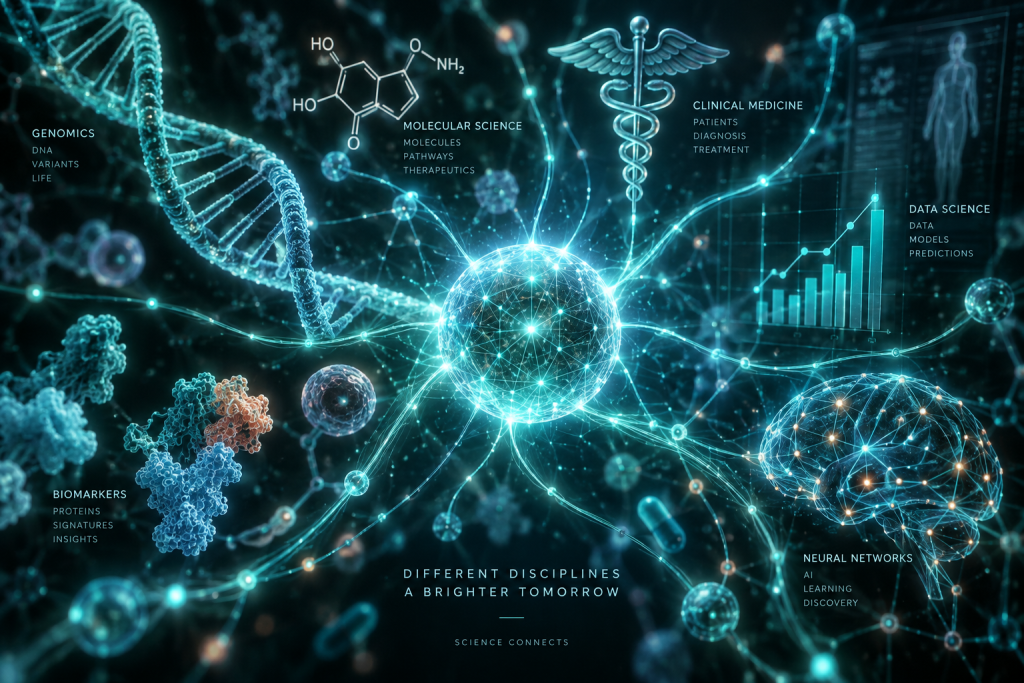
Image generated by AI
A single drop of blood contains within it the narrative of your future health. Hidden in that fluid are proteins, genetic sequences, and metabolic signatures that can predict whether you’ll develop heart disease, cancer, or Alzheimer’s disease years before symptoms emerge. Yet reading this biological manuscript requires expertise spanning molecular biology, clinical medicine, mathematics, and computational science—a convergence of disciplines that is fundamentally transforming how we diagnose and treat disease. Biomarkers have become the Rosetta Stone of modern medicine, translating the silent language of disease into actionable medical knowledge.
The ability to predict disease outcomes before they manifest represents one of the most consequential shifts in healthcare and science. Rather than waiting for symptoms to appear and then reacting, physicians increasingly can now identify high-risk individuals, monitor disease progression in real time, and personalize treatment based on each patient’s unique biological fingerprint. This transformation is reshaping not only the practice of medicine but also fundamental research in genetics, neuroscience, oncology, and immunology—and it’s doing so by forcing scientists from traditionally separate disciplines to collaborate in ways that are generating entirely new fields of inquiry. Understanding biomarkers and their role in disease prognosis reveals how modern science works at its frontiers, where no single discipline holds all the answers.
What Are Biomarkers and Disease Prognosis?
A biomarker is a measurable biological characteristic that can serve as an indicator of normal biological processes, pathogenic processes, or pharmacological responses to therapeutic interventions. In practical terms, it’s any detectable substance, physical trait, or genetic alteration that provides objective evidence of disease state. Biomarkers can be proteins in the blood (like troponin for heart attacks), genetic mutations (like BRCA1 for breast cancer risk), imaging findings (like brain amyloid on PET scans), or even behavioral patterns detected through wearable devices. Disease prognosis—the prediction of disease course and outcome—depends critically on identifying which biomarkers correlate with progression, which indicate good or poor responses to treatment, and how multiple biomarkers interact to predict future health states. Together, biomarkers and prognosis form a predictive framework that has moved medicine from a reactive to a proactive discipline.
The concept of disease markers stretches back centuries, but modern biomarker science emerged in the late 1970s and 1980s. When researchers discovered that certain enzymes like creatine kinase and myoglobin could be detected in blood during heart attacks, they opened a new frontier in diagnosis. The turning point came with the development of monoclonal antibodies and later DNA sequencing technologies, which allowed scientists to identify and measure biological molecules with unprecedented precision. The completion of the Human Genome Project at the turn of the millennium accelerated this revolution exponentially, providing the genetic blueprint against which disease-associated mutations could be mapped. Today, biomarker research sits at the intersection of molecular biology, biochemistry, genetics, statistics, epidemiology, and machine learning—a genuinely interdisciplinary endeavor that requires insights from all these fields simultaneously.
Across the Sciences
The journey from biomarker discovery to clinical prognosis involves a complex interplay between multiple scientific domains, each contributing essential perspectives. Molecular biologists and geneticists identify which molecular alterations are associated with disease, working in laboratories to understand the biological mechanisms underlying those alterations. Physicians and epidemiologists then study whether these molecular findings actually predict clinical outcomes in real patients—a crucial distinction, since a biomarker might be biologically interesting but clinically irrelevant. Biostatisticians design studies to determine whether a biomarker’s predictive power holds up across different populations and whether it remains valid when other confounding factors are controlled. Finally, computer scientists and artificial intelligence researchers develop algorithms that can integrate multiple biomarkers into sophisticated predictive models, uncovering patterns that no single discipline could discern alone. This convergence is not accidental but fundamental: predicting disease outcomes in all their complexity genuinely requires the combined expertise of these fields.
Consider the example of cardiovascular disease prognosis. A cardiologist might observe that certain patients have heart attacks despite normal cholesterol levels, prompting inquiry into other risk factors. A molecular biologist might discover inflammatory proteins like C-reactive protein and IL-6 in the blood of these patients. An epidemiologist would then track thousands of patients, measuring both these inflammatory markers and their subsequent heart attack rates, to establish statistical associations. A biostatistician would determine whether inflammatory markers improve prediction beyond traditional risk factors like blood pressure and smoking status. And a computer scientist would build machine learning models that weight all these factors together—along with genetic data, imaging findings, and lifestyle information—to generate personalized risk predictions. Each step requires different expertise, different methodologies, and different standards of evidence. Only through this interdisciplinary dialogue can a truly useful prognostic tool emerge.
The Molecular Foundation: How Biomarkers Reveal Hidden Pathology
At the most fundamental level, biomarkers work because disease leaves molecular traces before it becomes clinically apparent. When cancer cells begin to proliferate uncontrollably, they express altered versions of proteins or shed fragments into the bloodstream. When Alzheimer’s disease begins its silent destruction of brain tissue, amyloid-beta and tau proteins accumulate in cerebrospinal fluid and eventually appear in blood. When the immune system is failing, T-cell counts drop and inflammatory markers spike. These molecular changes occur not as sudden switches but as gradual shifts along biological continua—variations in the amount, structure, or activity of proteins and nucleic acids that can be measured by sensitive laboratory techniques. The profound insight underlying modern biomarker science is that disease doesn’t emerge fully formed but announces itself through subtle molecular whispers years before clinical manifestations appear. Scientists have learned to listen for these whispers.
Think of biomarkers as the body’s own early warning system, like smoke detectors in a building. Just as a smoke detector senses smoke particles and triggers an alarm before the fire becomes visible, biomarkers detect molecular disruptions that signal disease long before symptoms appear. A person carrying a BRCA1 mutation doesn’t have cancer—the tumor hasn’t formed—but at the molecular level, their cells carry a genetic vulnerability. Similarly, amyloid-beta accumulation in the brain precedes memory loss by a decade or more, offering a window for intervention. The challenge is that unlike smoke detectors, which operate according to simple physical principles, biological systems are extraordinarily complex. A single biomarker rarely tells the complete story; instead, patterns across multiple biomarkers, considered in the context of a patient’s genetics, environment, and lifestyle, paint a probabilistic picture of their future health.
The Statistical Dimension: From Correlation to Causation to Prediction
Here is where biomarker science requires the specialized expertise of statistics and epidemiology. Identifying that a biomarker correlates with disease outcome is just the beginning. Biostatisticians must address crucial questions: Does this correlation hold across different age groups, ethnic populations, and geographic regions? Does the biomarker remain predictive when other known risk factors are accounted for? How much does it improve prediction compared to existing clinical tools? These questions require sophisticated statistical designs, including longitudinal cohort studies that follow thousands of participants over years, meta-analyses that synthesize data across many studies, and validation studies that test biomarkers in independent populations. The field has developed rigorous frameworks like the “phases of biomarker development,” which parallel the phases of drug development, ensuring that biomarkers are rigorously validated before being adopted in clinical practice. Without this statistical rigor, biomarkers can lead clinicians astray—identifying correlations that are artifacts of study design or statistical noise rather than true predictive signals.
A famous cautionary tale comes from hormone replacement therapy in women. Large observational studies showed that women taking hormone replacement therapy had lower rates of heart disease. Physicians interpreted this as evidence that hormones reduced cardiovascular risk. However, randomized controlled trials conducted later revealed that hormones actually increased heart disease risk. The problem was confounding: women taking hormones were healthier overall and better able to afford healthcare, so they had better outcomes for reasons unrelated to the hormones themselves. This lesson transformed how biomarkers are evaluated. Modern standards now require that biomarkers demonstrate predictive ability in prospective cohorts, ideally with independent validation in separate populations. Statistical methods like receiver operating characteristic (ROC) curves and calibration plots allow researchers to quantify exactly how well a biomarker discriminates between those who will and won’t develop disease, and to identify the optimal cutoff values for clinical decision-making.
The Computational Revolution: Machine Learning Discovers Biomarker Patterns
The explosion of biomarker complexity in recent years has been made possible by advances in artificial intelligence and machine learning—fields that bring entirely new perspectives to disease prognosis. Where traditional biomarker research might examine ten to twenty markers and their simple combinations, machine learning algorithms can simultaneously analyze thousands of measurements from a single patient: gene expression profiles with thousands of genes, proteomic signatures with tens of thousands of proteins, imaging data with millions of pixels, and temporal data tracking how all these measurements change over time. These algorithms discover patterns in high-dimensional data that human researchers could never identify manually, sometimes revealing unexpected connections between seemingly unrelated biomarkers. Deep learning networks, a particularly powerful subset of machine learning, have shown remarkable ability to extract predictive signals from complex data types like medical images and genetic sequences. Yet this power comes with challenges: machine learning models can appear to work brilliantly on the data they were trained on while failing catastrophically on new patients, a phenomenon called overfitting. Ensuring that machine learning-based biomarker predictions are genuinely useful requires collaboration between computer scientists, physicians, and biostatisticians working in concert to validate models appropriately and understand what they’re actually measuring.
The integration of machine learning into biomarker research has created entirely new scientific challenges. A deep learning model might achieve 95 percent accuracy at predicting which patients will develop dementia, but if asked to explain its prediction, it might point to seemingly irrelevant features like image artifacts or patient ID numbers. Researchers call this the “black box” problem, and solving it requires expertise in explainable artificial intelligence—a field that sits at the intersection of computer science, statistics, and cognitive science. Clinicians need to understand not just what a model predicts but why, so they can determine whether the prediction is based on genuine biology or on statistical phantoms. This has sparked renewed interest in interpretable machine learning approaches, which build in transparency and create models that can explain their own reasoning. The result is that modern biomarker science demands not just that algorithms work but that they work in ways that make biological and medical sense.
Why This Matters for the Future
The practical impact of biomarker-based prognosis is already reshaping clinical medicine in profound ways. In oncology, tumor biomarkers now guide treatment decisions; patients with certain mutations receive targeted drugs designed for their specific cancer subtype, dramatically improving outcomes compared to one-size-fits-all chemotherapy. In cardiology, risk stratification based on troponin levels and other biomarkers determines who receives aggressive intervention for acute coronary syndromes. In psychiatry and neurology, emerging biomarkers of neuroinflammation, tau accumulation, and amyloid-beta pathology are opening possibilities for early intervention in neurodegenerative diseases—a transformation from watching patients decline to attempting prevention before symptoms begin. The shift from reactive to proactive medicine, from treating disease to preventing it, is fundamentally dependent on our ability to identify and validate biomarkers that can predict disease years in advance. This represents a medical paradigm shift as significant as the germ theory of disease or the development of antibiotics.
Beyond individual patient care, biomarker-based prognosis is transforming drug development itself. Pharmaceutical companies increasingly conduct clinical trials with biomarker-driven designs, enrolling only patients who possess specific biomarkers likely to respond to the experimental drug. This enrichment strategy means smaller, shorter, and more efficient trials—and crucially, it means that drugs that work for specific subpopulations aren’t discarded when they fail in unselected populations. The liquid biopsy industry—companies that detect cancer, heart disease, and other conditions from blood samples—represents a massive commercial application of biomarker science, with multiple tests now available clinically and dozens more in development. Wearable devices that continuously monitor heart rate, sleep patterns, and other physiological parameters are generating new biomarker streams, creating continuous rather than snapshot assessments of health status. Collectively, these applications represent a multi-billion dollar market that is growing exponentially as biomarker science matures.
Recent Breakthroughs in Biomarkers and Disease Prognosis
The past few years have witnessed extraordinary advances in biomarker discovery and validation, driven by technological innovations and interdisciplinary collaboration. The development of ultra-sensitive blood tests that can detect circulating tumor DNA (ctDNA) and circulating tumor RNA (ctRNA) in cancer patients has enabled monitoring of tumor burden and detection of treatment resistance with unprecedented sensitivity. In Alzheimer’s disease, blood biomarkers for amyloid-beta, phosphorylated tau, and glial fibrillary acidic protein (GFAP) have now been validated as predictors of future cognitive decline and amyloid accumulation in the brain, potentially enabling screening and early intervention on a population level. Long-read sequencing technologies and spatial proteomics methods are revealing the three-dimensional architecture of tumor microenvironments and how that architecture predicts treatment response. Artificial intelligence models trained on large electronic health record datasets have identified novel risk factors and interactions that traditional epidemiological approaches missed, sometimes contradicting conventional medical wisdom. These breakthroughs demonstrate how the convergence of molecular biology, biostatistics, computational science, and clinical medicine is generating new knowledge that no single discipline could produce alone.
Current research frontiers in biomarker science include the development of multi-biomarker panels and algorithms that integrate information across different biomarker categories—genetic, proteomic, metabolomic, imaging, and behavioral—to generate comprehensive disease risk profiles. Researchers are working to understand how individual biomarkers integrate with environmental and lifestyle factors, social determinants of health, and psychological factors to determine outcomes. There is growing interest in longitudinal biomarker trajectories—not just measuring biomarkers at a single timepoint but tracking how they change over time to predict disease acceleration or response to therapy. Open questions remain about how to validate biomarkers across diverse populations, ensuring that predictions don’t simply reflect health disparities and historical inequities in medical research. And researchers are grappling with the ethical and practical challenges of identifying high-risk individuals through biomarker screening when effective preventive interventions don’t yet exist for all at-risk states.
Why Biomarkers and Disease Prognosis Matter for the Future
The broader implications of biomarker-based prognosis extend far
Explore TED Talks on Biomarkers and Disease Prognosis:
TED content is used under CC BY-NC-ND 4.0. © TED Conferences, LLC.
Frequently Asked Questions
What specific types of biological molecules serve as biomarkers in blood samples?
Biomarkers include proteins (such as cardiac troponins or PSA), genetic sequences (DNA/RNA variants), and metabolic signatures (lipids, glucose metabolites) that correlate with disease states. Each type provides different information about disease risk, presence, or progression depending on the condition being evaluated.
How do biomarkers enable disease prediction before symptoms appear?
Biomarkers reflect subclinical pathological changes occurring at the molecular and cellular level long before clinical manifestations become evident. By identifying these early biological alterations through statistical analysis and machine learning models, clinicians can stratify patients into risk categories and intervene preventively.
Why is artificial intelligence necessary for interpreting biomarker data in disease prognosis?
Biomarker datasets are high-dimensional and complex, often containing thousands of variables with non-linear relationships that traditional statistical methods cannot efficiently analyze. AI algorithms can identify subtle patterns across multiple biomarkers simultaneously and generate predictive models that account for individual biological variation more accurately than conventional approaches.
Can a single biomarker accurately predict disease outcomes, or are multiple biomarkers required?
Most diseases involve multiple biological pathways, so panels of biomarkers typically provide superior predictive accuracy compared to single markers. Combining biomarkers from different biological systems (proteomic, genomic, metabolomic) creates more robust prognostic signatures with higher sensitivity and specificity for disease prediction.