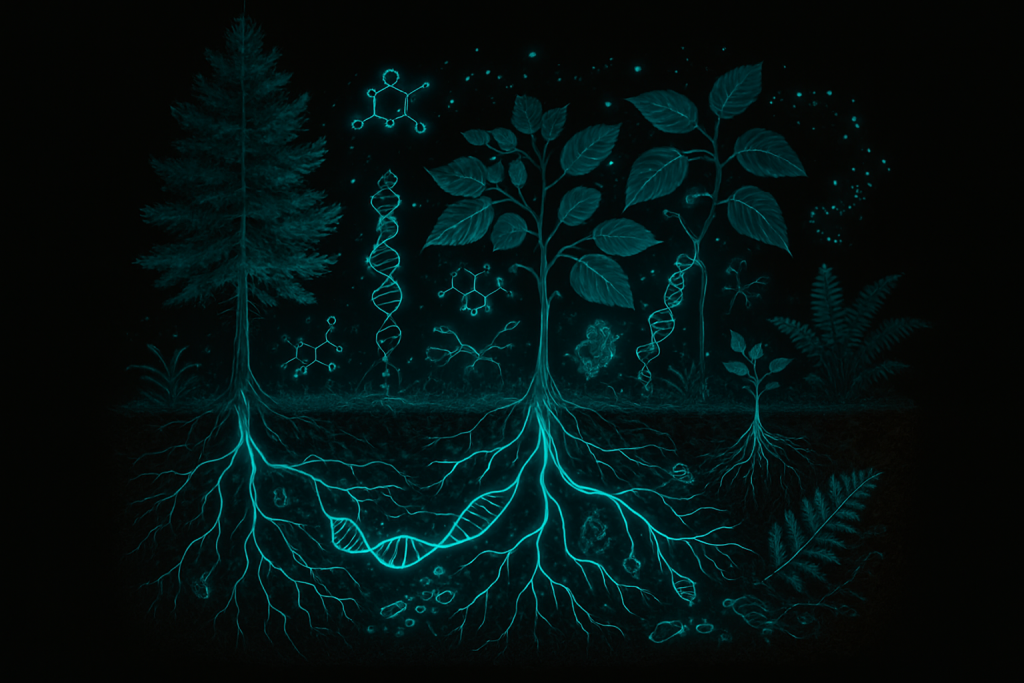
Image generated by AI
Beneath the forest floor, a tree’s roots are under siege—attacked by a fungus that threatens its survival. Yet instead of mounting a solitary defense, the tree sends out an invisible chemical alarm that travels through a network of fungal threads connecting it to neighboring trees miles away. Within hours, those distant trees have fortified their chemical defenses, preparing for an attack that hasn’t even reached them yet. This phenomenon, discovered only in the last few decades, reveals that ecosystems operate as vast chemical communication networks—and understanding how they work requires bridging biology, chemistry, physics, and even neuroscience in ways that challenge our traditional view of nature.
As climate change accelerates and biodiversity plummets, deciphering these hidden chemical languages has become urgent. Scientists now recognize that chemical signaling isn’t confined to individual organisms—it orchestrates the relationships between predators and prey, plants and pollinators, competitors and allies. From the volatile compounds that warn of insect attacks to the pheromones that guide animal behavior across continents, these chemical messages are literally shaping the structure and resilience of ecosystems. Understanding this intricate web of molecular communication isn’t just academic—it holds keys to restoring damaged ecosystems, predicting how wildlife will respond to environmental stress, and even developing new agricultural strategies for a warming world.
What Is Chemical Signaling in Ecosystems?
Chemical signaling in ecosystems refers to the production, emission, and detection of chemical compounds that convey information between organisms and between organisms and their environment. These molecules—ranging from simple gases like ethylene to complex organic compounds—travel through air, soil, and water, triggering behavioral, physiological, or developmental responses in receivers. Unlike the obvious signals of visual displays or vocalizations, chemical signals operate in an invisible realm that most humans cannot directly perceive, yet they profoundly influence virtually every ecological interaction. The sender of a chemical signal doesn’t necessarily intend to communicate; sometimes the signal is a byproduct of metabolism or defense that receivers have evolved to interpret. This distinction makes chemical signaling fundamentally different from intentional communication systems, introducing a layer of complexity that fascinates researchers across disciplines.
The modern study of chemical signaling in ecosystems emerged in the mid-20th century, beginning with the groundbreaking work of entomologists who isolated and identified pheromones—the chemical signals insects use to attract mates and coordinate behavior. In 1959, Adolf Butenandt won the Nobel Prize in Chemistry for isolating bombykol, a sex pheromone of the silkworm moth, marking a turning point in scientific recognition of chemical communication. However, the ecological implications of chemical signaling remained largely unexplored until the 1980s and 1990s, when ecologists began investigating how plants warn each other of herbivore attacks and how these chemical cues structure entire food webs. The field truly matured when researchers from chemistry, ecology, neurobiology, and genetics began collaborating, recognizing that chemical signaling represents a fundamental principle of nature that transcends traditional disciplinary boundaries.
Across the Sciences
Chemical signaling in ecosystems operates at the intersection of multiple scientific domains, each contributing essential perspectives. Ecology provides the systems-level understanding of how these signals shape population dynamics, community structure, and ecosystem function. Chemistry offers the molecular toolkit—the ability to identify, synthesize, and analyze the specific compounds involved. Neurobiology and sensory physiology reveal how organisms detect these chemicals, sometimes at concentrations of parts per trillion, and how their nervous systems process this information into behavioral responses. Evolutionary biology explains why certain signals evolved and how they persist despite the constant pressure of natural selection. Genetics illuminates the molecular basis of signal production and reception, identifying the genes and proteins responsible for both the synthesis of signaling molecules and the receptors that detect them. This convergence of perspectives creates something greater than the sum of its parts: a unified understanding of how information flows through nature at the molecular level.
Consider the chemical arms race between plants and herbivorous insects. When a caterpillar begins chewing on a leaf, the plant detects the damage through a combination of physical wounding and specific chemical compounds in the insect’s saliva. This triggers a cascade of chemical responses: the plant synthesizes defensive compounds like alkaloids and phenolics, and simultaneously releases volatile organic compounds that attract parasitic wasps—the caterpillar’s natural enemies. Meanwhile, the plant’s roots exude root exudates that alter the microbial community in the soil, potentially recruiting beneficial bacteria that boost the plant’s immune system. The caterpillar, in turn, has evolved detoxification enzymes and behavioral strategies to counter these defenses. This single ecological interaction involves chemistry (the synthesis and detection of specific molecules), toxicology (how compounds affect biological systems), microbiology (the role of soil bacteria), entomology (insect behavior and physiology), and evolutionary biology (how these strategies coevolve). It is fundamentally an interdisciplinary phenomenon.
Why This Matters for the Future
The practical applications of understanding chemical signaling in ecosystems extend far beyond basic science. In agriculture, researchers are harnessing chemical signals to develop pest management strategies that work with nature rather than against it—using plant volatiles to attract beneficial insects or to disrupt mating signals in crop pests, reducing reliance on broad-spectrum pesticides. In conservation biology, scientists are investigating how pollution interferes with chemical communication networks, potentially disrupting mate-finding, predator avoidance, and other critical behaviors in vulnerable species. Climate change research increasingly focuses on how shifting temperatures and precipitation patterns alter the production and dispersal of chemical signals, potentially desynchronizing the ecological relationships that countless species depend upon. Restoration ecology uses knowledge of chemical signaling to help rehabilitate damaged ecosystems, sometimes by reintroducing the soil microbes or plant species that provide essential chemical cues for other organisms. These applications demonstrate that chemical signaling is not a curiosity of nature but a fundamental process that, when harnessed intelligently, could address some of humanity’s most pressing environmental challenges.
Specific industries and research initiatives are already capitalizing on this knowledge. Biotechnology companies are developing “biopesticides” based on insect pheromones that disrupt reproduction in agricultural pests—products that are safer for non-target organisms than conventional insecticides. Pharmaceutical researchers are studying how the immune system responds to chemical signals from the microbiome, leading to new therapeutic approaches for inflammatory diseases and metabolic disorders. Environmental monitoring agencies are exploring the use of volatile organic compound signatures to detect plant stress from disease or pollution, potentially allowing early intervention before visible symptoms appear. Fragrance and flavor industries have long relied on chemical signaling research, but they are increasingly using this knowledge to develop sustainable alternatives to synthetic chemicals by understanding and mimicking natural signals.
Recent Breakthroughs in Chemical Signaling in Ecosystems
The past few years have witnessed remarkable advances in our ability to detect, analyze, and manipulate chemical signals in real time. High-throughput sequencing technologies and advanced mass spectrometry have revealed that the chemical diversity of ecosystems is far greater than previously imagined—plants produce thousands of different volatile compounds in response to different types of damage, and these signals are even more finely tuned than researchers expected. A 2022 study published in *Science* demonstrated that plants can discriminate between different herbivore species based on specific elicitors in their saliva, mounting tailored chemical defenses rather than generic responses. Simultaneously, researchers have developed sophisticated computational models that predict how chemical signals disperse through different environmental conditions, accounting for temperature, humidity, wind patterns, and terrain—allowing them to map chemical communication networks across entire landscapes. These technological advances have transformed chemical signaling from a phenomenon that could only be studied through painstaking laboratory experiments into something that can be observed and measured at the ecosystem scale.
Current research frontiers are pushing these capabilities even further. Scientists are using machine learning algorithms to analyze the vast datasets generated by chemical profiling studies, discovering previously unknown relationships between chemical signals and ecological outcomes. Researchers are investigating how anthropogenic noise and light pollution interfere with chemical communication, a field called “chemical pollution ecology” that is just beginning to receive serious attention. There is growing interest in understanding how chemical signaling shapes microbial communities and how these microbial communications in turn affect plant and animal health—a perspective that recognizes the microbiome as an integral part of ecosystem-level signaling networks. One major open question remains: how do organisms integrate multiple chemical signals to make behavioral decisions? This “chemical grammar” question—the idea that sequences and combinations of chemical signals carry meaning beyond the meaning of individual signals—is an active area of investigation with profound implications for understanding animal behavior and ecosystem dynamics.
Why Chemical Signaling in Ecosystems Matters for the Future
As we face unprecedented environmental challenges, the ability to understand and work with chemical signaling networks becomes increasingly valuable. Climate change is reshuffling ecosystems at a scale and speed not seen in millions of years, and many species will only survive if they can track changes in chemical cues—the timing of flowering plants, the emergence of pollinators, the presence of predators and competitors. Understanding chemical signaling networks provides a lens through which to predict which species might successfully adapt and which might fall into ecological traps where outdated chemical cues lead them astray. In a world of declining insect populations, the loss of chemical communication pathways may be as damaging as the loss of the insects themselves, since many plants have evolved to depend on specific insect responses to their chemical signals. The integration of chemical signaling research with climate science, conservation biology, and restoration ecology offers a more sophisticated understanding of ecosystem resilience and the interventions most likely to be effective. Furthermore, this knowledge is essential for maintaining human food security; as pollinators decline and agricultural pests evolve resistance, our ability to use chemical signals strategically will determine whether we can sustain productive agriculture without poisoning the environment.
The challenges ahead are substantial and multifaceted. Pollution—from pesticides to industrial chemicals to atmospheric nitrogen compounds—alters the production and transmission of chemical signals, creating “chemical noise” that disrupts ecological communication. Understanding these disruptions requires new interdisciplinary research approaches that traditional funding mechanisms and academic structures don’t always support. Another challenge is the sheer complexity: ecosystems typically involve hundreds or thousands of species, each producing and responding to multiple chemical signals, creating networks of interactions that are difficult to model and predict. Additionally, much of the research on chemical signaling has focused on temperate ecosystems and model organisms; our understanding of tropical rainforests, deep-sea ecosystems, and other understudied environments remains fragmentary. Finally, translating laboratory findings into ecosystem-scale management strategies requires integration with indigenous and local ecological knowledge systems that have long recognized the importance of ecological relationships, creating the need for new forms of collaboration and knowledge exchange.
Key Takeaways
- Chemical signaling in ecosystems is a universal language through which organisms communicate information about danger, resources, reproduction, and competition, orchestrating the structure and function of entire ecological communities.
- Understanding chemical signaling requires integration across multiple scientific disciplines—ecology, chemistry, neurobiology, genetics, and evolutionary biology—each contributing essential insights into how these molecular messages shape nature.
- The most promising near-term application is sustainable agriculture, where chemical signals are being used to manage pests and recruit beneficial organisms without relying on broad-spectrum pesticides.
- Recent technological advances in chemical detection and computational modeling have transformed chemical signaling research from a descriptive discipline into a quantitative, predictive science capable of addressing ecosystem-scale questions.
- As ecosystems face unprecedented stress from climate change and pollution, understanding and protecting chemical signaling networks will be essential for maintaining biodiversity, food security, and ecosystem resilience in the coming decades.
Explore TED Talks on Chemical Signaling in Ecosystems:
TED content is used under CC BY-NC-ND 4.0. © TED Conferences, LLC.
Frequently Asked Questions
How do trees communicate chemical defense signals through fungal networks underground?
Trees transfer chemical alarm signals through mycorrhizal fungal networks (symbiotic fungi connected to root systems), which transport volatile compounds and molecular messengers across distances of miles. These fungal threads act as a biological conduit, allowing trees to share information about pathogen threats before the infection reaches neighboring plants.
What are volatile organic compounds and what role do they play in ecosystem chemical signaling?
Volatile organic compounds (VOCs) are airborne chemical molecules released by plants in response to insect attacks or stress, serving as warning signals to nearby plants and predatory insects. These compounds trigger defensive responses in receiver organisms and can travel through the atmosphere to communicate threats across significant distances in an ecosystem.
Why do pheromones represent a critical form of chemical signaling in animal populations?
Pheromones are species-specific chemical signals that regulate animal behavior including mating, territorial marking, and foraging, allowing organisms to coordinate actions without visual or auditory communication. They are essential for ecosystem stability because they influence predator-prey dynamics, reproduction rates, and population distribution across environments.
Can understanding chemical signaling networks help predict how ecosystems will respond to climate change?
Yes—by mapping how organisms detect and respond to chemical signals, scientists can model how altered temperature and moisture conditions will disrupt these communication pathways and cascade through food webs. This knowledge helps predict whether species will adapt quickly enough or face population collapse when chemical signaling systems fail.