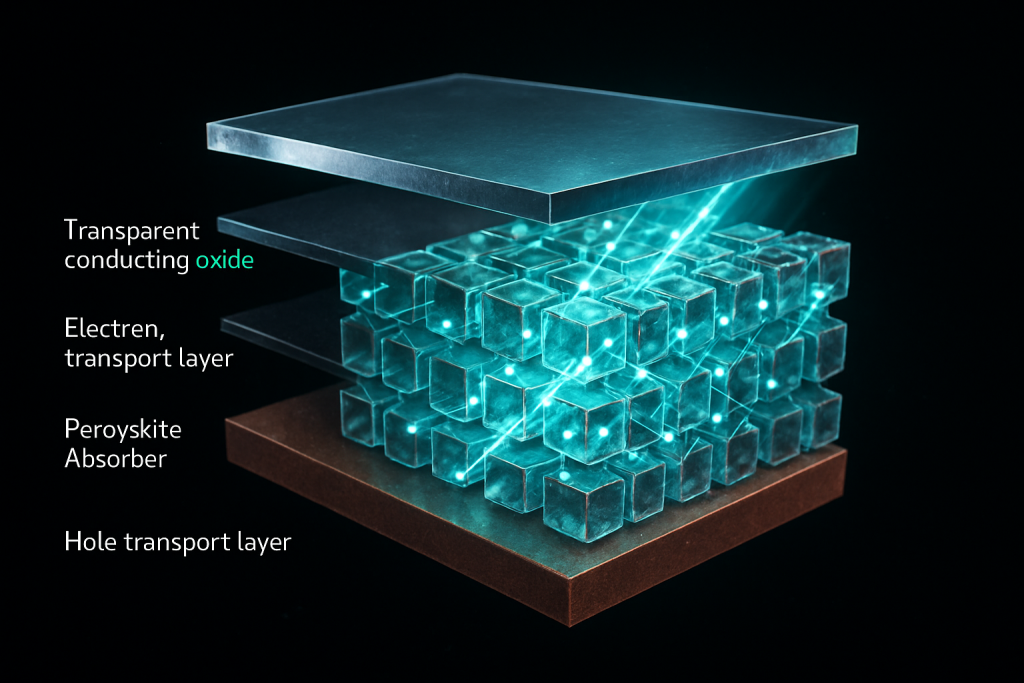
Image generated by AI
Imagine a material that could convert sunlight into electricity almost as efficiently as the silicon panels on your roof, yet could be manufactured using spray-coating techniques as simple as painting a wall. This isn’t science fiction—perovskite solar cells are bringing this vision closer to reality. Within just two decades, these materials have achieved efficiencies rivaling conventional photovoltaics, and researchers are racing to unlock even greater potential, with laboratory prototypes now surpassing 33 percent efficiency compared to silicon’s typical 15 to 22 percent.
The race to develop next-generation solar technology has become urgent as the world confronts climate change and the need for cleaner energy sources. While silicon has dominated solar technology for decades, its manufacturing is energy-intensive and costly. Perovskites represent a genuine alternative—lightweight, flexible, and potentially cheap enough to make solar energy accessible in ways previously unimaginable, from powering remote villages to coating entire buildings with electricity-generating surfaces.
What Is Perovskite Solar Cells and Next-Generation Photovoltaics?
A perovskite solar cell is a photovoltaic device made from a crystalline material with a specific atomic structure known as the perovskite crystal lattice. The name comes from the mineral perovskite (calcium titanate), which exhibits this distinctive cubic or nearly-cubic arrangement of atoms. In these solar cells, the perovskite material—typically an organic-inorganic hybrid compound containing lead, tin, or other metals—sits at the heart of the device, sandwiched between conductive layers that extract the electrical current generated by sunlight. Unlike traditional silicon solar cells, which require thick, expensive wafers of pure crystalline material, perovskite solar cells can be manufactured from thin films, sometimes just a few hundred nanometers thick, making them potentially more economical to produce.
The story of perovskite solar cells began in earnest around 2009, when researchers at the University of Tokyo first demonstrated that an organic-inorganic perovskite could be used as a light-absorbing material in a solar cell, achieving modest efficiencies of around 3 percent. This breakthrough sparked intense international research, with scientists at institutions including Oxford University, MIT, and the Swiss Federal Institute of Technology racing to improve the material’s stability and efficiency. By 2020, just a decade later, laboratory prototypes had reached efficiencies exceeding 25 percent, a pace of improvement that astonished the photovoltaics community and captured the attention of major technology companies and venture investors worldwide.
The Basic Principle
At their core, perovskite solar cells operate on the same fundamental principle as all photovoltaic devices: they convert photons from sunlight into flowing electrons through a process called the photovoltaic effect. When a photon hits the perovskite material, it strikes an electron, imparting enough energy to knock it free from its atom, creating what physicists call an electron-hole pair. Think of it like a marble game: the photon is like a cue ball striking a marble (the electron), sending it rolling while leaving a gap (the hole) where it started. This separation of charge is the crucial first step. However, electrons naturally want to recombine with holes almost immediately, releasing their energy as heat. To harness this energy before recombination occurs, the perovskite is sandwiched between two special layers—electron and hole transport layers—that act like one-way gates, guiding electrons to one electrode and holes to the other, creating an electrical current.
To understand this more intuitively, imagine the perovskite material as a perfectly designed highway system for charge carriers. When sunlight acts like traffic entering the system, electrons and holes begin moving. The electron transport layer is like a highway that only allows electrons northbound, while the hole transport layer is like a separate highway allowing holes southbound. These materials are carefully chosen so that electrons can flow easily into one contact and holes into another, preventing them from recombining inside the perovskite itself. This spatial separation of charges is maintained by what physicists call the built-in electric field at the interfaces between the perovskite and the transport layers, a natural barrier that keeps electrons and holes moving in opposite directions until they exit the device through external contacts where they can do useful work.
Why It Matters in the Real World
The potential of perovskite solar cells extends far beyond laboratory demonstrations into transformative real-world applications. Their low-temperature manufacturing process means they can be produced on flexible substrates like plastic or metal foils, enabling roll-to-roll manufacturing similar to printing newspapers—a process that could dramatically reduce production costs. Perovskites are also highly tunable: by adjusting the chemical composition, researchers can engineer the bandgap (the energy difference between light absorption and electricity generation) to match the solar spectrum more precisely, allowing them to be stacked in tandem cells that capture more of the sun’s energy. Several companies, including Oxford PV and Perovskite Photovoltaics, are already scaling up production and planning commercial deployment within the next few years, with initial applications targeting specialized markets like space satellites and building-integrated photovoltaics.
Consider the practical implications: today, installing solar panels on a home requires expensive inverters and thick, heavy panels mounted on reinforced roofs. Perovskite panels could be sprayed onto building surfaces—walls, windows, or even clothing—creating distributed power generation at a fraction of current costs. In developing regions without established electrical infrastructure, such lightweight and inexpensive solar technology could provide electricity to millions currently living without access to reliable power. Farmers could paint solar coatings on greenhouses to power irrigation systems while simultaneously shading crops. Aerospace engineers see potential in using perovskites to power lightweight aircraft and satellites, where weight savings translate directly to fuel efficiency and mission capabilities.
Recent Breakthroughs in Perovskite Solar Cells and Next-Generation Photovoltaics
The field has experienced remarkable acceleration in recent years. In 2023, researchers at the National Renewable Energy Laboratory (NREL) certified perovskite-silicon tandem solar cells with efficiencies exceeding 33 percent, approaching the theoretical maximum for such stacked configurations. Simultaneously, significant progress has been made in addressing the material’s historically critical weakness: instability. Perovskite crystals are vulnerable to moisture and heat, degrading within months in humid environments—a barrier to commercial deployment. Teams at various institutions have discovered that adding trace elements and protective coatings can extend device lifetimes to several years, with some laboratory prototypes now passing 1,000-hour durability tests. Research groups at the University of Toronto and elsewhere have also demonstrated that by incorporating specific organic molecules into the perovskite lattice, they can reduce defects and improve charge carrier collection, pushing efficiencies higher while simultaneously improving stability.
Current research frontiers include developing lead-free alternatives, as lead toxicity remains a regulatory concern that could limit widespread deployment. Tin and germanium-based perovskites are showing promise, though they currently exhibit lower efficiencies and even greater stability challenges. Another active area involves understanding and controlling defects at the atomic scale—microscopic imperfections that trap charges and reduce efficiency. Advanced characterization techniques, including machine learning algorithms, are being deployed to rapidly screen candidate materials and predict stability. The race is on to commercialize this technology before competing next-generation photovoltaics, such as dye-sensitized solar cells and organic photovoltaics, potentially mature first.
Why Perovskite Solar Cells and Next-Generation Photovoltaics Matters for the Future
From a global energy perspective, perovskite solar cells could be transformative. According to the International Energy Agency, solar power must triple by 2050 to meet climate targets, yet cost remains the primary barrier to adoption in developing countries and cost-sensitive applications. Perovskites’ potential for cheap, flexible, high-efficiency devices aligns precisely with this need. If manufacturing costs fall to $0.10 per watt, as some optimistic projections suggest (compared to roughly $0.40 per watt for current silicon), the economics of solar energy become dramatically more favorable. Beyond sheer efficiency and cost, perovskites enable an entirely new category of photovoltaics: semitransparent devices that generate power while allowing light through, opening possibilities for windows, greenhouse covers, and vehicle surfaces. The combination of high efficiency, tunability, mechanical flexibility, and potential for extremely low manufacturing costs makes perovskites perhaps the most promising candidate for democratizing solar energy globally.
However, substantial challenges remain before perovskites become ubiquitous. Stability and durability are improving but not yet proven over the 25-30 year lifespans expected from commercial solar installations. The lead toxicity issue, while manageable through encapsulation, raises regulatory and ethical questions. Manufacturing at scale will require solving complex engineering problems, including uniform deposition on large areas and integration with other photovoltaic and electronic components. Supply chain issues for precursor materials and recycling pathways for degraded devices remain largely unexplored. The field also faces intense competition from improving silicon technologies and emerging alternatives, with research funding distributed across many promising but uncertain approaches.
Key Takeaways
- Perovskite solar cells use crystalline materials with a distinctive cubic atomic structure to convert sunlight into electricity, potentially more efficiently and cheaply than conventional silicon panels.
- The mechanism relies on photons exciting electrons in the perovskite layer, which are then separated and transported away by specialized adjacent layers before they can recombine, generating electrical current.
- The most promising real-world application is manufacturing flexible, lightweight, low-cost solar panels that can be sprayed or printed onto buildings, vehicles, and other surfaces, democratizing access to solar energy.
- Laboratory research has achieved efficiencies exceeding 33 percent in tandem cells, with major improvements in stability and durability expected within the next 2-3 years as several companies approach commercial deployment.
- Perovskites could prove essential to meeting global climate targets by providing cheap, high-efficiency photovoltaics suitable for developing regions and specialized applications where silicon panels are impractical or unaffordable.
Explore TED Talks on Perovskite Solar Cells and Next-Generation Photovoltaics:
TED content is used under CC BY-NC-ND 4.0. © TED Conferences, LLC.
Frequently Asked Questions
What is the perovskite crystal lattice structure that makes these solar cells unique?
The perovskite crystal lattice is a specific atomic arrangement named after the mineral calcium titanate, which creates the distinctive structural framework that enables efficient light absorption and charge carrier transport. This crystalline structure allows perovskites to convert photons into electrical current more effectively than many other materials.
How do perovskite solar cells achieve higher efficiency than traditional silicon panels?
Perovskite materials have a direct bandgap that allows them to absorb a broader spectrum of sunlight wavelengths more efficiently than silicon, and their crystal structure facilitates faster and more effective movement of electrons and holes to generate electrical current. Laboratory prototypes have demonstrated efficiencies exceeding 33 percent compared to silicon's typical 15 to 22 percent range.
Why is the manufacturing process for perovskites simpler and less energy-intensive than silicon production?
Perovskites can be deposited using spray-coating techniques similar to painting, which requires significantly lower processing temperatures and less energy compared to silicon's complex high-temperature purification and crystallization methods. This simplified manufacturing approach potentially reduces production costs and environmental impact substantially.
Can perovskite solar cells be made flexible and lightweight compared to conventional photovoltaics?
Yes, perovskites can be deposited on flexible substrates using their simple coating techniques, enabling lightweight and bendable solar devices that silicon panels cannot easily achieve due to their rigid crystalline structure. This flexibility opens applications for curved surfaces, building-integrated photovoltaics, and portable power systems.