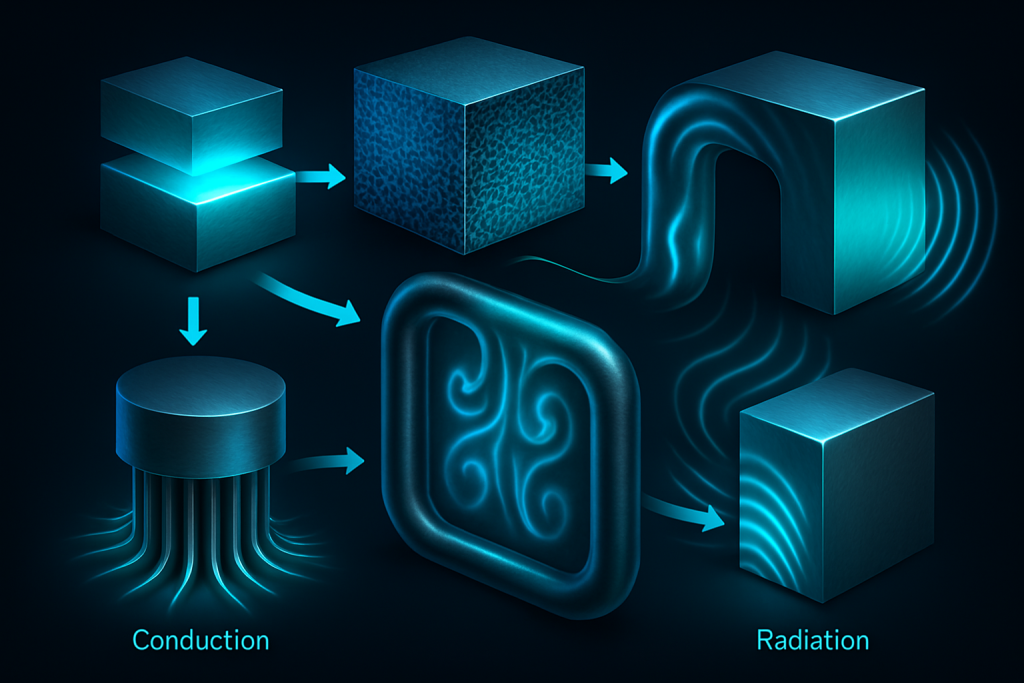
Image generated by AI
Heat is constantly moving from hot places to cold places, like water flowing downhill. Understanding how to control this flow is essential for everything from keeping your home comfortable to powering modern technology. But what’s actually happening when heat moves, and how can we stop it or direct it where we want?
The Basic Principle
Heat flows because molecules in hot objects vibrate faster than those in cold objects. When a hot cup of coffee sits on your table, its energetic molecules collide with cooler ones nearby, transferring energy until everything reaches the same temperature. This process, called thermal diffusion, happens through three main mechanisms: conduction (direct contact), convection (movement of fluids), and radiation (electromagnetic waves). Think of it like a crowded room where energetic people gradually calm down and settle into the crowd’s average energy level. The driving force behind all heat flow is the second law of thermodynamics: entropy always increases, meaning systems naturally move toward disorder and equilibrium.
Why It Matters in the Real World
Thermal control shapes nearly every aspect of modern life. Engineers design building insulation to trap heat in winter and keep it out in summer, reducing energy waste and lowering bills. In electronics, heat sinks and thermal paste channel heat away from processors before they overheat and fail. Refrigerators and air conditioners deliberately reverse the natural heat flow, pumping heat from cold spaces to warmer surroundings—a process that requires energy but keeps food fresh and rooms comfortable. Even your body relies on thermal regulation, sweating to cool down through evaporation and shivering to generate heat. Consider a smartphone: without careful thermal management through metal frames and strategic vents, the processor would generate so much heat it would damage itself in minutes.
Key Takeaways
- Heat always flows from hot to cold, driven by the natural tendency toward disorder and equilibrium
- Three mechanisms—conduction, convection, and radiation—allow heat to move, each dominant in different situations
- Controlling heat flow is fundamental to technology, building design, and even biological survival
Explore TED Talks on Heat Flow & Thermal Control:
TED content is used under CC BY-NC-ND 4.0. © TED Conferences, LLC.
Frequently Asked Questions
What is the difference between conduction, convection, and radiation in heat transfer?
Conduction transfers heat through direct contact between molecules (like a hot cup warming your hands), convection moves heat through the movement of fluids like air or water, and radiation transfers heat through electromagnetic waves without requiring a medium (like the sun warming Earth). All three are fundamental mechanisms by which thermal energy moves from hot to cold regions.
Why does heat always flow from hot objects to cold objects and not the other way around?
The second law of thermodynamics dictates that entropy in a closed system always increases, meaning systems naturally move toward disorder and thermal equilibrium. Heat flow from hot to cold is the spontaneous process that increases disorder, while the reverse would decrease entropy and violate this fundamental law of physics.
How do thermal insulators like building insulation actually prevent heat from flowing?
Insulators don't stop heat flow entirely; instead, they dramatically slow it down by reducing conduction and convection through their material structure—typically by trapping air pockets or using low-density materials that conduct heat poorly. This allows less energy to transfer between the inside and outside of a building, keeping temperatures more stable and reducing energy waste.
Why do heat sinks and thermal paste prevent computer processors from overheating?
Heat sinks increase the surface area available for heat dissipation and are made from highly conductive materials like aluminum or copper that pull heat away from the processor, while thermal paste fills microscopic gaps between the processor and heat sink to improve contact and enhance conduction. Together, they efficiently channel waste heat away from sensitive electronic components before temperatures become dangerously high.