Image generated by AI
Every second, your body is being bombarded by invisible particles from space. Cosmic rays penetrate the atmosphere, radioactive atoms decay in the ground beneath your feet, and uranium-238 lingers in trace amounts in almost every material around you. Yet we remain blissfully unaware of this constant atomic activity—not because it isn’t happening, but because we lack the natural senses to perceive it. Nuclear and radiation detection is the technology that gives us those missing senses, allowing us to perceive and measure the invisible atomic realm that has shaped everything from medical diagnostics to nuclear energy to national security.
The ability to detect radiation has become indispensable in the modern world. From hospitals using PET scans to diagnose cancer, to nuclear power plants monitoring reactor safety, to customs officials screening cargo for smuggled radioactive materials, radiation detection is woven into the infrastructure of contemporary life. As concerns about nuclear proliferation, climate change, and the future of energy production intensify, understanding how we detect and measure radiation has never been more relevant.
What Is Nuclear and Radiation Detection?
Nuclear and radiation detection is the science and technology of identifying, measuring, and analyzing radiation emitted by unstable atomic nuclei. Radiation comes in several forms: alpha particles (helium nuclei), beta particles (electrons), gamma rays (high-energy photons), and neutrons. When an unstable nucleus decays, it releases one or more of these particles or waves, and detectors convert this invisible phenomenon into a measurable signal that scientists and instruments can analyze. The detector essentially acts as a translator, converting the language of subatomic particles into information humans can understand and use.
The story of radiation detection begins with Henri Becquerel’s serendipitous discovery in 1896 when he noticed that uranium salts exposed photographic plates even in darkness. This accidental finding launched the field of radioactivity research. Marie Curie and Pierre Curie expanded on this work, coining the term “radioactivity” and discovering new radioactive elements. In the early 1900s, Ernest Rutherford and his team developed the first radiation detectors, including the electroscope and the cloud chamber, which made the invisible visible by revealing the trails of ionized particles.
The Basic Principle
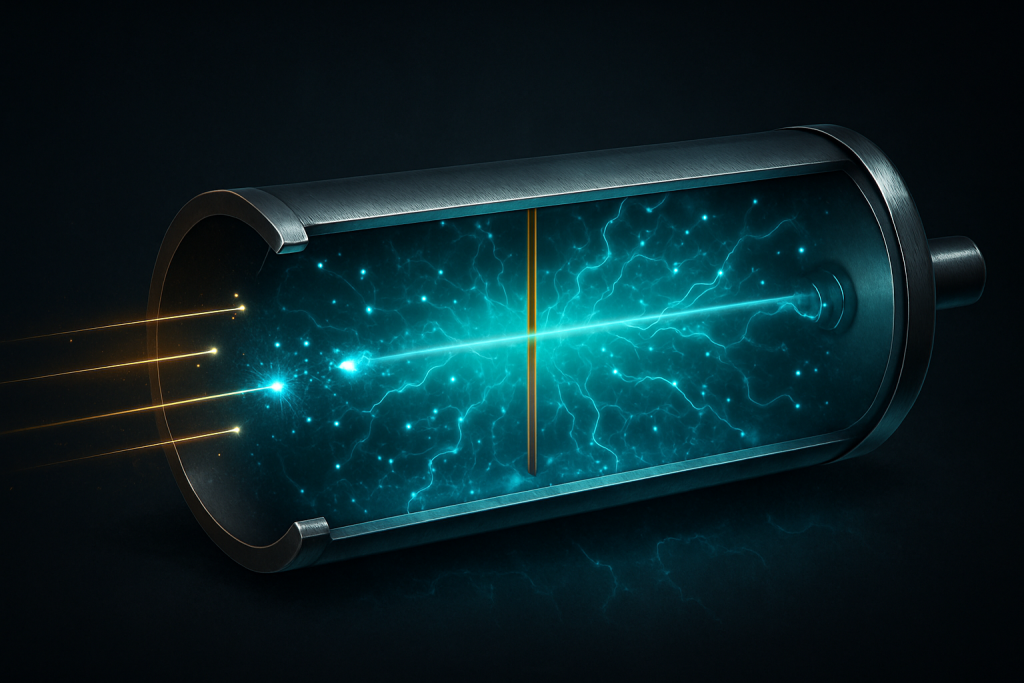
At its core, radiation detection operates on a deceptively simple principle: radiation knocks electrons out of atoms, creating a cascade of charged particles that can be detected and measured. When an alpha particle, beta particle, or gamma ray enters a detector, it ionizes the atoms it encounters—stripping them of electrons and creating positively charged ions and free electrons. These charged particles create a temporary electrical signal that sensitive instruments can amplify, count, and analyze. The detector’s job is to convert this microscopic chaos into organized, quantifiable data.
Think of radiation detection like a smoke detector. Just as smoke particles trigger a chemical reaction that sets off an alarm, radiation particles trigger ionization events that produce electrical signals. In a smoke detector, photoelectric sensors recognize smoke; in a radiation detector, various technologies recognize the energetic particles released by radioactive decay. The key insight is that radiation leaves a trackable signature—a trail of electrical charges—wherever it goes, and detectors are essentially machines designed to spot and record these signatures.
Why It Matters in the Real World
The applications of radiation detection span nearly every domain of modern science and industry. In medicine, gamma cameras and PET scanners use radiation detection to visualize the distribution of radioactive tracers within the body, enabling early diagnosis of cancer, heart disease, and neurological conditions. In nuclear power plants, radiation detectors continuously monitor reactor cores and containment structures to ensure safe operation and prevent catastrophic failures. In environmental science, radiation detection helps identify contamination in soil and water, track the dispersion of fallout from accidents, and measure background radiation levels.
Beyond these established applications, radiation detection is essential for nuclear security and nonproliferation efforts. Border security agencies use radiation portal monitors to scan cargo containers and vehicles for illicit radioactive materials. Archaeologists use radioisotope dating methods to establish the age of artifacts. Industrial facilities use radiation to sterilize medical equipment and preserve food. Geologists use radioactive decay rates to date rocks and understand Earth’s history. In each case, the underlying technology remains the same: converting invisible nuclear events into measurable, interpretable signals.
Recent Breakthroughs in Nuclear and Radiation Detection
Recent advances in radiation detection have focused on improving sensitivity, reducing false positives, and miniaturizing detection equipment. In 2022 and 2023, researchers at institutions like MIT and the National Laboratories developed novel scintillating materials and semiconductor detectors with dramatically improved energy resolution, allowing them to distinguish between different types and energies of radiation with unprecedented precision. Machine learning algorithms have been increasingly applied to radiation detection data, enabling faster threat identification at borders and ports. Simultaneously, researchers have engineered solid-state detectors that operate at room temperature without the cryogenic cooling previously required, making detectors more practical and cost-effective for widespread deployment.
Current research frontiers include developing detectors sensitive enough to measure rare nuclear events predicted by beyond-the-Standard-Model physics, enhancing real-time isotope identification in security applications, and improving the ability to image the origin of radiation sources in complex environments. Scientists are also exploring novel detection materials based on perovskites, halide crystals, and other emerging compounds that could overcome limitations of current technologies. The field remains intensely active because even incremental improvements in detection capability have profound implications for fundamental physics, medical diagnosis, and global security.
Why Nuclear and Radiation Detection Matters for the Future
As the world navigates complex challenges around energy, environmental remediation, and security, radiation detection technology becomes increasingly critical. The potential expansion of nuclear energy as a carbon-free power source hinges partly on the ability to safely monitor reactors and manage nuclear waste—both applications that depend entirely on reliable radiation detection. Climate change is driving renewed interest in nuclear power, which means demand for improved detection systems will grow. Additionally, the rising threat of nuclear terrorism and the proliferation of radioactive materials in the modern supply chain make robust detection infrastructure a matter of geopolitical importance.
However, significant challenges remain. Existing detector technologies have inherent tradeoffs: scintillation detectors are sensitive but have poor energy resolution; semiconductor detectors have excellent resolution but are expensive and fragile; gas-filled detectors are versatile but susceptible to environmental interference. No single detector technology is optimal for all applications. Furthermore, detecting radiation emitted by shielded sources or distinguishing legitimate medical radiation from illicit radioactive materials in complex background radiation environments remains technically challenging. Advancing the field requires continued innovation across materials science, electronics, physics, and computer science.
Key Takeaways
- Radiation detection works by converting invisible ionizing particles into measurable electrical signals through ionization of atoms in the detector medium.
- When radiation passes through a detector, it strips electrons from atoms, creating charged particles that produce electrical signals amplified by sensitive electronics.
- Medical imaging applications like PET scans and gamma cameras represent some of the most beneficial uses of radiation detection technology in modern healthcare.
- Recent breakthroughs include new scintillating materials, room-temperature semiconductor detectors, and machine learning algorithms that dramatically improve detection capabilities.
- As nuclear energy expands and security threats evolve, advanced radiation detection technology will be essential for safe energy production, environmental monitoring, and global security in the coming decades.
Explore TED Talks on Nuclear and Radiation Detection:
TED content is used under CC BY-NC-ND 4.0. © TED Conferences, LLC.
Frequently Asked Questions
What are the different types of radiation that detection systems can measure?
Detection systems measure several forms of radiation including alpha particles (helium nuclei), beta particles (electrons), gamma rays (high-energy photons), and neutrons emitted from unstable atomic nuclei. Each type has different penetrating power and requires different detection methods based on its physical properties.
How do radiation detectors convert invisible particles into measurable signals?
Radiation detectors use materials that interact with incoming particles to produce secondary effects like ionization, light emission, or electrical current that can be measured and quantified. Common detector types include ionization chambers that measure electrical charge from ionized atoms, scintillators that produce light flashes, and semiconductor detectors that create electron-hole pairs.
Why is radiation detection important for nuclear power plant safety?
Radiation detection systems continuously monitor radiation levels in nuclear reactors to ensure the reactor core remains shielded and contained, allowing operators to detect any leaks or unsafe conditions before they pose a public health risk. These detectors provide real-time data essential for maintaining control and preventing catastrophic failures.
Can radiation detection distinguish between different types of radioactive elements?
Yes, advanced detection systems like gamma-ray spectrometers can identify specific radioactive isotopes by analyzing the unique energy signatures of the radiation they emit, since each radioactive element produces characteristic radiation patterns. This capability is crucial for medical diagnostics, environmental monitoring, and security screening applications.