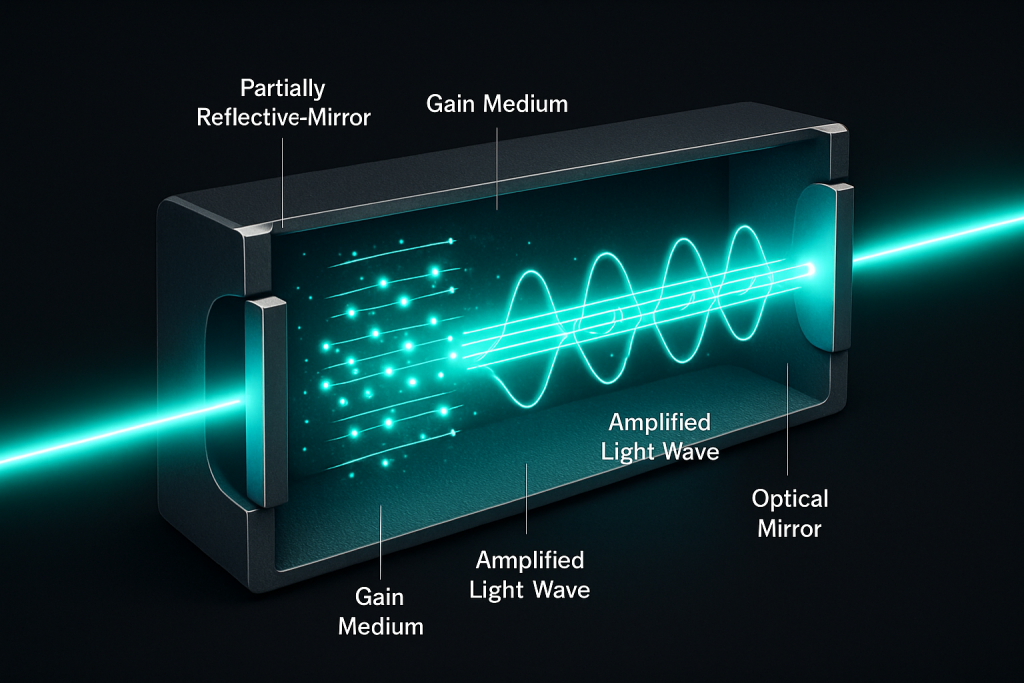
Image generated by AI
Imagine if you could harness light itself as a tool—not as a diffuse glow but as an impossibly precise beam of pure energy that can cut through steel, read information encoded in microscopic grooves, or even reshape the structure of living tissue. This is not science fiction; this is the everyday reality of lasers, one of the most transformative inventions of the twentieth century. Yet most people encounter lasers without truly understanding the elegant physics that makes them possible: the remarkable ability to force billions of light particles to march in lockstep, all vibrating in perfect synchronization, all traveling in the same direction with unwavering focus.
The story of coherent light generation reveals something profound about how nature works. While ordinary light from a flashlight or the sun is a chaotic jumble of waves traveling in random directions and phases, laser light is fundamentally different—it is organized, unified, and extraordinarily powerful in its simplicity. Today, lasers underpin technologies that shape modern civilization: they read barcodes in supermarkets, enable lightning-fast internet through fiber optic cables, perform delicate eye surgeries, and drive cutting-edge quantum computers. Understanding how lasers work is therefore essential to understanding the technological forces that increasingly define our world.
What Is Laser Technology and Coherent Light Generation?
A laser is a device that produces coherent light—light where the waves are synchronized, traveling together in phase and typically in the same direction. The word “laser” itself is an acronym: Light Amplification by Stimulated Emission of Radiation. At its core, laser technology exploits a quantum mechanical phenomenon where electrons in atoms can be excited to higher energy levels and then forced to release that energy in a coordinated, amplifying manner. Unlike the random, chaotic emission of light from an incandescent bulb or fluorescent lamp, laser light emerges as an organized beam characterized by three key properties: coherence (all waves in phase), monochromatic quality (single wavelength or color), and collimation (traveling parallel rather than spreading out). These properties make laser light uniquely suitable for precision applications where other light sources simply cannot perform.
The laser was first successfully built in 1960 by Theodore Maiman at Hughes Research Laboratories in California, who used a ruby crystal illuminated by a powerful flash lamp to produce the first laser beam. However, the theoretical foundations were laid decades earlier by Albert Einstein, who in 1917 described the process of stimulated emission—the key mechanism that makes lasers work. Einstein’s insights remained largely theoretical until the 1950s, when physicists like Charles Townes developed the “maser” (microwave amplification by stimulated emission of radiation), the microwave precursor to the laser. Maiman’s ruby laser breakthrough opened the floodgates: within months, other types of lasers were demonstrated, including the helium-neon laser and the CO₂ laser, each finding specific applications in research, industry, and medicine.
The Basic Principle
To understand how lasers generate coherent light, we must first grasp the concept of stimulated emission, which is fundamentally different from the spontaneous emission we observe in ordinary light sources. In a normal atom, electrons occupy energy levels like runners on different steps of a staircase. When an electron absorbs energy—from heat, electricity, or light—it jumps to a higher step. Spontaneously, it eventually falls back down, releasing that energy as a photon (a particle of light) in a random direction at a random time. Stimulated emission, by contrast, occurs when a photon encounters an excited electron and essentially “triggers” that electron to emit an identical photon—one with the same frequency, direction, phase, and polarization. This is the key to laser operation: if you can get enough atoms excited and then trigger them to emit simultaneously with stimulated emission, you amplify the light coherently rather than letting it scatter randomly.
Consider an orchestra as an analogy. If each musician played their instrument at random times and in random tempos, the result would be noise—like spontaneous emission. But a well-conducted orchestra produces beautiful, organized sound because all musicians are synchronized, playing the same notes at the same time with the same rhythm. A laser is similar: by exciting a large population of atoms to a higher energy level (called “population inversion”) and then causing them to emit light together through stimulated emission, the waves combine constructively, reinforcing each other rather than canceling out. The laser cavity—typically two mirrors positioned at opposite ends of a tube containing the laser medium—further enhances this effect by bouncing photons back and forth, stimulating more and more atoms to emit, until the light builds up to an intensity powerful enough to escape through one partially transparent mirror as a coherent beam.
Why It Matters in the Real World
The unique properties of coherent laser light have made it indispensable across virtually every sector of modern technology and science. In medicine, lasers enable surgeons to perform procedures with sub-millimeter precision—LASIK eye surgery reshapes the cornea using ultraviolet excimer lasers to vaporize tissue layer by layer, while CO₂ lasers can cut and cauterize tissue simultaneously in other surgical applications. In manufacturing, high-powered lasers cut, weld, and engrave materials ranging from textiles to titanium aircraft components with a precision and speed that conventional tools cannot match. In telecommunications, lasers are the engines of the internet: fiber optic cables carry data encoded as laser pulses at speeds approaching that of light itself, enabling the global network that connects billions of devices.
Beyond these established applications, lasers are central to emerging technologies that will define the coming decades. Quantum computing relies on precisely tuned lasers to manipulate individual atoms and ions. Advanced manufacturing techniques like laser powder bed fusion create complex three-dimensional parts for aerospace and medical applications. Quantum sensing uses lasers to measure gravitational fields, enable next-generation navigation systems independent of GPS, and detect exoplanets through subtle shifts in starlight. Medical diagnostics increasingly employ laser-based techniques like coherent optical tomography, which produces high-resolution images of tissue without invasive surgery. Even the future of energy may depend on lasers: the National Ignition Facility’s recent breakthrough in achieving nuclear fusion ignition relied on 192 massive lasers focused simultaneously on a tiny target, demonstrating a path toward clean, virtually limitless fusion energy.
Recent Breakthroughs in Laser Technology and Coherent Light Generation
The past few years have witnessed remarkable advances in laser technology that are expanding the boundaries of what was previously thought possible. In December 2022, the National Ignition Facility made headlines by achieving the long-sought goal of “net energy gain” in nuclear fusion—producing more energy output than was delivered to the fusion target by lasers. This represented the culmination of decades of development in high-power laser systems and marked a watershed moment in fusion energy research. Simultaneously, advances in fiber laser technology have enabled increasingly compact, efficient lasers that can operate continuously for extended periods without thermal degradation. Researchers have also made breakthroughs in extreme ultraviolet (EUV) laser development, producing coherent light at wavelengths as short as 13.5 nanometers, wavelengths essential for next-generation semiconductor manufacturing and lithography.
At the frontier of current research, scientists are exploring laser systems with unprecedented properties. Attosecond lasers—pulses lasting only billionths of a billionth of a second—now allow researchers to observe and potentially control the motion of electrons within atoms in real time, opening new possibilities for understanding chemical reactions at the quantum level. Researchers are developing frequency combs, lasers that emit light across a wide range of frequencies simultaneously in a precisely spaced pattern, which are revolutionizing precision measurement and fundamental physics. Meanwhile, quantum physicists are exploring how to generate lasers from exotic states of matter and how to entangle laser photons in ways that violate classical limits on measurement precision, advancing both fundamental physics and practical applications in quantum information processing.
Why Laser Technology and Coherent Light Generation Matters for the Future
As we stand at the threshold of a new era, laser technology is poised to drive transformative advances across multiple frontiers of human knowledge and capability. The convergence of lasers with quantum technologies promises to revolutionize computing, enabling machines that can solve certain classes of problems exponentially faster than classical computers. In materials science, the ability to manipulate matter at increasingly fine scales using laser-induced processes will enable the design and manufacture of materials with properties tailored for specific applications—from ultra-efficient solar cells to biocompatible implants. Climate science and environmental monitoring increasingly rely on laser-based remote sensing systems that can measure atmospheric composition, ocean temperatures, and forest structure from space with unprecedented accuracy. In fundamental physics, lasers may help resolve some of the deepest questions about the nature of reality, from testing the limits of quantum mechanics to searching for dark matter.
Yet significant challenges remain before lasers can fully realize their potential. Scaling laser systems to higher power levels while maintaining efficiency and stability remains an engineering challenge, particularly for applications like fusion energy and laser-based manufacturing. The cost of advanced laser systems remains prohibitively high for many applications, limiting accessibility and adoption. There are also concerns about the environmental impact of manufacturing laser systems and managing the waste heat they generate. Fundamental physics questions also remain open: developing compact, reliable sources of coherent light at specific wavelengths remains difficult, and understanding and controlling the nonlinear effects that emerge at very high intensities requires continued research.
Key Takeaways
- Lasers generate coherent light through stimulated emission, a quantum mechanical process where photons trigger excited atoms to emit identical photons in perfect synchronization.
- The key mechanism involves exciting atoms to a higher energy level (population inversion) and using a resonant cavity to amplify light through repeated cycles of stimulated emission.
- The most promising emerging applications are in quantum computing, fusion energy, advanced manufacturing, and precision measurement systems that could transform technology and science.
- Recent breakthroughs include achieving net energy gain in laser-driven nuclear fusion and developing attosecond lasers that can observe electron motion in real time.
- Future technological revolutions in computing, materials science, and energy production will increasingly depend on advances in laser technology and coherent light generation.
Explore TED Talks on Laser Technology and Coherent Light Generation:
TED content is used under CC BY-NC-ND 4.0. © TED Conferences, LLC.
Frequently Asked Questions
What is the fundamental difference between ordinary light and laser light in terms of wave properties?
Ordinary light is a chaotic mixture of waves traveling in random directions and phases, while laser light is coherent—meaning all photons vibrate in perfect synchronization, travel in the same direction, and maintain a constant phase relationship. This coherence gives laser light its extraordinary power and precision compared to incoherent light sources like the sun or flashlights.
How does a laser force billions of light particles to vibrate in lockstep synchronization?
Lasers use stimulated emission within an active medium (solid, gas, or semiconductor) where excited atoms are triggered to release photons that match the phase and direction of existing photons, creating a cascading amplification effect. This process occurs within an optical cavity with mirrors that reflect light back and forth, continuously reinforcing the synchronized emission until a coherent beam exits through a partially transparent mirror.
Why is coherent light capable of cutting through steel or performing precise surgical procedures while ordinary light cannot?
Coherent laser light concentrates all its energy into a single direction with a tightly focused beam, allowing extremely high intensity at the point of impact, whereas ordinary incoherent light spreads energy in multiple directions and diffuses rapidly. This concentrated energy density enables lasers to reach temperatures and power densities sufficient to vaporize or precisely ablate materials that ordinary light cannot affect.
Can laser light maintain its coherence and focus over long distances, and what enables this property?
Yes, coherent laser light maintains its tight focus and directional integrity over much longer distances than ordinary light because all photons travel parallel to each other in the same phase. This remarkable property of coherence is what allows lasers to be used effectively in applications like fiber optic communication across thousands of kilometers and precise positioning systems like LIDAR.