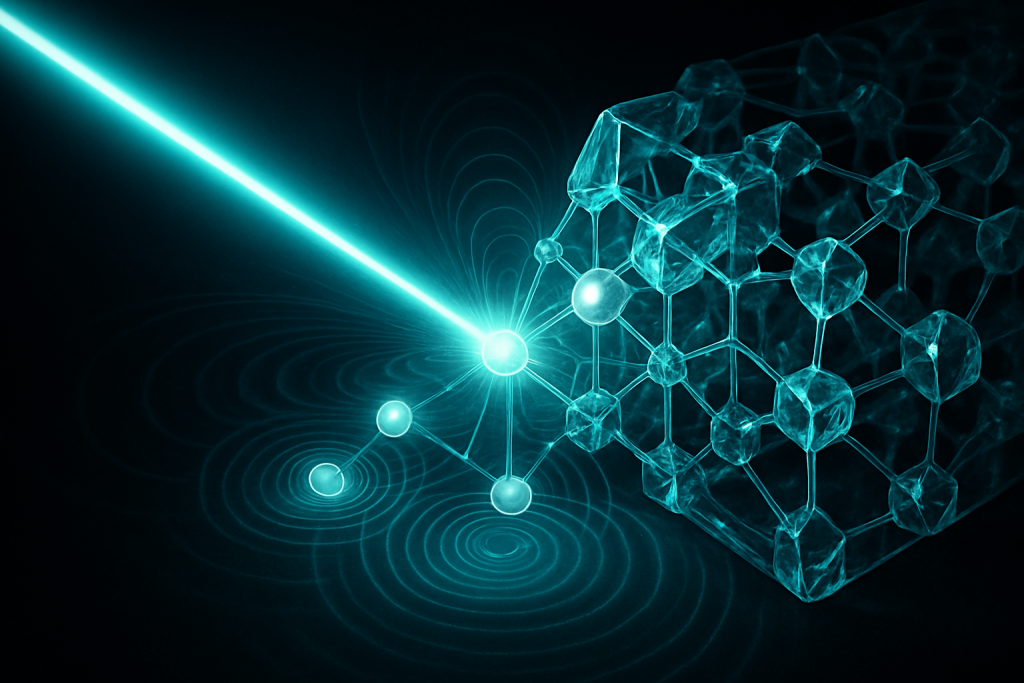
Image generated by AI
AI Insight
Light-matter interaction occurs when photons encounter electrons in atoms, resulting in three possible outcomes: transmission, reflection, or absorption. Electrons absorb light only when the photon's energy precisely matches the energy gap between electron orbital states, a principle called resonance. When absorption occurs, electrons jump to higher energy states and subsequently release this energy as heat or other forms of radiation, which explains phenomena like color perception and why sunlit objects warm up.
Why it matters
This fundamental interaction underlies critical technologies including photosynthesis, solar panels, smartphone cameras, medical imaging devices, and LED lighting. Understanding light-matter interactions enables scientists to design materials with customized optical properties and develop more efficient energy conversion and imaging systems.
Understand the Science
Every time you see an object, light bounces off it and reaches your eyes—but what’s actually happening at that microscopic moment? Light-matter interaction is the fundamental dance between photons (particles of light) and electrons in atoms, and it’s responsible for nearly everything we observe in the physical world, from the colors we see to the screens displaying these words.
The Basic Principle
Think of light as a wave carrying energy, and matter as a collection of electrons orbiting atomic nuclei. When light arrives at an atom, it can do one of three things: pass straight through (transmission), bounce off (reflection), or get absorbed. The key lies in the electrons. Light’s energy jiggles these electrons, briefly exciting them to higher energy states. If the light’s energy perfectly matches the gap between electron states—like a key fitting a lock—the atom absorbs it. If there’s no match, the light often bounces away, unchanged.
This is why different materials have different colors. When white light hits a red apple, the apple’s electrons absorb blue and green light wavelengths but refuse to absorb red. That red light bounces back to your eyes, making the apple appear red. The electrons then release the absorbed energy as heat, which is why objects sitting in sunlight get warm.
Why It Matters in the Real World
Light-matter interactions are the foundation of countless technologies we depend on daily. Photosynthesis, the process plants use to convert sunlight into food, relies entirely on light exciting electrons in chlorophyll molecules. Solar panels work by the same principle—photons knock electrons loose, creating an electric current. Even your smartphone’s camera operates on this basis: photons strike a sensor, excite electrons, and those charges are converted into digital images.
Medical imaging, like X-rays and MRI machines, harnesses light-matter interactions to see inside our bodies. Understanding these interactions also helps scientists design new materials with custom optical properties, from invisibility cloaks in laboratory experiments to more efficient LED lighting that’s revolutionizing how we illuminate our homes and cities.
Key Takeaways
- Light interacts with matter’s electrons by either exciting them to higher energy states or passing through unchanged
- The energy of light must match the gaps between electron states for efficient absorption—a principle called resonance
- This fundamental interaction enables everything from photosynthesis and solar power to medical imaging and color vision
Explore TED Talks on Light-Matter Interactions:
TED content is used under CC BY-NC-ND 4.0. © TED Conferences, LLC.
Frequently Asked Questions
How do electrons determine whether to absorb light or reflect it?
Electrons absorb light only when the photon's energy exactly matches the energy gap between two electron orbital states—a principle called energy matching. If the photon energy doesn't match any available transition, the light is typically reflected unchanged rather than absorbed.
Why does a red apple appear red when white light contains all colors?
The apple's electrons absorb the blue and green wavelengths from white light because their photon energies match the atom's energy gaps, while red wavelengths are not absorbed and therefore reflect back to your eyes. The absorbed light energy is then released as heat rather than reflected light.
What happens to the energy that matter absorbs from light?
When electrons absorb light energy and jump to higher energy states, they eventually release that energy by dropping back to their original states, emitting the energy as heat, light, or other forms of radiation. This is why objects in sunlight become warm—the absorbed photon energy converts to thermal energy.
Can light pass through all materials, or does the type of matter affect transmission?
Whether light transmits through material depends on whether the material's electron energy gaps match the light's photon energy; transparent materials like glass have large energy gaps that don't match visible light frequencies, so photons pass through, while opaque materials absorb or reflect most visible wavelengths. Different materials therefore have fundamentally different transmission properties based on their atomic structure.