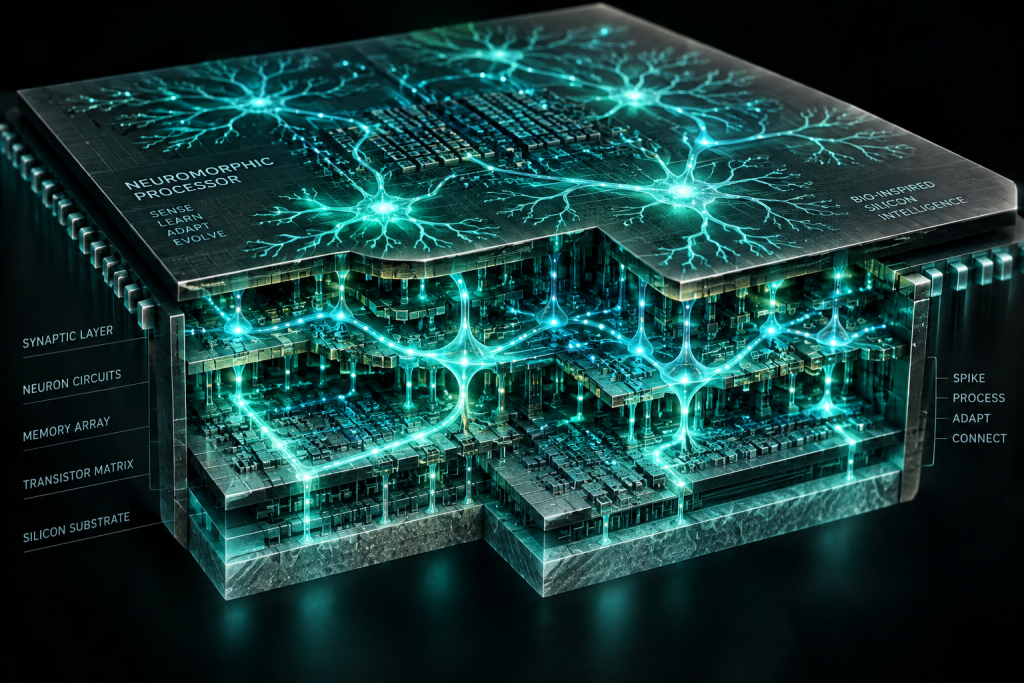
Image generated by AI
Your brain processes information at roughly 20 watts of power while performing calculations that would require a nuclear power plant to accomplish with conventional computers. It does this not through the sequential, logic-gate operations that have governed computing for decades, but through something fundamentally different: billions of neurons firing in parallel, learning through experience, and adapting to new problems almost effortlessly. What if we could build computers that work the same way? This is the central question driving neuromorphic computing, a radical reimagining of how machines process information that could transform everything from artificial intelligence to robotics to medical devices.
Today, as artificial intelligence systems consume ever-more electrical power and struggle with tasks that human brains solve in milliseconds—like recognizing faces in cluttered scenes or making snap decisions with incomplete information—researchers are turning to neuroscience for inspiration. Neuromorphic computing represents more than just an academic curiosity; it addresses a genuine crisis in the computing industry: the power demands of artificial intelligence are becoming unsustainable, and traditional chip architectures are hitting fundamental physical limits. Companies like Intel, IBM, and startups across Europe, Asia, and North America are now investing billions into neuromorphic hardware, treating brain-inspired computing not as a futuristic fantasy but as an urgent engineering challenge.
What Is Neuromorphic Computing and Brain-Inspired Devices?
Neuromorphic computing refers to the design of computer systems that replicate the structure and function of biological neural networks—the architecture that makes brains work. Rather than organizing computation around a central processor executing sequential instructions, neuromorphic systems use artificial neurons connected in networks that process information in parallel, with learning happening through changes in connection strengths over time. These systems are fundamentally asynchronous, meaning components don’t all tick to the same clock; instead, they communicate through discrete events or “spikes” only when something meaningful happens. This event-driven approach is radically different from conventional computers, which continuously consume power whether they’re doing useful work or waiting for input.
The neuromorphic computing field began to take recognizable shape in the 1980s and 1990s, though the intellectual roots stretch back further. Carver Mead, a legendary Caltech physicist, coined the term “neuromorphic” in 1989 to describe silicon systems that emulate the physical design principles of biological nervous systems. Around the same time, researchers like John Hopfield and Geoffrey Hinton were developing theoretical frameworks for neural computation. However, it wasn’t until the last decade—as conventional computers struggled with power efficiency and as neuroscience revealed more about how brains actually work—that neuromorphic hardware evolved from laboratory curiosities into serious commercial and research platforms.
The Basic Principle
At its core, neuromorphic computing relies on the principle of spike-based neural communication. In biological brains, neurons don’t transmit their full state continuously; instead, they fire discrete electrical spikes—action potentials—that travel along axons to other neurons. The receiving neurons accumulate these incoming signals, and if the accumulated electrical charge exceeds a threshold, they fire their own spike. This threshold-crossing mechanism is the fundamental unit of neural computation. Artificial neuromorphic systems replicate this spiking behavior: artificial neurons integrate incoming signals over time, and when the membrane potential reaches a threshold, they emit a spike that propagates to other neurons in the network. The crucial innovation is that this spiking is sparse and event-driven, meaning neurons only consume power and communicate when they actually spike, not continuously.
Think of it this way: imagine a town’s emergency response system. In a conventional computer architecture, every fire station, police station, and ambulance is constantly reporting their status to a central dispatcher on a fixed schedule, whether or not anything is happening. This wastes enormous energy on repetitive, irrelevant communication. A neuromorphic system, by contrast, works like an actual emergency network: responders stay quiet until something important happens, and only then do they send a signal. A fire station only broadcasts when there’s a fire; police only report when they encounter a situation. This event-driven principle makes neuromorphic systems extraordinarily energy-efficient compared to conventional systems, sometimes achieving the same computational results while using a thousandth of the power.
The learning mechanism in neuromorphic systems typically employs principles inspired by biological neuroscience, particularly Hebbian learning—the idea that “neurons that fire together wire together.” When two connected neurons spike in close temporal proximity, the strength of the synapse (connection) between them increases; when they fire at different times, the connection weakens. This synaptic plasticity is the basis for learning in neuromorphic systems. Additionally, many neuromorphic platforms implement spike-timing-dependent plasticity (STDP), where the precise timing between incoming and outgoing spikes determines how connection strengths change. This learning happens locally at each synapse—without requiring a centralized supervisor to correct the system—making learning distributed and inherently parallel.
Why It Matters in the Real World
The real-world relevance of neuromorphic computing comes down to three pressing problems in modern technology. First, energy consumption: artificial neural networks for tasks like image recognition or natural language processing now require enormous electrical resources. A single large language model can consume as much electricity as several hundred homes, and these models must be continuously retrained as new data becomes available. Neuromorphic systems could perform equivalent or superior computations while using a fraction of this power. Second, latency: conventional systems must gather data, send it to a central processor, run computations, and return results—this pipeline introduces delays that matter for applications like autonomous vehicles, where split-second perception and response are critical. Neuromorphic systems, with their event-driven architecture, can respond to sensory inputs in milliseconds rather than seconds. Third, adaptability: traditional deep learning requires massive labeled datasets and extensive retraining to adapt to new tasks or environments. Neuromorphic systems, learning through ongoing synaptic changes, can adapt continuously as they encounter new information, much like biological brains do.
Current applications span robotics, where neuromorphic vision sensors enable autonomous machines to navigate complex, dynamic environments with minimal power consumption; autonomous vehicles, where rapid, real-time processing of multiple sensor streams is essential; edge computing and IoT devices, where power constraints are severe; biomedical devices like prosthetic limbs and cochlear implants, which benefit from power efficiency and rapid signal processing; and anomaly detection in security and industrial systems, where the ability to learn from normal patterns and identify deviations requires minimal human supervision. Companies like Intel with their Loihi chip, IBM with their TrueNorth neuromorphic processor, and emerging startups like BrainScaleS are already deploying these systems in real applications.
Recent Breakthroughs in Neuromorphic Computing and Brain-Inspired Devices
The past few years have witnessed accelerating progress in neuromorphic hardware and algorithms. In 2023-2024, several major advances captured the attention of researchers and investors. Intel announced the second generation of their Loihi chip with increased neuron density and improved communication capabilities, demonstrating new applications in optimization problems and pattern recognition. Simultaneously, researchers at universities worldwide published results showing that neuromorphic systems could solve certain machine learning tasks with dramatically lower energy consumption than conventional approaches—in some cases, achieving 100 to 1,000 times better energy efficiency for inference tasks. Event-based neuromorphic vision sensors, which capture only changes in brightness rather than continuously scanning entire images, have matured significantly, enabling real-time visual processing for robotics and autonomous systems with power consumption measured in milliwatts rather than watts.
Open questions and active research areas include how to effectively train neuromorphic systems at scale—biological learning is slow and incremental, while machine learning has grown accustomed to rapid, gradient-based optimization. Researchers are developing hybrid approaches that use conventional training methods to initialize neuromorphic networks before they adapt through local, spiking-based learning. Another frontier is scaling: current neuromorphic chips have millions of neurons, while mammalian brains have billions, and we still don’t fully understand what computational advantages emerge at such larger scales. Additionally, there’s growing interest in combining neuromorphic computing with other emerging technologies like quantum processors and optical computing, exploring whether hybrid architectures might offer advantages beyond what any single approach can achieve.
Why Neuromorphic Computing and Brain-Inspired Devices Matters for the Future
The implications of successful neuromorphic computing extend far beyond incremental improvements in chip efficiency. If neuromorphic systems can deliver AI capabilities with a fraction of the power consumption, it fundamentally changes what’s possible for distributed, autonomous systems. Imagine swarms of tiny drones or robotic sensors that can operate for weeks on battery power while performing sophisticated environmental monitoring or search-and-rescue operations. Consider prosthetic limbs that adapt to their user’s movement patterns in real-time without requiring external computation. Picture edge AI systems deployed throughout hospitals, factories, and smart cities that make intelligent decisions locally without constantly transmitting data to distant servers—addressing privacy, security, and latency concerns simultaneously. On a larger scale, neuromorphic computing could help make advanced AI more sustainable, reducing the carbon footprint of machine learning and making sophisticated AI accessible to parts of the world without extensive electrical infrastructure.
Challenges remain substantial. We still don’t have programming models for neuromorphic systems that are as mature or intuitive as conventional programming languages and frameworks. Debugging and testing neuromorphic systems is harder because their computation is distributed and continuous rather than sequential and discrete. The field needs more standardization—different neuromorphic platforms use incompatible neuron models and communication protocols, making it difficult to port algorithms between systems. Perhaps most fundamentally, while we’ve made impressive progress in understanding some aspects of neural computation, the brain remains vastly more complex than any system we’ve built, and we may not yet fully grasp the principles that would allow us to extract maximum computational advantage from neural-inspired architectures.
Key Takeaways
- Neuromorphic computing systems are inspired by biological neural networks, using spiking neurons and event-driven computation to process information far more efficiently than conventional computers.
- The fundamental mechanism relies on artificial neurons that integrate incoming signals and emit discrete spikes only when a threshold is crossed, combined with Hebbian learning where synaptic connections strengthen based on temporal correlation between neuron firings.
- The most promising near-term application is autonomous systems and edge AI, where neuromorphic processors can deliver AI capabilities with a fraction of the power consumption of conventional hardware.
- Neuromorphic computing has transitioned from theoretical research to practical implementation, with commercial chips from Intel, IBM, and startups demonstrating real advantages in robotics, autonomous vehicles, and biomedical devices.
- Widespread adoption of neuromorphic computing could make advanced artificial intelligence more sustainable and accessible, while enabling new applications in distributed computing, biomedics, and autonomous systems that are impractical with current technology.
Explore TED Talks on Neuromorphic Computing and Brain-Inspired Devices:
TED content is used under CC BY-NC-ND 4.0. © TED Conferences, LLC.
Frequently Asked Questions
How do neuromorphic computers process information differently from traditional computers?
Neuromorphic computers use parallel processing through billions of artificial neurons firing simultaneously, rather than sequential logic-gate operations used in conventional computers. This brain-inspired architecture allows them to learn and adapt through experience rather than following pre-programmed instructions.
Why is the power efficiency of neuromorphic computing significant for artificial intelligence?
The human brain performs complex calculations at approximately 20 watts, while equivalent AI tasks on conventional computers would require power consumption comparable to a nuclear power plant. Neuromorphic devices aim to dramatically reduce AI's electrical power demands by mimicking the brain's inherently efficient parallel processing architecture.
What specific computational challenges can neuromorphic devices solve faster than traditional computers?
Neuromorphic devices excel at tasks like facial recognition in cluttered scenes and decision-making with incomplete information—problems that human brains solve in milliseconds but traditional computers struggle with due to their sequential processing limitations. These capabilities arise from the parallel, adaptive nature of neural network computation.
Are neuromorphic computing systems addressing a real limitation in current computer chip design?
Yes, traditional chip architectures are reaching fundamental physical limits in speed and efficiency, while AI systems' power consumption has become unsustainable for large-scale deployment. Neuromorphic computing represents a solution to both the performance plateau and energy crisis facing the computing industry.